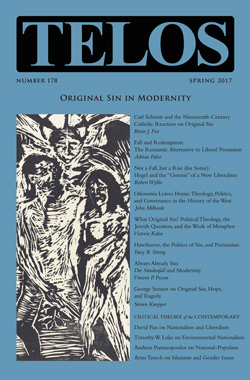
At the beginning of his 1961 study The Death of Tragedy, George Steiner claimed that Christian “optimism” contributed to the demise of tragic drama in modernity. The ensuing chapters of The Death of Tragedy actually offer a more nuanced account, though, in which Steiner finds tragic potential in the doctrine of original sin. In subsequent essays, Steiner has doubled down on his claim that tragedy must be bleak. Indeed, he now holds up an ideal of hopeless “absolute tragedy.” In these later writings, Steiner has also continued to show interest in original sin, even claiming in a 2004 essay that original sin is the core of tragic art.
|
The thoughts below were first presented at the 2017 Telos Paul Piccone Institute conference, “Asymmetrical Warfare: The Centrality of the Political to the Strategic.” On the perhaps naïve presumption that politics are grounded in ideals, norms, and values that guide (if not govern) societal conduct, I have extended the title to “Asymmetrical Warfare: The Centrality of the Ethical to Politics and the Strategic.” Since the writing of these remarks, Donald Trump has taken the office of president, promised a vast build-up of the U.S. military, and proposed large increases in the military budget alongside substantial decreases in humanitarian aid programs. He has detonated in Afghanistan the largest non-nuclear bomb in U.S. military history, he is saber-rattling with North Korea, and he has bombed Syria—all in his first 100 days, indicating a certain unconsidered readiness to use military force. This article develops new empirical perspectives on the growing gender policy and gender role clash of civilizations now looming ahead in Western countries. The very same European governments that welcomed hundreds of thousands of migrants from countries with what the Muslim feminist Ziba Mir-Hosseini called “compulsory dress codes, gender segregation, and the revival of cruel punishments and outdated patriarchal and tribal models of social relations,” are untiringly promoting gender mainstreaming, which is now a top priority for European Union policymakers. Western feminism is at a turning point. Will it share with large sections of the green and left political currents in the West the cowardly silence about the threat of Islamist totalitarianism and terrorism, or will it develop solidarity with Muslim feminism? Telos Press is delighted to announce that Elliot Neaman’s Free Radicals: Agitators, Hippies, Urban Guerrillas, and Germany’s Youth Revolt of the 1960s and 1970s has been awarded the Silver Medal in the Europe: Best Regional Non-Fiction category at this year’s Independent Publisher Book Awards. The annual IPPY Awards showcase the best books published by independent publishers throughout North America and the English-speaking world. Twenty-five years after the end of the Cold War, there is arguably a crisis of democracy: not only has the transition from totalitarian communism failed to bring about liberal market capitalism, but politics in mature democracies has been becoming post-democratic. Models of authoritarianism and state capitalism are spreading in different parts of the world, while countries with long-standing democratic traditions are characterized by a rejection of the political mainstream and a turn to extremes on the far left or the far right. In addition to its main focus on original sin in modernity, Telos 178 (Spring 2017) features a special section of topical writing, introduced here by Russell A. Berman, that continues our ongoing commitment to setting forth a critical theory of the contemporary. Telos 178 is now available for purchase in our store.
|
   |
|||
|
Privacy Policy · Data Protection Copyright © 2026 Telos Press Publishing · All Rights Reserved |
||||