David Pan’s “Carl Schmitt on Culture and Violence in the Political Decision” aims at challenging the widespread view that Carl Schmitt’s decisionism is motivated by violence and pure power. Pan presents his readers to “another Schmitt” that has escaped the attention of many commentators, including Müller, Žižek, McCormick, and Agamben. For Pan, Schmitt’s decision must not be separated from spiritual ideals and cultural values.
|
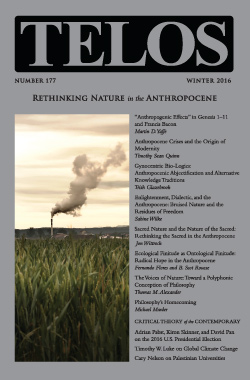
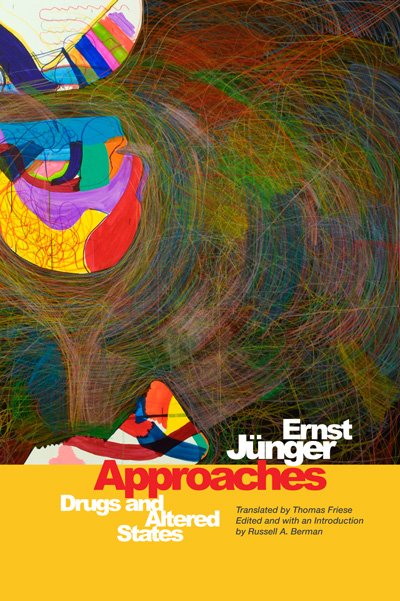
On the way back from Jerusalem to Ben Gurion airport following a few weeks in Israel in 2016 I settled in expecting to doze off. As usual it was 1 a.m., and I was pretty well done in from nonstop travel. But every taxi cab driver, Jewish or Arab, wants to talk, and I always learn something from these nonacademic conversations. Before long I was hearing things I was not eager to know, but it brought home the human costs of nearly a century of conflict. Telos Press is delighted to announce that Elliot Neaman’s Free Radicals: Agitators, Hippies, Urban Guerrillas, and Germany’s Youth Revolt of the 1960s and 1970s has won first place in the History category at the London Book Festival. Congratulations! Critical Theory of the Contemporary: Election 2016, Environmental Nationalism, and Palestinian ShameIn addition to its main focus on nature and the Anthropocene, Telos 177 (Winter 2016) features a special section of topical writing, introduced here by Russell A. Berman, that continues our ongoing commitment to setting forth a critical theory of the contemporary. Telos 177 is now available for purchase in our store. Telos 177 (Winter 2016) is now available for purchase in our store. “The populace consists of individuals and free men, while the state is made up of numbers. When the state dominates, killing becomes abstract. Servitude began with the shepherds; in the river valleys it attained perfection with canals and dikes. Its model was the slavery in mines and mills. Since then, the ruses for concealing chains have been refined.” |
   |
|||
|
Privacy Policy · Data Protection Copyright © 2026 Telos Press Publishing · All Rights Reserved |
||||