If we want to gain a deeper understanding of the specific relationship between the ethical and the political in current times, we have to talk about the mediating agencies that enable this relationship. And if what the announcement for the Telos Conference 2016 in New York states were really true, namely, that at “the theoretical level, political reality has come to be seen as divorced from ethical life,” we need to ask: what has happened to these mediating agencies? That is exactly what the German philosopher Max Horkheimer was doing with his racket theory. He never explicitly referenced the “ethical” as a philosophical category. Yet he was able to show that in post-liberal societies, the social instances that made the relationship between the political and the ethical possible in the first place, are being destroyed—or they are at least tending towards a loss of their reflexive function. For Horkheimer this is at the core of what he called the racket society: that ultimately, every reference to universality and to society, or in German to the Allgemeinheit, is lost.
|
Asymmetrical Warfare: Unconventional, nontraditional, or more precisely asymmetrical warfare has become the pervasive reality for the modern world. All realistic prognoses compellingly suggest it will remain so throughout the twenty-first century. The recent terrorist attacks in Paris and San Bernadino were no temporary aberration, or incidents of domestic political violence, but part of an increasingly normative pattern of asymmetrical warfare against the West. These events are inextricably related to the unconventional warfare and terrorism characterized by the conflicts extending from Afghanistan, Iraq, and Syria to Africa. Isis, al-Qaeda, and Boko Haram have become the common coinage of political discourse and news cycles. The controversy over the very terminology of the “War on Terror,” like that over the Obama Administration’s determination to close Guantanamo, illustrate the domestic as well as foreign policy implications of such developments. Meanwhile, Europe likewise faces both overt actions and indirect consequences of asymmetrical warfare. Russia’s proxy war in Ukraine and annexation of the Crimea, together with the massive Middle Eastern refugee influx, has thrust Europe into its own highly divisive disputes over its very cultural essence, political will, and future unity. The reader may recall observations made in 2013 by Professor Bruno Chaouat of the University of Minnesota-Twin Cities regarding the strange quotation, or misquotation, of Emmanuel Levinas by Judith Butler. In one of her recent books, Parting Ways: Jewishness and the Critique of Zionism, Butler quotes Levinas as having said that Palestinians are “faceless.” Such a statement was obviously pure invention on her part and in no way figures in the text she claims it comes from: “Israël, éthique et politique.” Many of her epigones jumped to her defense, hardly allowing a serious debate on methods and ethics of scholarship. An important report by Alex Chalmers on antisemitic anti-Zionism and the scandal of Oxford University Labour Club (OULC) has just appeared at Fathom. An excerpt:
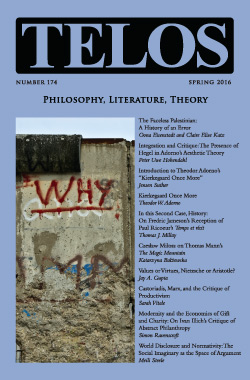
Telos 174 (Spring 2016): Philosophy, Literature, Theory is now available for purchase in our store. |
   |
|||
|
Privacy Policy · Data Protection Copyright © 2026 Telos Press Publishing · All Rights Reserved |
||||