By Terence Hoyt · Thursday, February 25, 2016 This article argues that after more than two centuries, our system of justice is no longer functioning as intended by its founders. I argue that this breakdown can be ultimately traced to a philosophical dilemma at the heart of American civilization: the assumption that economic self-interest can by itself sustain ethical care for a common good. In treating economic freedom as a moral absolute, the American right has misconstrued the practical purpose of freedom and undermined justice and equality for all. In contrast to the ahistorical claim of libertarians that economic freedom should be treated as a moral value, the goal of the founders of the United States was very concrete: enabling most citizens to get basic economic needs met in peace and security. Free and open elections and a system of checks and balances would motivate the naturally more powerful to manage their own passions in ways that contributed to a common good. By contrast, in unchecked political systems that arose by the struggle for dominance among the powerful few, the de facto rulers lacked any motive to act in ways that were consistent with the interests of the average citizen. As Thrasymachus claims in Plato’s Republic, they habitually wrote laws that benefited themselves at the expense of everyone else.
Continue reading →
By Simas Čelutka · Tuesday, February 23, 2016 In his essay “Carl Schmitt on Friends, Enemies and the Political,” Andrew Norris inquires into the question that I have been interested in for quite some time: political friendship in Carl Schmitt’s political philosophy. Schmitt’s interpreters usually focus on the issue of enmity in his concept of the political, not least because Schmitt himself elaborates on the existential significance of political enmity much more extensively. From a conceptual point of view, however, political friendship should be viewed as at least equally relevant a part of Schmitt’s account of the political. The specific criterion of the political is famously the distinction “between friend and enemy,” not simply an indefatigable presence of political enmity. Norris should be lauded for his attempt to foreground a crucial, though still insufficiently explored, notion of a political (public) friend in Schmitt’s Concept of the Political.
Continue reading →
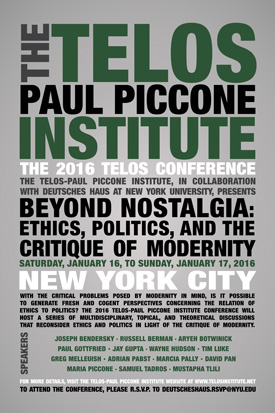
By Lukas Szrot · Monday, February 22, 2016 The following paper was presented at the 2016 Telos Conference, held on January 16–17, 2016, in New York City. For additional details about this and upcoming conferences, please visit the Telos-Paul Piccone Institute website.
 What is modernity? First, a period “occasioned by a peculiarly ahistorical view of the world, which is flattened into an eternal present. The world we experience appears to exhaust all possible worlds.” Second, modernity is deeply rooted in the three Kantian principles of Enlightenment: “‘What can know?’ the question of knowledge; of the ‘What should I do?’ which is the question of ethics, and of the ‘What can I hope?'” What is modernity? First, a period “occasioned by a peculiarly ahistorical view of the world, which is flattened into an eternal present. The world we experience appears to exhaust all possible worlds.” Second, modernity is deeply rooted in the three Kantian principles of Enlightenment: “‘What can know?’ the question of knowledge; of the ‘What should I do?’ which is the question of ethics, and of the ‘What can I hope?'”
The Western modern project is dependent upon both Greek and Hebrew antiquity. In ancient Ionia, Thales of Miletus predicted a solar eclipse, Anaximander predicted the changing of the seasons, Theodorus invented the ruler, the carpenter’s square, and the level, and Hippocrates began accumulating medical knowledge through trial and error. These “pre-Socratic” Ionians were merchants and artisans; they worked with their hands, whereas the Athenians were engaged primarily in contemplation.
Continue reading →
By Vicente Medina · Friday, February 12, 2016 The following paper was presented at the 2016 Telos Conference, held on January 16–17, 2016, in New York City. For additional details about upcoming conferences and events, please visit the Telos-Paul Piccone Institute website.
While the expression “moral relativism” means different things to different people, I offer the following characterization of it. By “moral relativism,” I understand a normative view that explains people’s incommensurable moral judgments based on their subjective preferences or on different action-guiding contexts. Moral relativists deny that value judgments can be universally justified. Therefore, for them, value judgments have neither objective universal truth-value nor universal moral import. That is, these judgments are neither true nor false, nor right or wrong for everyone. For some moral relativists even to raise the possibility of moral disagreement across different cultures or communities would be simply moot.
Moral relativists can assume a subjective or a contextual point of view. If they assume a subjective point of view, one might describe their theories or hypotheses as nihilistic. Nihilists recognize no transcendent moral values and no moral facts. According to them, predicates, such as right or wrong, or good or bad, have no independent reference. So nihilists recognize no significant moral difference between, for example, the deliberate killing of the objectively innocent, which is considered murder by most civilized people, and killing in self-defense. For them, even the principle of the presumption of innocence would be vacuous.
Continue reading →
By Kenneth D. Johnson · Monday, February 8, 2016 Kenneth D. Johnson is affiliated with the William J. Seymour Institute for Black Church and Policy Studies, in Boston. The following paper was presented at the 2016 Telos Conference, held on January 16–17, 2016, in New York City. For news about upcoming conferences and events, please visit the Telos-Paul Piccone Institute website.
Introduction
The spate of killings of unarmed African American males by police and vigilante residents has continued to roil public opinion in the black community, leading to various forms of social protest, in particular by varied groups of young adult African Americans.
Preeminent among these groups is #BlackLivesMatter, which now aspires to become a national movement, sometimes in coalition with other contemporary groups formed near the same time, and displacing older Civil Rights groups and the Black Church’s ethical and protest traditions.
While #BlackLivesMatter has partly instrumentalized Black Church social protest tradition, it has done so in the service of a fundamentally secular set of ethical commitments. In the process, the #BlackLivesMatter movement has discarded the internal resources of self-critique that Black Church ethical praxis provides.
Continue reading →
By Nigel Tubbs · Thursday, February 4, 2016 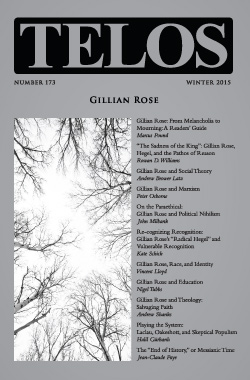 In her preface to the 1995 edition of Hegel Contra Sociology, Gillian Rose says that her project is “to demonstrate a nonfoundational and radical Hegel, which overcomes the opposit[ion] between nihilism and rationalism” and can renew critical thought “in the intellectual difficulty of our time.” However, I think this is not quite the case, for two reasons. First, Rose’s Hegel is not nonfoundational. Instead, as the book makes very clear, Rose’s Hegel does think the absolute, or the true. Yet her Hegel is also radical because she does not eschew the “ineluctable difficulty” of the authority of saying that truth either can or cannot be thought. Second, and in the teeth of this apparent inconsistency, thinking the absolute does not “overcome” such oppositions. Instead, it learns of their truth, their self-determination, by rethinking the religious and political presuppositions upon which these oppositions depend. Against the logic of mastery and ownership, or the propertied logic, that continues to dominate Western thinking, in Rose’s Hegel the learning and education which is endemic to the Aufhebung is not prejudged as “overcoming” (i.e., as abstract truth) or “failing to overcome” (yielding chaos and infinite regression). Instead, what it commends, and what I explore in this article, is a different logic of freedom, an educational logic, which can find its truth in preserving and reforming the opposition between nihilism and rationalism. This self-determining educational logic is the work in which thinking can renew itself in the intellectual difficulty of our time. In her preface to the 1995 edition of Hegel Contra Sociology, Gillian Rose says that her project is “to demonstrate a nonfoundational and radical Hegel, which overcomes the opposit[ion] between nihilism and rationalism” and can renew critical thought “in the intellectual difficulty of our time.” However, I think this is not quite the case, for two reasons. First, Rose’s Hegel is not nonfoundational. Instead, as the book makes very clear, Rose’s Hegel does think the absolute, or the true. Yet her Hegel is also radical because she does not eschew the “ineluctable difficulty” of the authority of saying that truth either can or cannot be thought. Second, and in the teeth of this apparent inconsistency, thinking the absolute does not “overcome” such oppositions. Instead, it learns of their truth, their self-determination, by rethinking the religious and political presuppositions upon which these oppositions depend. Against the logic of mastery and ownership, or the propertied logic, that continues to dominate Western thinking, in Rose’s Hegel the learning and education which is endemic to the Aufhebung is not prejudged as “overcoming” (i.e., as abstract truth) or “failing to overcome” (yielding chaos and infinite regression). Instead, what it commends, and what I explore in this article, is a different logic of freedom, an educational logic, which can find its truth in preserving and reforming the opposition between nihilism and rationalism. This self-determining educational logic is the work in which thinking can renew itself in the intellectual difficulty of our time.
Continue reading →
|
|