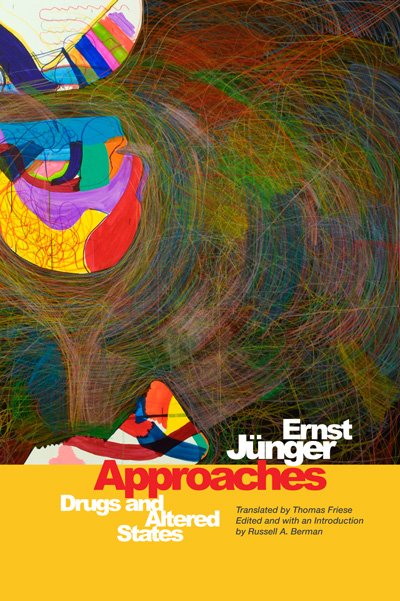
By Telos Press · Thursday, January 7, 2016 Telos Press is delighted to announce that two of its recent book publications, Eumeswil and Sturm, both by Ernst Jünger, have received honorary mentions in the general fiction category in the 2015 London Book Festival. Congratulations to editors Russell A. Berman and David Pan and to Sturm’s translator, Alexis P. Walker!
You can save 20% on these and other Telos Press books by purchasing them in our online store. Just use the coupon code BOOKS20 during checkout. When you order directly from the Telos Press website, you make it possible for us to publish the kinds of books that you want to read. As a small independent publisher, we rely on the support of our readers to continue producing new, challenging works in politics, philosophy, and critical theory. Visit our store for a complete listing of our books.
Continue reading →
By Ellis Hanson · Wednesday, December 30, 2015 However improbably, Michel Houellebecq’s novel Soumission returns continually to the work of Joris-Karl Huysmans for inspiration, if one can call it inspiration, this exercise in disillusionment seeking its literary echo. All the more surprising is Houellebecq’s insistence on a view of Huysmans that scarcely anyone, even those who have read his best work, will recognize, despite its being scrupulously accurate in its biographical and literary detail. When Huysmans is read today, it is almost invariably as the quintessential Decadent of À rebours, which Houellebecq touches upon only lightly when he declares it a masterpiece and then declines to discuss it in any meaningful way except to ask where one goes, where Huysmans went, where Houellebecq’s protagonist François might go, when his best work, his greatest inspirations, and his greatest dissipations are behind him. “In the case of Joris-Karl Huysmans,” the protagonist worries, “the obvious problem was what to do with À rebours. Once you’ve written a book of such powerful originality, unrivaled even today in all of literature, how do you go on writing?” Houellebecq even seems to be inviting us to contemplate his own midlife crisis as a novelist and wonder if, after writing the great novel of cynicism in our time, after exploring in painful detail better than anyone else all the great whatevers of modern anomie, he has simply run out of fresh disillusionments to anatomize in prose. His answer to his own question is quite simply Durtal, Huysmans’ other great literary accomplishment, the autobiographical alter ego around whom he focalized a series of somewhat mystical, somewhat Naturalistic, somewhat Decadent novels of Catholic conversion that occupied him for much of the two decades that followed the success of À rebours.
Continue reading →
By Giuseppina Mecchia · Wednesday, December 23, 2015 Reading the latest novel by Michel Houellebecq, I remembered an essay by Maurice Blanchot that appeared in 1964, entitled “L’Apocalypse déçoit,” roughly translatable as “The Apocalypse Disappoints.” Originally devoted to the intellectual failure on the part of the French intelligentsia to deal with the possibility of nuclear annihilation, the title of that essay seems the perfect commentary to a plot that would sound nothing less than apocalyptic to a very sizable part of contemporary French society: the election of a Muslim president of the French Republic and the Islamization of its civil code. This disastrous occurrence, currently treated in the Western media as nothing less than a catastrophic finis Europae, is narrated by Houellebecq in his increasingly understated voice, now mostly situated halfway between deadpan satire, melancholic brooding, and a touch of occasional melodrama. Gone are the violent Islamic terrorists of Plateforme, the 2001 novel that ended with terrorist attack on European sexual tourists in Thailand. No more spectacular explosions of the 9/11 kind: if the Western way of life will go, it won’t be with a bang, but with a merely audible whimper.
Continue reading →
By Alex Dubilet · Friday, December 18, 2015 A miasma of exhaustion and obsolescence pervades Michel Houellebecq’s Submission. It is occasionally punctured by explicit expressions of a pornographic libidinality, but these, in the end, serve only as desperate manifestations of increasingly temporary respites. The end is nigh, if it didn’t already happen. Houellebecq’s universe remains what it has been repeatedly—a universe of male libidinal desire, its intensifying frustrations and anxieties monumentally projected onto the background of the specters of the civilizational decline of the West. Houellebecq is at the tired end of the secular liberal dream of possessive individualism and sexual freedom, or, as the narrator puts it rather succinctly: “In the end, my cock was all I had” (81).
Continue reading →
Telos 173 (Winter 2015) is now available for purchase in our store.
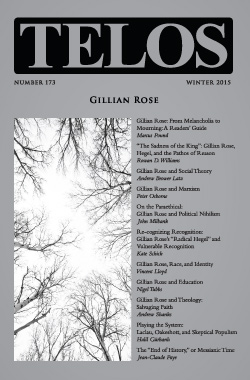 Gillian Rose (1947–1995) had an influence in excess of her literary output and treatment in secondary literature. Author of eight books, two articles, and four book reviews, she also had important, though perhaps hidden, effects on the UK academic scene through academic friendship, doctoral supervision, and interdisciplinary work. She inspired many students and colleagues, even where she does not appear in bibliographies or citations. She made major contributions to introducing the Frankfurt School to the UK; aided the Hegel renaissance in English-language scholarship; and was an early critic of post-structuralism and political theology. Several of the papers gathered here were first given at a conference at Durham University on January 9, 2015, to mark the twentieth year since Rose’s death. That conference and this special issue of Telos are premised on the view that Rose’s work still has much philosophical insight and inspiration to offer. The authors of these papers were students, colleagues, and/or friends of Rose, or studied her work as part of their doctoral research. The diversity of their fields reflects some of the range and interdisciplinarity of Rose’s own work: Hegel, social theory, Marxism, politics, race, recognition theory, education, and theology. We hope that this issue provokes a renewed interest in what Rose can still offer us today. Gillian Rose (1947–1995) had an influence in excess of her literary output and treatment in secondary literature. Author of eight books, two articles, and four book reviews, she also had important, though perhaps hidden, effects on the UK academic scene through academic friendship, doctoral supervision, and interdisciplinary work. She inspired many students and colleagues, even where she does not appear in bibliographies or citations. She made major contributions to introducing the Frankfurt School to the UK; aided the Hegel renaissance in English-language scholarship; and was an early critic of post-structuralism and political theology. Several of the papers gathered here were first given at a conference at Durham University on January 9, 2015, to mark the twentieth year since Rose’s death. That conference and this special issue of Telos are premised on the view that Rose’s work still has much philosophical insight and inspiration to offer. The authors of these papers were students, colleagues, and/or friends of Rose, or studied her work as part of their doctoral research. The diversity of their fields reflects some of the range and interdisciplinarity of Rose’s own work: Hegel, social theory, Marxism, politics, race, recognition theory, education, and theology. We hope that this issue provokes a renewed interest in what Rose can still offer us today.
Continue reading →
By Michael Allan · Friday, December 11, 2015 For scholars of religion and literature, Michel Houellebecq’s Submission glimmers like a shiny lure. The storyline contains the sorts of details that appeal to an easy and seductive journalistic gloss. The year is 2022. A charismatic Muslim prime minister is elected in France, and an almost caricatured series of events follows: men and women are separated; the university president converts to Islam and weds a young wife; professors are coerced to convert or retire early; and so on. Add to the plot Houellebecq’s professed Islamophobia and the massacre at Charlie Hebdo, and you have the ingredients of a newsworthy book to be addressed by critics, journalists, and readers across the world. Like a number of reviewers, I initially found myself lured to consider religion, secularism, and contemporary French politics against the backdrop of the newly published English translation. But as I began reading, I was confronted with a challenge of a different sort.
Continue reading →
|
|