By Vincent Lloyd · Thursday, December 10, 2015 Michel Houellebecq’s novel Submission raises important questions about the cultural crises of modernity. It reflects on the dialectics of post-secularism and post-democracy in ways that have become particularly salient in light of the terror attacks in Paris and San Bernadino. Beginning with Vincent Lloyd’s post today, TELOSscope presents a series of discussions of the novel that will appear over the next several days.
The violence of November 13, 2015, in Paris was met with an avalanche of grief and sympathy from around the world. Similar feelings followed the attack on Charlie Hebdo several months earlier. Paris is an iconic and beloved city; to see blood and bullet holes on the streets of Paris caused pain. Or rather, it causes professions of emotion. In an age of personal mediation, when we are expected to advertise our feelings about world events nearly in real time through tweets and Facebook posts, it is an open question how much feelings are felt—though they are most certainly performed. Affect circulates with ever increasing velocity, but such affect is increasingly shallow, more like a shared way of talking than anything having to do with inwardness. This does not mean mediated emotions are insignificant. As leftist critics of such public mourning charge, shared ways of talking about the world lead to shared ways of seeing the world and can ultimately legitimate violent ways of acting in the world.
Continue reading →
By Panajotis Kondylis · Monday, November 23, 2015 The following article was originally published in the Greek newspaper To Vima on December 21, 1997, on the occasion of the 70th anniversary of the first publication of Martin Heidegger’s Being and Time.
I consider Being and Time to be one of the overrated books of the century. To be precise, I regard it as a collection of platitudes expressed in pretentious and obscure language. Whoever goes beyond the narrow philosophical perspective and surveys the history of ideas and problems in its totality arrives at this conclusion. Being very one-sidedly educated as a rule, philosophers usually inflate the importance of things that take place in their own field and consider an author original solely because he introduces them to one or two new concepts. In reality, the philosophy of the Modern Era did not create its own problematic but followed, directly or indirectly, in a better or worse manner, the rapid changes that occurred chiefly in the natural sciences to begin with, and subsequently in the social and human sciences. The epistemologically oriented philosophy of the subject was developed in the seventeenth and eighteenth centuries as an attempt to provide answers to questions raised by the mathematical physics of the time (the distinction between primary and secondary qualities, causality, substance). The social and human sciences, whose foundations were laid in the eighteenth century and which came into their own in the nineteenth, introduced a perspective that has proven fatal for philosophy’s vital myth, namely, that of the autonomy of spirit, since they demonstrated its dependence not only on “irrational” and “existential” factors but on “non-spiritual,” socioeconomic, and historical ones too.
Continue reading →
By Telos Press · Monday, November 2, 2015 Telos Press Publishing is pleased to announce that Carl Schmitt’s Land and Sea: A World-Historical Meditation is now available for purchase. Order your copy today in our online store.
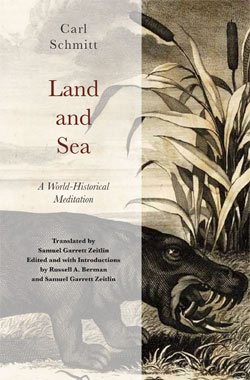 Land and Sea: Land and Sea:
A World-Historical Meditation
by Carl Schmitt
Translated by Samuel Garrett Zeitlin
Edited and with Introductions by Russell A. Berman and Samuel Garrett Zeitlin
Originally published in 1942, at the height of the Second World War, Land and Sea: A World-Historical Meditation recounts Carl Schmitt’s view of world history “as a history of the battle of sea powers against land powers and of land powers against sea powers.” Schmitt here unfolds his view of world history from the Peloponnesian War to European colonial expansion to the birth pangs of capitalism, while polemically setting Nazi Germany as a continental land power against Britain and the United States as its maritime enemies. In Land and Sea, Schmitt offers his interpretations of the rise of Venice, piracy, “corsair capitalism,” the spatial revolution of European colonial expansion, the rise of the British empire, and his readings of thinkers as diverse as Seneca, Shakespeare, Herman Melville, and Benjamin Disraeli.
This new and authorized edition from Telos Press Publishing, translated by Samuel Garrett Zeitlin and edited by Russell A. Berman and Samuel Garrett Zeitlin, includes extensive textual annotations that compare critical variations between the original 1942 edition of Land and Sea and the subsequent editions published in 1954 and 1981.
Continue reading →
By Kyle Nicholas · Thursday, October 22, 2015 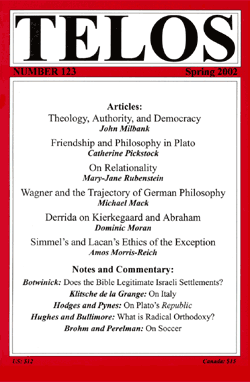 Mention “Radical Orthodoxy” in a room of people who are either quite intimately or only remotely acquainted with contemporary theology, and one surely will receive equal parts of praise and scorn. Whether it is being praised or scorned, however, it is plain that Radical Orthodoxy has worked its way deep into the fabric of contemporary theological discourse. Since the publication of John Milbank’s Theology and Social Theory in 1992, Catherine Pickstock’s After Writing in 1997, and Radical Orthodoxy: A New Theology, edited by Milbank, Pickstock, and Graham Ward in 1998, the Radical Orthodoxy movement has done what any explosively innovative intellectual movement will do after the hype settles down: mature or wither away. Mention “Radical Orthodoxy” in a room of people who are either quite intimately or only remotely acquainted with contemporary theology, and one surely will receive equal parts of praise and scorn. Whether it is being praised or scorned, however, it is plain that Radical Orthodoxy has worked its way deep into the fabric of contemporary theological discourse. Since the publication of John Milbank’s Theology and Social Theory in 1992, Catherine Pickstock’s After Writing in 1997, and Radical Orthodoxy: A New Theology, edited by Milbank, Pickstock, and Graham Ward in 1998, the Radical Orthodoxy movement has done what any explosively innovative intellectual movement will do after the hype settles down: mature or wither away.
In their article “What is Radical Orthodoxy?” (Telos 123, Spring 2002), John Hughes and Matthew Bullimore map out, in a short space and yet with crisp detail, the main themes in the Radical Orthodoxy project. For those familiar with the movement, their points will not come as a shock: that a deep metaphysical violence underlies modernity, political liberalism, and capitalism; that the philosophical and theological dualisms of modernity must be named and then overcome with the aid of both premodern and postmodern thought; and that in the face of proliferating violence it is Christian orthodoxy—in line with Aquinas, Boethius, Augustine, Gregory of Nyssa, and Iamblichean Neo-Platonism—that presents truly “radical” alternatives to the prevailing political, philosophical, and theological orders.
Continue reading →
By Matthew Lepori · Tuesday, October 20, 2015 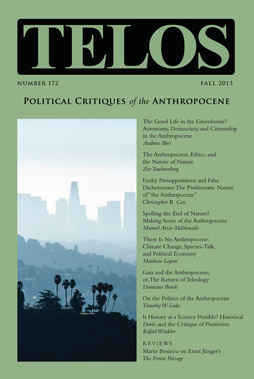 Anthropocene scholars push a new universal history and subject: we (the “anthropos”) are digging our grave as a species. Though this rhetoric is effective for drawing attention to the ecological crisis, the Anthropocene concept is dangerous for social theory. By generalizing responsibility and guilt for our contemporary ecological crisis to the point that it encompasses the human species, the concept and discourse elide the particular people and structures responsible for creating it. Rather than clarify the origins of the contemporary crisis—the history of capitalism, colonialism, and simplistic ideas about nature—it occludes them through forays into “deep history” and tales of technology disembedded from their social context. Lacking this history, the Anthropocene operates as an empty cosmopolitanism. Rather than provide a ground for a new political ecology, the Anthropocene removes it. Worse, the concept may prove useful for global actors who wish to hide their climate debts, using the rhetoric of collective responsibility that the Anthropocene makes possible. Anthropocene scholars push a new universal history and subject: we (the “anthropos”) are digging our grave as a species. Though this rhetoric is effective for drawing attention to the ecological crisis, the Anthropocene concept is dangerous for social theory. By generalizing responsibility and guilt for our contemporary ecological crisis to the point that it encompasses the human species, the concept and discourse elide the particular people and structures responsible for creating it. Rather than clarify the origins of the contemporary crisis—the history of capitalism, colonialism, and simplistic ideas about nature—it occludes them through forays into “deep history” and tales of technology disembedded from their social context. Lacking this history, the Anthropocene operates as an empty cosmopolitanism. Rather than provide a ground for a new political ecology, the Anthropocene removes it. Worse, the concept may prove useful for global actors who wish to hide their climate debts, using the rhetoric of collective responsibility that the Anthropocene makes possible.
Continue reading →
By Damiano Bondi · Thursday, October 15, 2015 The Gaia hypothesis was formulated for the first time in 1979 by James Lovelock. According to this conception, the Earth should be seen as a macro-organism whose purpose is to keep constant some conditions that are necessary for the presence of life on its surface. However—often with the consent of Lovelock himself—this scientific hypothesis has gone beyond its limits, transforming itself in a sort of anti-humanistic pseudo-religion: the Earth becomes a kind of divinity (Gaia) with a purposive will. This process of “personification” is quite paradoxical: Nature acquires features that are denied, at the same time, to the single man. In fact the human being, in this conceptual framework, is only a part of the Great Whole, the Mother Nature; he cannot be “her” guardian at all, he has to abandon any pretense of ontological superiority and to “believe” in the infinite potential of Gaia, who always finds a way to restore the threatened balance. On the ontological level, there is no difference between the single man and the natural ambient that surrounds him; so, on the moral level, this metaphysical conception ends to justify the indifference of the person to the impact of his own actions on the ecosystem. Not surprisingly, Lovelock has recently been deployed in favor of nuclear power.
Continue reading →
|
|