By Monika Lemke · Tuesday, April 7, 2015 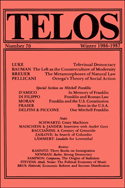 Premised on the Left’s fundamental inability to dissociate itself from the ideals of the bourgeois revolution, Zygmunt Bauman’s “The Left as the Counter-Culture of Modernity” introduces the notion of reconstituting “the Left as the counter-culture of modernism,” rather than as the “counter-culture of capitalism.” Bauman makes the case for this repositioning because, in his view, there is no historical agent to carry out an anti-capitalist program. However, by continuing to defend and maintain the Left’s core values of individual autonomy and political democracy, Bauman believes that the Left can identify the barriers preventing their realization in the present neoliberal paradigm. Bauman recounts the Left’s courtship with various strategies, namely, the heterodox critique of capitalist practice and professed affinity with the industrial working class, and the recent flirtation with postmodern theory. By examining each as it addresses the present historical paradigm, he emphasizes the need to rehabilitate the values of the Leftist program and search for alternative strategies to realize them. Premised on the Left’s fundamental inability to dissociate itself from the ideals of the bourgeois revolution, Zygmunt Bauman’s “The Left as the Counter-Culture of Modernity” introduces the notion of reconstituting “the Left as the counter-culture of modernism,” rather than as the “counter-culture of capitalism.” Bauman makes the case for this repositioning because, in his view, there is no historical agent to carry out an anti-capitalist program. However, by continuing to defend and maintain the Left’s core values of individual autonomy and political democracy, Bauman believes that the Left can identify the barriers preventing their realization in the present neoliberal paradigm. Bauman recounts the Left’s courtship with various strategies, namely, the heterodox critique of capitalist practice and professed affinity with the industrial working class, and the recent flirtation with postmodern theory. By examining each as it addresses the present historical paradigm, he emphasizes the need to rehabilitate the values of the Leftist program and search for alternative strategies to realize them.
Continue reading →
By Robert Wyllie · Monday, April 6, 2015  Archaeologists have found the oldest known example of complex intergenerational cooperation at Göbekli Tepe in southern Turkey. Thirty miles away, just across the Syrian border, is the latest flashpoint of a complex intergenerational conflict—what President Obama calls the “barbarism” of the Islamic State.[1] What does the world’s oldest civilization have to do with the world’s newest barbarians? Both show the fundamental role of religion in organizing human societies. Viewing civilization as the product of religion bucks a long academic tradition. A consensus holds that human culture is an adaptive response to the environment. Ecological factors shape the economic base of society, molding civilizations in different ways. Thus, in the “Neolithic Revolution” hypothesis of V. Gordon Childe, civilization originated when the global climate warmed some 12,000 years ago, such that human beings could cultivate grains in fertile river valleys (Mesopotamia, Egypt, India, and China). This was the economic base upon which a civilizational superstructure—hierarchies, regimes, and religion itself—was built. Archaeologists have found the oldest known example of complex intergenerational cooperation at Göbekli Tepe in southern Turkey. Thirty miles away, just across the Syrian border, is the latest flashpoint of a complex intergenerational conflict—what President Obama calls the “barbarism” of the Islamic State.[1] What does the world’s oldest civilization have to do with the world’s newest barbarians? Both show the fundamental role of religion in organizing human societies. Viewing civilization as the product of religion bucks a long academic tradition. A consensus holds that human culture is an adaptive response to the environment. Ecological factors shape the economic base of society, molding civilizations in different ways. Thus, in the “Neolithic Revolution” hypothesis of V. Gordon Childe, civilization originated when the global climate warmed some 12,000 years ago, such that human beings could cultivate grains in fertile river valleys (Mesopotamia, Egypt, India, and China). This was the economic base upon which a civilizational superstructure—hierarchies, regimes, and religion itself—was built.
Continue reading →
By Andrew M. Wender · Friday, April 3, 2015 The emerging exhaustion of the Westphalian paradigm of state sovereignty intimates the profoundly contestable and contingent character of modern, Western claims for a universal model of history. Over several centuries, the state has embodied and enforced foundational postulates, such as the pre-eminence of the individual knowing subject, and the imagined divide between religious and secular realms of existence and authority (with the latter sphere effectively internalizing the sacred import of the former). At present, though, the state’s tenuousness, and yet in key instances fierce tenacity, amidst a world of potent transnational forces, portends the urgency for alternative conceptions of the meaning and arrangement of human life. Contemporary Middle Eastern quandaries are especially illustrative of this predicament: for example, the disintegration (as in Iraq, Syria, Libya) or, then again, coercive retrenchment (viz., Egypt) of state formations and nationalist identities; or, to take another sort of instance, the chimerical prospects for coexistence, or even bare existence, among conflicting national communities, as in Israel/Palestine. Are there political paradigms beyond the Westphalian state that could help to integrate plural traditions in pursuit of less exclusionary, and more just, historical possibilities?
Continue reading →
By Tsutomu Ben Yagi · Wednesday, April 1, 2015 The aim of this short paper is to offer a critical response to Philippe Van Parijs concerning his notion of linguistic justice as worked out most extensively in his book Linguistic Justice for Europe and for the World (2011). I thus begin by elucidating his conception of linguistic justice by presenting two basic theses on which it rests: first, he attempts to demonstrate the need for a lingua franca in the “globalized” (or rather “globalizing”) world today (i.e., advocating a common language for the entire world); and second, he seeks to justify the exceptional and unprecedented position the English language is now in to serve as the de facto lingua franca for this globalizing world. Given the general theme of history for this conference, I shall present Van Parijs’ thoughts with a particular focus on its historical aspects and implications. Accordingly, the first part of my discussion will center on the idea of lingua franca in relation to history. As a critical response to Van Parijs’ view, I subsequently take up the question of translation and discuss in the second part the significant role translation can and must play in our contemporary, multilingual world. Such an analysis will be carried out by examining some of the important contributions made in the hermeneutic tradition on the question of translation. In particular, the works of George Steiner, John Sallis, and Paul Ricoeur will be considered. By doing so, I wish to demonstrate in this paper that it is not English as the lingua franca that serves linguistic justice, but rather our openness to translation that must be seen as a fundamental principle of linguistic justice.
Continue reading →
By Timothy Melley · Tuesday, March 31, 2015
 Western societies increasingly imagine, plan, and even rehearse their own destruction. This cultural habit reflects a growing contradiction in democracy. On the one hand, liberal societies laud the ideals of participatory democracy, free speech, individual liberty, and governmental transparency. On the other, they grow ever more committed to the biopolitical regulation of life, the mitigation of threats to public health and safety, and the restriction of liberties as a way of securing liberty itself. How do we understand the inexorable growth of a security paradigm in liberal democracies? The answer lies partly in the cultural imaginary that shapes public contemplation of citizenship, liberty, and security. This imaginary reflects both the growing influence of biopolitics and the legacy the Cold War covert action. Paradoxically, the Cold War state’s growing commitment to covert action was itself increasingly public; as a result, public culture has became obsessed with, and enamored of, covert affairs. Despite state secrecy, most citizens believe they know the “kinds of things” their government is doing in secret—yet they cannot know in detail, and they receive most of their knowledge in the form of melodramatic fiction. The result is a growing irrationality in the democratic public sphere. Western societies increasingly imagine, plan, and even rehearse their own destruction. This cultural habit reflects a growing contradiction in democracy. On the one hand, liberal societies laud the ideals of participatory democracy, free speech, individual liberty, and governmental transparency. On the other, they grow ever more committed to the biopolitical regulation of life, the mitigation of threats to public health and safety, and the restriction of liberties as a way of securing liberty itself. How do we understand the inexorable growth of a security paradigm in liberal democracies? The answer lies partly in the cultural imaginary that shapes public contemplation of citizenship, liberty, and security. This imaginary reflects both the growing influence of biopolitics and the legacy the Cold War covert action. Paradoxically, the Cold War state’s growing commitment to covert action was itself increasingly public; as a result, public culture has became obsessed with, and enamored of, covert affairs. Despite state secrecy, most citizens believe they know the “kinds of things” their government is doing in secret—yet they cannot know in detail, and they receive most of their knowledge in the form of melodramatic fiction. The result is a growing irrationality in the democratic public sphere.
Continue reading →
By Jay A. Gupta · Monday, March 30, 2015 Hegel’s lectures on the philosophy of history chart the development of free, reflective self-conscious selves, but what exactly does that mean? For skeptics, it doesn’t mean much, as Hegel notoriously appears to ground this development in the development of the state. This has inspired Popper’s well-known accusations that Hegel was a puppet of the Prussian monarchy, the “enemy of the open society,” etc., etc., and that the “free” subjects of the state as Hegel describes it are anything but. Further, from Marx to Habermas, Hegel is indicted as one who adopts a quietist attitude of priestly monasticism, so while those imbued with the proper critical, historical consciousness are busy trying to change the world according to the dictates of one or another praxis philosophy, Hegel is content to contemplate it as it goes up in flames. Habermas sees in Hegel’s mature work a “blunting of critique” and a “stoic retreat” from the problems of modernity, the very ones that Habermas believes the younger Hegel so incisively diagnosed.
Continue reading →
|
|