By Telos Press · Monday, December 1, 2025 Now available: Knowledge, What Is It Good For? Italian/American Leadership in the Twenty-First Century, by Anthony Julian Tamburri. Order the paperback edition today in our online store and save 20% by using the coupon code BOOKS20.
Knowledge, What Is It Good For? Italian/American Leadership in the Twenty-First Century
by Anthony Julian Tamburri
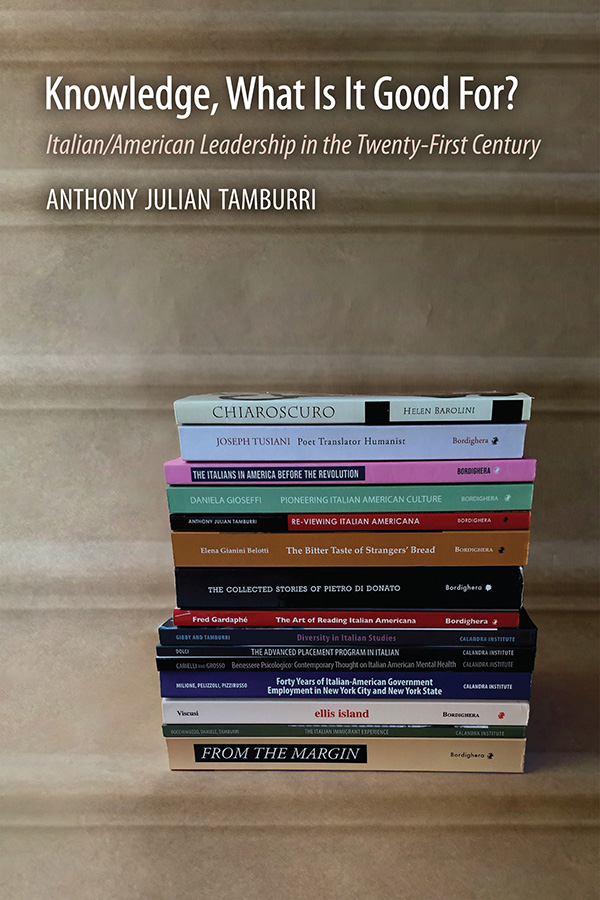 Anthony Julian Tamburri’s Knowledge, What Is It Good For? provides a detailed and systematic examination of Italian/American leadership today, whether that leadership arose through consensus or self-appointment. The various chapters describe the key issues at hand, which overall reflect a lack of knowledge about the history of Italians and their descendants in the United States. Through the critique of these issues, Tamburri emphasizes the need for solutions to remedy these gaps. This book is a follow-up to Tamburri’s A Politics of [Self‑]Omission: The Italian/American Challenge in a Post-George Floyd Age (2022), which offered a first look at influential individuals and leaders of non-scholarly Italian/American organizations. Anthony Julian Tamburri’s Knowledge, What Is It Good For? provides a detailed and systematic examination of Italian/American leadership today, whether that leadership arose through consensus or self-appointment. The various chapters describe the key issues at hand, which overall reflect a lack of knowledge about the history of Italians and their descendants in the United States. Through the critique of these issues, Tamburri emphasizes the need for solutions to remedy these gaps. This book is a follow-up to Tamburri’s A Politics of [Self‑]Omission: The Italian/American Challenge in a Post-George Floyd Age (2022), which offered a first look at influential individuals and leaders of non-scholarly Italian/American organizations.
Continue reading →
By Telos Press · Wednesday, November 26, 2025 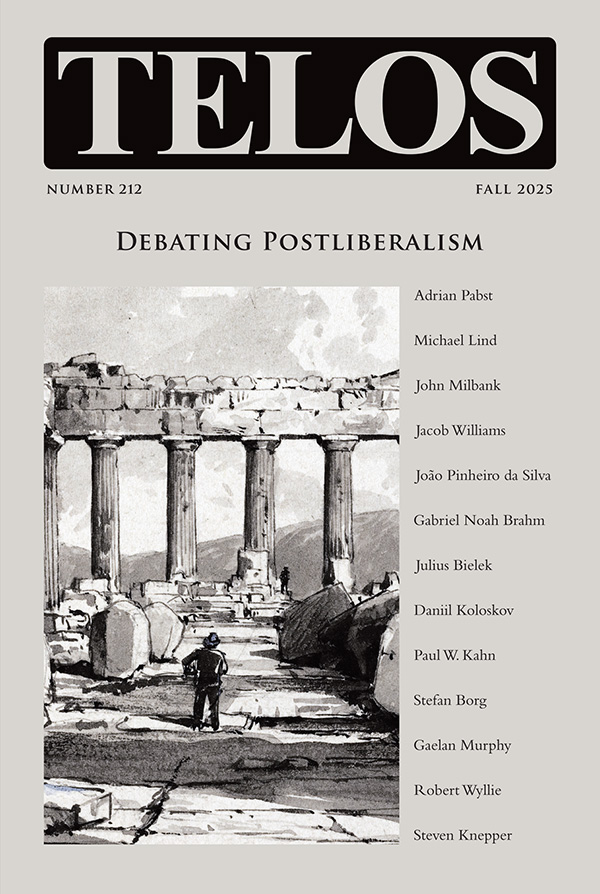 In today’s episode of the Telos Press Podcast, Adrian Pabst talks with Michael Lind and John Milbank about postliberalism, the topic of the current issue of Telos, “Debating Postliberalism.” Adrian Pabst’s “The New Era: What Comes After the Self-Erosion of Liberalism,” Michael Lind’s “After Liberalism,” and John Milbank’s “The Politics of Virtue” all appear in the issue. We have made the articles by Pabst and Lind available as open access publications, and they can be read for free at our website. To purchase a copy of the issue or to subscribe to Telos, visit our online store. In today’s episode of the Telos Press Podcast, Adrian Pabst talks with Michael Lind and John Milbank about postliberalism, the topic of the current issue of Telos, “Debating Postliberalism.” Adrian Pabst’s “The New Era: What Comes After the Self-Erosion of Liberalism,” Michael Lind’s “After Liberalism,” and John Milbank’s “The Politics of Virtue” all appear in the issue. We have made the articles by Pabst and Lind available as open access publications, and they can be read for free at our website. To purchase a copy of the issue or to subscribe to Telos, visit our online store.
Continue reading →
By Telos Press · Monday, May 19, 2025 With Donald Trump’s second presidential term now underway, it is the perfect time to pick up your copy of Timothy W. Luke’s The Travails of Trumpification, from Telos Press Publishing. Save 25% on the paperback edition of The Travails of Trumpification by purchasing it in our online store and using the coupon code TRAVAILS25 during checkout. The journal Educational Philosophy and Theory published a collection of reviews of The Travails of Trumpification in 2022, excerpts of which appear below. Read the full set of reviews here (subscription required).
Continue reading →
By Telos Press · Friday, December 22, 2023 Now available: Shards and Specters of the New World Order, by Timothy W. Luke. Order the paperback edition today in our online store and save 20% by using the coupon code BOOKS20. Also available in Kindle ebook format at Amazon.com.
Shards and Specters of the New World Order: Casting Soviet and Post-Soviet Studies as Critique
by Timothy W. Luke
 From ideological dynamics in revolutionary Russia, cultural stagnation in the USSR, and ineffective Soviet governance in the 1980s to the USSR’s institutional collapse in 1991, the emergence of the Russian Federation under Boris Yeltsin, and Vladimir Putin’s wars in Ukraine since 2014, Timothy W. Luke’s Shards and Specters of the New World Order investigates how the geopolitical clout of the United States has worked to contain, but at other times sustain, the Soviet Union and later the Russian Federation. Luke’s critical studies also examine how Moscow’s strategies provoked radical Islamic resistance movements in Afghanistan and aided anti-Western client states, like Iraq and Syria, that threatened the New World Order envisioned in Washington after 1991. From ideological dynamics in revolutionary Russia, cultural stagnation in the USSR, and ineffective Soviet governance in the 1980s to the USSR’s institutional collapse in 1991, the emergence of the Russian Federation under Boris Yeltsin, and Vladimir Putin’s wars in Ukraine since 2014, Timothy W. Luke’s Shards and Specters of the New World Order investigates how the geopolitical clout of the United States has worked to contain, but at other times sustain, the Soviet Union and later the Russian Federation. Luke’s critical studies also examine how Moscow’s strategies provoked radical Islamic resistance movements in Afghanistan and aided anti-Western client states, like Iraq and Syria, that threatened the New World Order envisioned in Washington after 1991.
Continue reading →
By Telos Press · Tuesday, November 7, 2023 In today’s episode of the Telos Press Podcast, David Pan talks with Sherman A. Jackson about his article “Islam and the Promotion of Human Rights,” from Telos 203 (Summer 2023). An excerpt of the article appears here. If your university has an online subscription to Telos, you can read the full article at the Telos Online website. For non-subscribers, learn how your university can begin a subscription to Telos at our library recommendation page. Print copies of Telos 203 are available for purchase in our online store.
Note: The podcast below was recorded on September 8, 2023.
Continue reading →
By Telos Press · Monday, October 30, 2023  In sorrow, the Telos-Paul Piccone Institute, in cooperation with the journal Telos, announces a series of events and publications designed to explore the place of critical theory in the response within the American university to the atrocities perpetrated by Hamas on October 7, 2023. In sorrow, the Telos-Paul Piccone Institute, in cooperation with the journal Telos, announces a series of events and publications designed to explore the place of critical theory in the response within the American university to the atrocities perpetrated by Hamas on October 7, 2023.
From the start of this war, theory was present. It was present in sublimated ways, as widespread presuppositions and “narratives,” infused with charismatic authority by a popularized “postcolonial” jargon. It was present in kinetic, emotionally charged, intellectually unsophisticated responses in “mass” demonstrations, public statements by groups and institutions, and individual social media campaigns. Yet above all, it was manifest in considered, open, intentional ways, within our universities. The American college campus, the traditional home of critical theory—which emerged in the twentieth century most powerfully as a response to fascism and Nazism—has become a nodal point for the dramatic unfolding of a morally and politically deficient discourse about a present-day Kristallnacht.
What can this state of affairs tell us about American higher education? What does it reveal about the fate of “theory” itself, in concrete, practical, and abstract theoretical terms? How does the ritual deployment of certain theoretical vocabularies in response to the attacks help obscure the interests and power of the New Class of managers, information workers, social engineers, and therapeutic organizers, against which Telos has launched a sustained critique since 1968? What does it signify that many members of this powerful strata have learned to conceive of justice and injustice in terms of reified castes in a hierarchy of victimhood, such that racial, ethnic, national, religious, sexual, or gender identity are largely equated with individual moral culpability or innocence? How have theories critical of symbolic violence turned into justifications for actual violence? And how is this justification of actual violence “by any means necessary” emancipated from any ethical constraints? How do macro-level geopolitical concerns provide a larger context for understanding the place of critical theory in the response to October 7?
Continue reading →
|
|