By Rufus Burrow, Jr. · Monday, April 23, 2018 Rufus Burrow, Jr.’s “Martin Luther King, Jr., and Ethical Leadership” appears in Telos 182 (Spring 2018), a special issue commemorating the life and thought of Martin Luther King, Jr. Read the full article at the Telos Online website, or purchase a print copy of the issue in our online store. Individual subscriptions to Telos are now available in both print and online formats.
James MacGregor Burns, a pioneer in leadership theory, was certain that many people lack clarity about the meaning and place of leadership. “The confusion,” he said, “will continue as long as we fail to distinguish leadership from brute power, leadership from propaganda, leadership from manipulation, leadership from pandering, leadership from coercion.” What we have seen during and after the 2016 presidential election cycle in the United States is evidence of this ambiguity and confusion. In addition, political operatives and other presumed leaders fail to exhibit integrity, character, civility, courage, and a sense of obligation to the highest and best values. Instead, what we see persistently, particularly in the Donald J. Trump presidency, are efforts to cater to the worst in citizens, especially uneducated, unemployed, and underemployed white working-class people. For a long time I have wondered whether a study of Martin Luther King, Jr., (1929–1968) might reveal important lessons about the nature and meaning of leadership, leadership that reasonable people eagerly follow. This essay seeks to clarify how King understood leadership.
Continue reading →
By Marco Patriarca · Monday, April 9, 2018 Among the discouraging quandaries that the European Union has had to face in recent years, no one could have imagined that the United Kingdom and the United States, our historical, crucial allies, would turn their back on the EU, thus leaving it exposed to the global influence to Russia, Turkey, and Iran, not exactly friends of our open societies and polity. It would have been equally impossible to predict that so many supposedly enlightened, tolerant, and democratic European citizens would rally around xenophobic and anti-Semitic political parties while reviving the most obtuse and primitive ethnocentrism. All these ills, and most of all of Brexit and its aftermath, were interpreted by many as a fatal blow to the EU, in combination with other indicators that seemed to point to a general design failure of its unifying project. Nevertheless, many reliable commentators have expressed faith that the EU, at long last, would react to this long-standing issue.
Continue reading →
By Russell A. Berman · Thursday, April 5, 2018 Cary Nelson and Telos editor, Russell Berman, respond to Saree Makdisi and raise broader questions about the contemporary humanities. Read their essay at Fathom.
Continue reading →
By Harriett Jernigan · Wednesday, April 4, 2018 Harriett Jernigan’s “‘Is there something wrong with that?’: The Transculturation of Martin Luther King, Jr., Schools in Germany” appears in Telos 182 (Spring 2018), a special issue commemorating the life and thought of Martin Luther King, Jr. Read the full article at the Telos Online website, or purchase a print copy of the issue in our online store. Individual subscriptions to Telos are now available in both print and online formats.
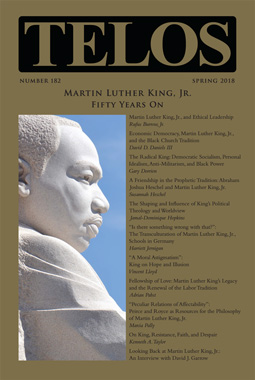 While it is common knowledge that a number of elementary, middle, and high schools in the United States are named after Martin Luther King, Jr., few people know that the Federal Republic of Germany is also home to a significant number of schools named in honor of him as well. The differences between American and German school systems, in particular the manner in which children are placed in special-needs schools in Germany, prompt a transculturation of the symbolic value of Martin Luther King, Jr., as the schools’ mission statements reflect. Although both American and German MLK schools are generally conspicuously diverse and underscore the importance of equality and diversity, their priorities diverge thereafter, with American MLK schools emphasizing academic preparation for upward mobility and global citizenship, and German MLK schools nonviolence and local integration, a divergence that arises partially from the priority German Leitkultur places on German-language proficiency. While it is common knowledge that a number of elementary, middle, and high schools in the United States are named after Martin Luther King, Jr., few people know that the Federal Republic of Germany is also home to a significant number of schools named in honor of him as well. The differences between American and German school systems, in particular the manner in which children are placed in special-needs schools in Germany, prompt a transculturation of the symbolic value of Martin Luther King, Jr., as the schools’ mission statements reflect. Although both American and German MLK schools are generally conspicuously diverse and underscore the importance of equality and diversity, their priorities diverge thereafter, with American MLK schools emphasizing academic preparation for upward mobility and global citizenship, and German MLK schools nonviolence and local integration, a divergence that arises partially from the priority German Leitkultur places on German-language proficiency.
Continue reading →
By Jack Robert Edmunds-Coopey · Tuesday, April 3, 2018 As an occasional feature on TELOSscope, we highlight a past Telos article whose critical insights continue to illuminate our thinking and challenge our assumptions. Today, Jack Robert Edmunds-Coopey looks at Jeffrey Bussolini’s “Ongoing Founding Events in Carl Schmitt and Giorgio Agamben” from Telos 157 (Winter 2011).
Jeffrey Bussolini’s article “Ongoing Founding Events in Carl Schmitt and Giorgio Agamben” is a discursive piece seeking to provide groundwork on the conception of the event and its theological and political dimensions. He coins this term “ongoing founding events” as a type of poetic gesture toward the movement of temporality to which events are founded, and which as a consequence of their founding then continue to contaminate the space around them. Bussolini claims that for Schmitt the event of decision generates sovereignty, and that within this basic movement, whether it be mythical or concrete reality at this point is unsure, becomes the generating and maintaining of political order.
Continue reading →
By Russell A. Berman · Wednesday, March 28, 2018 The ethnic cleansing in Syria is hardly a secret, but it continues unabated. A Syrian refugee and a Holocaust survivor have collaborated on an appeal that includes the following crucial paragraph:
The starvation, the torture, the siege and the chemical attacks in Syria can be stopped. Assad’s military is far from invincible; the Israeli strikes on Syrian air defenses last month showed that. After years of appeasement-style diplomacy have yielded only more body bags by an emboldened Assad, grounding Assad’s air force is the last option left to stop the slaughter.
Please read the full text here.
Continue reading →
|
|











The Massacre in Syria: An Appeal for Support
The ethnic cleansing in Syria is hardly a secret, but it continues unabated. A Syrian refugee and a Holocaust survivor have collaborated on an appeal that includes the following crucial paragraph:
Please read the full text here.
Continue reading →