By Jakob Norberg · Thursday, January 12, 2012 Jakob Norberg’s “Day-to-Day Politics: Carl Schmitt on the Diary” appears in Telos 157 (Winter 2011). Read the full version online at the TELOS Online website, or purchase a print copy of the issue here.
 Early on in his career, Carl Schmitt articulated a cultural critique of the diary. He saw the personal journal as a manifestation and reinforcement of the writing subject’s vanity and self-importance in a sterile modern world. The resulting record, moreover, offered up the diarist’s inner life to the gaze of dissecting readers, who tended to convert polemical arguments into psychological symptoms. Yet Schmitt also kept something like a daily journal and was thus forced to struggle against the diary from within the genre itself. His post-1945 notebooks, entitled Glossarium, constitute a cultural battlefield upon which this struggle takes place. By means of strategies such as scathing portraits of famous diarists and displays of sententious concision, Schmitt sought to expel the diary from his own notebooks, or stage a paradoxical day-to-day resistance to the pathologies of the age emblematized in the diary form itself. The study of Schmitt’s non-diary ultimately sheds light on his political understanding of writing. For him, genres are never neutral vehicles of ideas but rather inflect thought in ideologically relevant ways. Early on in his career, Carl Schmitt articulated a cultural critique of the diary. He saw the personal journal as a manifestation and reinforcement of the writing subject’s vanity and self-importance in a sterile modern world. The resulting record, moreover, offered up the diarist’s inner life to the gaze of dissecting readers, who tended to convert polemical arguments into psychological symptoms. Yet Schmitt also kept something like a daily journal and was thus forced to struggle against the diary from within the genre itself. His post-1945 notebooks, entitled Glossarium, constitute a cultural battlefield upon which this struggle takes place. By means of strategies such as scathing portraits of famous diarists and displays of sententious concision, Schmitt sought to expel the diary from his own notebooks, or stage a paradoxical day-to-day resistance to the pathologies of the age emblematized in the diary form itself. The study of Schmitt’s non-diary ultimately sheds light on his political understanding of writing. For him, genres are never neutral vehicles of ideas but rather inflect thought in ideologically relevant ways.
Continue reading →
By Russell A. Berman · Monday, December 19, 2011 Telos 157 (Winter 2011) is now available for purchase here.
The political disorder grows ever thicker. As of this writing, the European financial crisis seems as far away from resolution as ever, although the same complaint might have pertained three months ago nor is the diagnosis likely to lose its validity three months hence. The eurozone insists on tumbling toward an economic catastrophe that may drag the rest of the world down as well. Meanwhile prospects for a liberalizing democracy in the former Communist empire have largely vanished from living (or incarcerated) memory, and the trajectory of the Arab Spring poses more questions than answers. To be sure, things may still take a turn for the good, and the ignominious ends of some of the dictators merit celebration. Yet deserving candidates for violent overthrow and execution remain in power, in Damascus and Tehran, terrorizing their populations, amidst a larger civil war throughout the Middle East. Much of this disorder has profound local roots, stemming from competition among alternative religious traditions, political models, and economic agenda. But some of the instability results as well from the loss of ballast in the wake of the American retreat, itself a symptom of the chaos of American politics. The pre-primary period optimizes neither political virtue nor sober leadership, but even with that qualification, this lead-up to the 2012 electoral season stands out for its chilling hopelessness. It is hard to imagine a happy end to the story. The power of the state continues to expand, which undermines the integrity of individuals, but its capacity to influence the economy nonetheless diminishes. Disorder surrounds us, and the center gives way. Is there room for civic virtue?
Continue reading →
By David Pan · Monday, March 7, 2011 This paper was presented at the 2011 Telos Conference, “Rituals of Exchange and States of Exception: Continuity and Crisis in Politics and Economics.”
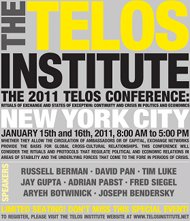 When we consider the metaphysical foundations of our world, we must make a basic choice between a universal conception of metaphysics and a relativist one. This choice commits us to either of two possibilities for world order. With a universalist conception, world order will evolve through a gradual establishment of one universal metaphysical structure that will establish its universality everywhere. With the relativist conception, world order can only consist of a set of agreements and rituals that can be established between a number of separate spaces, each of which is organized according to its own metaphysical structure. The choice for one or the other of these perspectives is consequently a fundamental one that will have far-reaching consequences for our conception of politics in a global context. When we consider the metaphysical foundations of our world, we must make a basic choice between a universal conception of metaphysics and a relativist one. This choice commits us to either of two possibilities for world order. With a universalist conception, world order will evolve through a gradual establishment of one universal metaphysical structure that will establish its universality everywhere. With the relativist conception, world order can only consist of a set of agreements and rituals that can be established between a number of separate spaces, each of which is organized according to its own metaphysical structure. The choice for one or the other of these perspectives is consequently a fundamental one that will have far-reaching consequences for our conception of politics in a global context.
Continue reading →
By Telos Press · Monday, February 7, 2011 Timothy Wong’s “Steward of the Dying Voice: The Intrusion of Horatio into Sovereignty and Representation” appears in Telos 153 (Winter 2010). Read the full version at TELOS Online website.
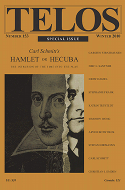 This article examines the issue of early modern sovereign succession and political representation through the figure of Horatio. Using Carl Schmitt’s comments on the “dying voice” in the first appendix of Hamlet or Hecuba, and his theory of political representation, this essay argues that Horatio represents the transitional space between the fading vestiges of political theology, and the first traces constituent sovereignty. In his role as mediator of the sovereign word of King Hamlet and the dying voice of Prince Hamlet, Horatio becomes the proto-constituent subject who signals the genesis of a reoriented political agency that is constituted by popular consent rather than authoritarian rule. Furthermore, Horatio is the paradoxical representative that both represents the body politic (in the sense of the King’s two bodies) to the people and the popular will to itself. This article examines the issue of early modern sovereign succession and political representation through the figure of Horatio. Using Carl Schmitt’s comments on the “dying voice” in the first appendix of Hamlet or Hecuba, and his theory of political representation, this essay argues that Horatio represents the transitional space between the fading vestiges of political theology, and the first traces constituent sovereignty. In his role as mediator of the sovereign word of King Hamlet and the dying voice of Prince Hamlet, Horatio becomes the proto-constituent subject who signals the genesis of a reoriented political agency that is constituted by popular consent rather than authoritarian rule. Furthermore, Horatio is the paradoxical representative that both represents the body politic (in the sense of the King’s two bodies) to the people and the popular will to itself.
Continue reading →
By Telos Press · Thursday, January 13, 2011 Drew Daniel’s “‘Neither Simple Allusions Nor True Mirrorings’: Seeing Double with Carl Schmitt” appears in Telos 153 (Winter 2010). Read the full version at TELOS Online website.
In response to recent criticisms of Schmitt’s argument as “tendentious” and symptomatic, this essay seeks to perform a reparative reading of the central claim of Hamlet or Hecuba for a substantial resemblance between the events within Shakespeare’s play and the murky circumstances surrounding the death of King James’s father, Lord Darnley. First, the historical archive surrounding Lord Darnley’s death is sounded for evidence that might support Schmitt’s claim and illuminate unresolved questions within the plot of Hamlet (in particular, the mysterious “sins” referred to by the Ghost). Secondly, the archive of James’s own published writings on sovereignty, demonology, and witchcraft are placed into relation with Jean Bodin’s similar writings, and brought to bear upon Schmitt’s reading of Shakespeare’s ghost scenes. The cruxes within Shakespeare’s play and Schmitt’s text about the ghost scene (“spirit of health” or “goblin damned”? Catholic or Protestant?) illuminate the relationship between sovereignty and demonology in early modern England: the two discourses are linked by the attempt to establish the divine status of sovereignty and the corresponding subordination of demons and ghosts to theologically established limits and laws. Departing from Schmitt’s initial arguments, this essay extends them in order to illuminate the political-theological terrain within which Hamlet functions.
Continue reading →
If recent discussions of Schmitt in these pages have made a broad case for the centrality of culture for his thinking, the current issue both specifies and generalizes this approach. The specificity derives from our focus on one key text by Schmitt that is often passed over but is in fact crucial for understanding his work. The generality is a result of the breathtaking sweep of issues that this text opens up for the contributors to this issue: the relation of sovereignty to popular will, the ontological status of modernity, the role of myth in society, the representational structure of human existence, the relation of art and theology to the public sphere. These discussions take our understanding of Schmitt into new directions that draw out not just the aesthetic and cultural aspects of his thought, but also reveal the import of his methods for fundamental questions of epistemology and ontology. He arrives at such questions through the consideration of a single exemplary case: Shakespeare’s Hamlet.
Continue reading →
|
|