By Telos Press · Monday, April 14, 2014 The Telos-Paul Piccone Institute has several important events in the works for 2014, including conferences and symposia in Melbourne, Australia, Beijing, China, L’Aquila, Italy, and Irvine, California. At the recent Telos Conference in New York City, David Pan, Executive Director of the Institute, outlined the themes for this year’s conference.
Continue reading →
By Jacob Dreyer · Friday, April 4, 2014  The shadow of geography in modern Chinese thought is profound, for the understanding of a modern China above all relies on the interpretation of what China is. A population? A geography? A continental form of knowledge, modulated as cultural system? The interrogation of China’s two modern cities—Harbin and Shanghai[1]—reveals certain disparities in the approach toward geography and landscape, and the resultant subject position. Shanghai, whose name literally means “up against the sea,” and the soil of which is nearly entirely all the eroded dust from the banks of the Yangtze in the Chinese interior,[2] is the heir to the watery tradition of Jiangnan, the Yangtze region of water towns; Harbin, the frozen Siberian capital, was founded as an outpost in the middle of the “Great Northern Wasteland,” which has been tamed by the successive generations of labor fanning out from the transportation network of which Harbin is the center. Shanghai, then, has never been sufficiently solid or stable to be a capital; it errs on the avant-garde of flow, a slippery Atlantis. Harbin, with its gruff dialect, with its ripe and aged neighborhoods, with the earnest and clean faces glimpsed on the boulevards, is a city in which the earth has come to life. The shadow of geography in modern Chinese thought is profound, for the understanding of a modern China above all relies on the interpretation of what China is. A population? A geography? A continental form of knowledge, modulated as cultural system? The interrogation of China’s two modern cities—Harbin and Shanghai[1]—reveals certain disparities in the approach toward geography and landscape, and the resultant subject position. Shanghai, whose name literally means “up against the sea,” and the soil of which is nearly entirely all the eroded dust from the banks of the Yangtze in the Chinese interior,[2] is the heir to the watery tradition of Jiangnan, the Yangtze region of water towns; Harbin, the frozen Siberian capital, was founded as an outpost in the middle of the “Great Northern Wasteland,” which has been tamed by the successive generations of labor fanning out from the transportation network of which Harbin is the center. Shanghai, then, has never been sufficiently solid or stable to be a capital; it errs on the avant-garde of flow, a slippery Atlantis. Harbin, with its gruff dialect, with its ripe and aged neighborhoods, with the earnest and clean faces glimpsed on the boulevards, is a city in which the earth has come to life.
Continue reading →
By Qi Zheng · Thursday, October 18, 2012 Qi Zheng’s “Carl Schmitt in China” appears in Telos 160 (Fall 2012). Read the full version online at the Telos Online website, or purchase a print copy of the issue here.
 This essay explores the justification for studying Schmitt’s theory in China. It reveals the reasons why political philosophers who are interested in philosophical contributions to practical life should consider Schmitt’s theory as relevant for China. The first and second sections separately explore the two different schools of the critique of Schmitt in China. One school criticizes Schmitt either as a fascist theorist or a political philosopher whose theory is uncomfortably similar to the theory of Mao’s that directly produced the Great Cultural Revolution. I define this school as advancing a strong critique of Schmitt. The other school advances a weak critique of Schmitt. The weak critics aim to demonstrate a complicated relationship between Schmitt’s theory, liberalism and Chinese liberalism. On the one hand, they usually acknowledge the significance of Schmitt’s theory for showing the importance of the role of a strong state that is greatly ignored by Chinese liberalism. On the other hand, they criticize Schmitt for underestimating the ability of liberalism to build a strong state. In contrast to these two schools of Chinese criticism of Schmitt, the third and fourth sections of this essay provide a justification for studying Schmitt’s political theory in the current Chinese context by analyzing the inability of Chinese liberalism to provide the theoretical resources to deal with real political problems faced by China today. This essay explores the justification for studying Schmitt’s theory in China. It reveals the reasons why political philosophers who are interested in philosophical contributions to practical life should consider Schmitt’s theory as relevant for China. The first and second sections separately explore the two different schools of the critique of Schmitt in China. One school criticizes Schmitt either as a fascist theorist or a political philosopher whose theory is uncomfortably similar to the theory of Mao’s that directly produced the Great Cultural Revolution. I define this school as advancing a strong critique of Schmitt. The other school advances a weak critique of Schmitt. The weak critics aim to demonstrate a complicated relationship between Schmitt’s theory, liberalism and Chinese liberalism. On the one hand, they usually acknowledge the significance of Schmitt’s theory for showing the importance of the role of a strong state that is greatly ignored by Chinese liberalism. On the other hand, they criticize Schmitt for underestimating the ability of liberalism to build a strong state. In contrast to these two schools of Chinese criticism of Schmitt, the third and fourth sections of this essay provide a justification for studying Schmitt’s political theory in the current Chinese context by analyzing the inability of Chinese liberalism to provide the theoretical resources to deal with real political problems faced by China today.
Continue reading →
By Russell A. Berman · Wednesday, June 7, 2006 Telos 135: Germany after the Totalitarianisms, Part I is available for purchase in our store.
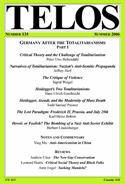 With the collapse of the Soviet Union and the end of the Cold War, a widespread rethinking of political history and social theory commenced. Questions long frozen in the glacial stand-off between East and West began to thaw out, and the ideological mythologies of the twentieth century were subjected to new scrutiny. Why had the century of modernity been so centrally catastrophic? What was the nature of the worst offenders, the totalitarian regimes—especially in Germany, Italy, and Russia—that had generated so much violence? How could intellectuals and public opinion alike have facilely regarded Nazi Germany and fascist Italy as nearly identical formations (when they displayed so many differences)? And how could Stalinist Russia have been hailed as a positive alternative to Nazi Germany (when they displayed so many similarities)? With the disappearance of the Soviet Union, these interrogations could be pursued without the agenda, baggage, and defensiveness of the previous historical era. The question of the totalitarian state could finally be posed with the advantage of historical distance.. With the collapse of the Soviet Union and the end of the Cold War, a widespread rethinking of political history and social theory commenced. Questions long frozen in the glacial stand-off between East and West began to thaw out, and the ideological mythologies of the twentieth century were subjected to new scrutiny. Why had the century of modernity been so centrally catastrophic? What was the nature of the worst offenders, the totalitarian regimes—especially in Germany, Italy, and Russia—that had generated so much violence? How could intellectuals and public opinion alike have facilely regarded Nazi Germany and fascist Italy as nearly identical formations (when they displayed so many differences)? And how could Stalinist Russia have been hailed as a positive alternative to Nazi Germany (when they displayed so many similarities)? With the disappearance of the Soviet Union, these interrogations could be pursued without the agenda, baggage, and defensiveness of the previous historical era. The question of the totalitarian state could finally be posed with the advantage of historical distance..
Continue reading →
|
|