The video of the third webinar in the Telos-Paul Piccone Institute’s “China Keywords” series is now available and can be viewed here. In this webinar, Eric Hendriks talks with Prof. Shadi Bartsch about the reception and use of ancient Greek philosophers in contemporary Chinese political thought.
Prof. Bartsch is the Helen A. Regenstein Distinguished Service Professor of Classics at the University of Chicago and the author and editor of a dozen books on Greek and Roman Antiquity. For her latest monograph on the reception of the ancient Greeks in China, she spent ten years studying Mandarin. The effort paid off: its fruit is Plato Goes to China: The Greek Classics and Chinese Nationalism (Princeton University Press, 2023).
Continue reading →
 The third webinar of the Telos-Paul Piccone Institute’s “China Keywords” series, entitled “The Greeks according to Chinese Nationalist Intellectuals,” will take place on Thursday, May 16, from 10:00 to 11:00 a.m. Eastern Time (16:00 to 17:00 Central European Time). Our guest will be Prof. Shadi Bartsch, who will discuss the reception and use of ancient Greek philosophers in contemporary Chinese political thought. Plato and Aristotle figure prominently in anti-Western polemics. The third webinar of the Telos-Paul Piccone Institute’s “China Keywords” series, entitled “The Greeks according to Chinese Nationalist Intellectuals,” will take place on Thursday, May 16, from 10:00 to 11:00 a.m. Eastern Time (16:00 to 17:00 Central European Time). Our guest will be Prof. Shadi Bartsch, who will discuss the reception and use of ancient Greek philosophers in contemporary Chinese political thought. Plato and Aristotle figure prominently in anti-Western polemics.
Click here to register for the webinar.
Continue reading →
Announcing a new Telos-Paul Piccone Institute webinar series, “China Keywords,” beginning Thursday, March 21, at 10 a.m. Eastern Time.
Register for the event here.
Tipping our hat to Keywords: A Vocabulary of Culture and Society, by Raymond Williams, the Telos-Paul Piccone Institute announces its newest webinar series: “China Keywords.” Each webinar will introduce and explore a single concept essential for understanding contemporary Chinese social and political theory. The series will illuminate these concepts with an eye toward non-specialists in the West, while also addressing deep contestations of interest to experts in the field. “China Keywords” is part of TPPI's larger Telos China Initiative.
Continue reading →
By David Pan · Friday, January 12, 2024 Telos 205 (Winter 2023): Forms of War is now available for purchase in our store. Individual subscriptions to Telos are also available in both print and online formats.
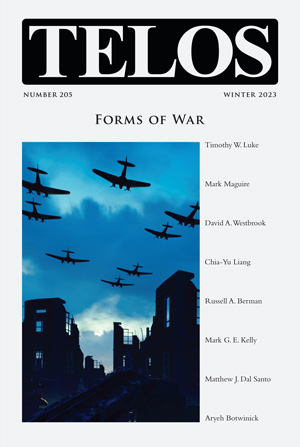 One of the most challenging aspects of the wars in Ukraine and Israel is the way in which the conflicts have been constantly shifting in form. In the first place, there is a conventional ground war between Russia and Ukraine, in which the identity and will of the two peoples are at stake. Yet Russia has used weapons supplied by Iran and North Korea, and Ukraine relies on NATO for its own supplies, indicating that this war depends on the maintenance and expansion of alliances. The stability of these alliances in turn depends on a combination of Realpolitik and shared values as the glue that holds them together. This logic of alliances motivates the energy war that Russia is waging with Europe, revealing that, unbeknownst to Europe, Russian energy policy over the last decade was an early form of the war. Similarly, the threat of nuclear war also tests the resolve of NATO, forcing it to consider the values at stake in the conflict. Is the war about Ukraine’s sovereignty or the principle of nation-state sovereignty itself? Is it about human rights for Ukrainians or the entire human rights project? For Russia, is it about self-defense or a pan-Slavic identity? Is it about the protection of Russian minorities in Ukraine or the threat of Western secularization? The answers to these questions will determine the will to fight on each side and thus the length and ferocity of the war. One of the most challenging aspects of the wars in Ukraine and Israel is the way in which the conflicts have been constantly shifting in form. In the first place, there is a conventional ground war between Russia and Ukraine, in which the identity and will of the two peoples are at stake. Yet Russia has used weapons supplied by Iran and North Korea, and Ukraine relies on NATO for its own supplies, indicating that this war depends on the maintenance and expansion of alliances. The stability of these alliances in turn depends on a combination of Realpolitik and shared values as the glue that holds them together. This logic of alliances motivates the energy war that Russia is waging with Europe, revealing that, unbeknownst to Europe, Russian energy policy over the last decade was an early form of the war. Similarly, the threat of nuclear war also tests the resolve of NATO, forcing it to consider the values at stake in the conflict. Is the war about Ukraine’s sovereignty or the principle of nation-state sovereignty itself? Is it about human rights for Ukrainians or the entire human rights project? For Russia, is it about self-defense or a pan-Slavic identity? Is it about the protection of Russian minorities in Ukraine or the threat of Western secularization? The answers to these questions will determine the will to fight on each side and thus the length and ferocity of the war.
Similarly, the war between Israel and Hamas began with Hamas’s use of terror and rape as instruments of war. The idea was to provoke Israel into attacking Hamas and causing civilian casualties. Because the terrain of war extends to public opinion in the West, Hamas’s use of Israeli hostages and Palestinian human shields becomes part of its strategy of increasing civilian casualties in the war. Even though Hamas is the ultimate cause of such casualties, Hamas is able to pressure Israel by placing civilians in the path of Israel’s war effort. The conflict on the ground in Gaza is thus overshadowed by the struggle for hearts and minds across the globe.
Continue reading →
By Telos Press · Wednesday, July 19, 2023 In today’s episode of the Telos Press Podcast, David Pan talks with Chih-yu Shih about his article “Loving Hong Kong: Unity and Solidarity in the Politics of Belonging,” from Telos 202 (Spring 2023). An excerpt of the article appears here. In their conversation they discuss why liberalism is based on universal love rather than universal rights; the relationship between a rights-based liberalism and communitarianism in the West; the difference between Western universal love and Confucian benevolent love; solidarity love and role-embedded love; the Confucian critique of universal love; the meaning of “One Country, Two Systems” in Hong Kong; how the idea of benevolent love affects the understanding of “One Country, Two Systems” in comparison with the liberal idea of it; the different interpretations, based on universal love and benevolent love, of the 2014 and 2019 protests in Hong Kong; the links between benevolent love and stability and prosperity and between universal love with autonomy and political rights, and why there is a conflict between these two sets of goals. If your university has an online subscription to Telos, you can read the full article at the Telos Online website. For non-subscribers, learn how your university can begin a subscription to Telos at our library recommendation page. Print copies of Telos 202 are available for purchase in our online store.
Continue reading →
By Telos Press · Monday, April 3, 2023 In today’s episode of the Telos Press Podcast, David Pan talks with Miles Yu about his article “Escape from Civilization’s Predicaments,” from Telos 201 (Winter 2022). An excerpt of the article appears here. In their conversation they discuss the main problems with using the idea of civilization as a way of understanding today’s geopolitical conflicts; the meaning of ideology and its effect on politics; why it is more important to think of ideology than of civilization as a way of understanding politics; how the inability of Americans to see the importance of ideology in the world has affected U.S. foreign policy; what kind of foreign policy would emerge out of the focus on ideology; why Marxism as an ideology has maintained its appeal both for countries such as China and for U.S. intellectuals; and what strategies the United States has in this ideological conflict. If your university has an online subscription to Telos, you can read the full article at the Telos Online website. For non-subscribers, learn how your university can begin a subscription to Telos at our library recommendation page. Print copies of Telos 201 are available for purchase in our online store.
Continue reading →
|
|