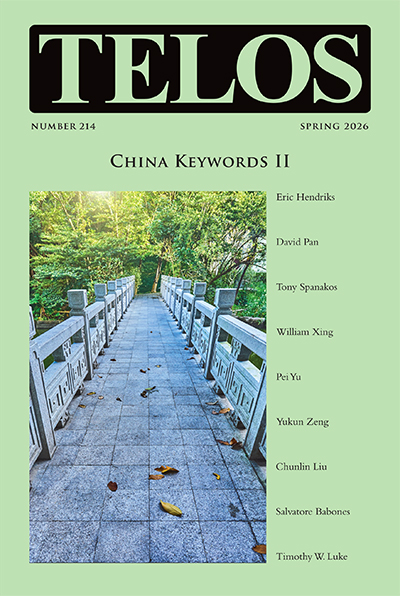
By Eric Hendriks and David Pan · Friday, April 3, 2026 Telos 214 (Spring 2026): China Keywords II is now available for purchase in our store. Individual subscriptions to Telos are also available in both print and online formats.
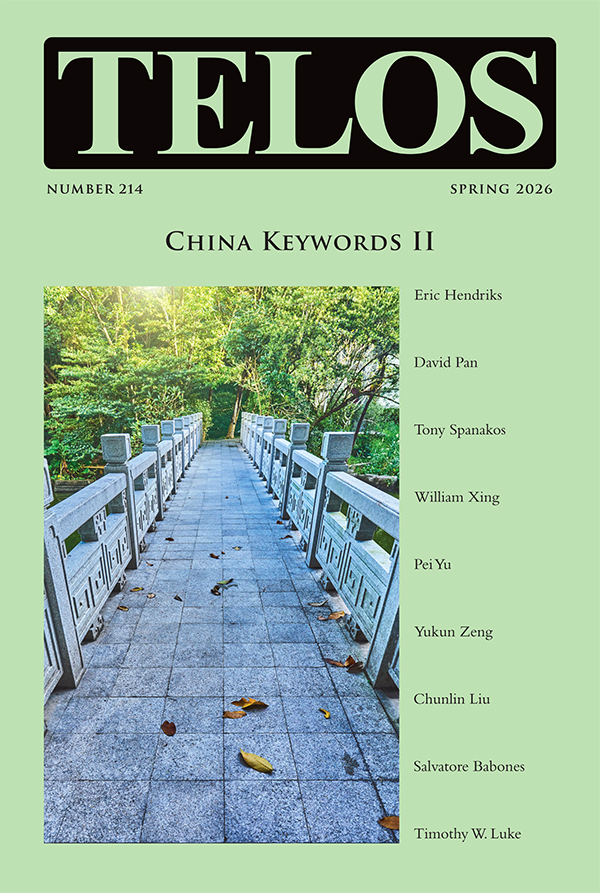 Modern China emerged through the struggle with the customs and traditions of imperial China. This struggle continues in present-day attempts to think through how earlier customs, on the one hand, remain active in Chinese culture and, on the other, have been transformed by China’s modernization. And then there are the customs that have been cut off by modernity; to what extent and in which ways can or should they be revived? Modern China emerged through the struggle with the customs and traditions of imperial China. This struggle continues in present-day attempts to think through how earlier customs, on the one hand, remain active in Chinese culture and, on the other, have been transformed by China’s modernization. And then there are the customs that have been cut off by modernity; to what extent and in which ways can or should they be revived?
The central challenge is that China has undergone spectacular political and social transformations over the past century, meaning that older ideas and customs must now operate within an entirely new sociopolitical context. Consider how different the political imagination was in imperial (neo-)Confucian China, which placed the imperial court at the center of the cosmos. Before the late nineteenth and early twentieth centuries, China saw itself as Zhongguo (中国) or Zhonghua (中华), meaning the “Middle Kingdom” and the “central civilization,” respectively. Thus, far from conceiving itself as merely one country among others, it imagined itself as the morality-carrying center of the tianxia (天下), “all under heaven,” which could only be harmoniously ordered if its Chinese center itself was properly ordered.
Continue reading →
By Eric Hendriks and David Pan · Tuesday, December 30, 2025 Telos 213 (Winter 2025): China Keywords I is now available for purchase in our store. Individual subscriptions to Telos are also available in both print and online formats.
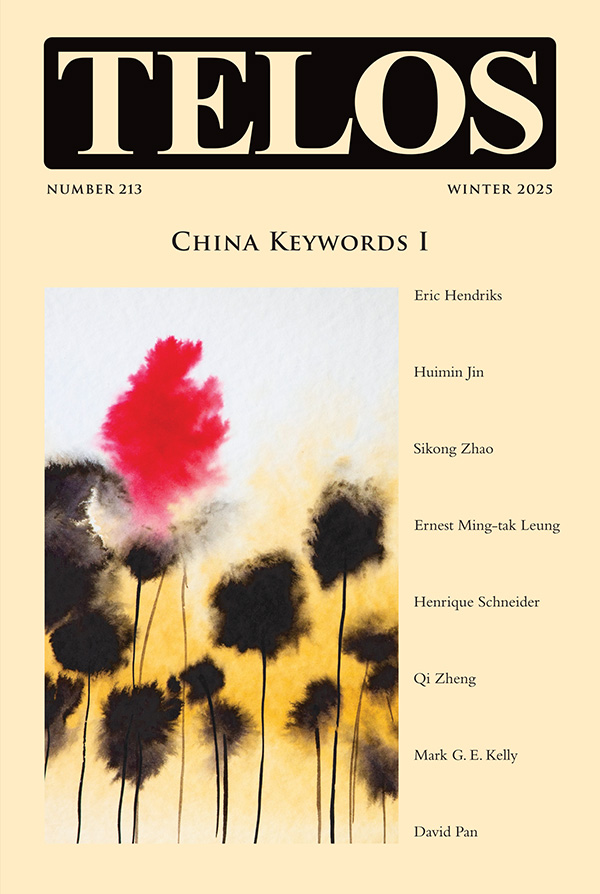 China saturates Western media and academic discourse, invoked incessantly as a force remaking the world, while the political and social-theoretical ideas through which China thinks, judges, and interprets that world remain largely unheard. Western discourses on China exhibit a persistent tendency toward objectification and reification. Chinese phenomena figure as objects of analysis, yet such analyses rarely delve into their subjective-interpretative depth. Were they to do so, they would encounter these “objects” as subjects who actively make sense of their worlds, carrying ideas, ideals, and self-conceptions embedded in distinct interpretive traditions. At the same time, Western media and academics are often unaware that their own views are actively influenced by the Chinese Communist Party (CCP), which spends $10 billion per year on international propaganda efforts that include advertising, news production, and social media campaigns. China saturates Western media and academic discourse, invoked incessantly as a force remaking the world, while the political and social-theoretical ideas through which China thinks, judges, and interprets that world remain largely unheard. Western discourses on China exhibit a persistent tendency toward objectification and reification. Chinese phenomena figure as objects of analysis, yet such analyses rarely delve into their subjective-interpretative depth. Were they to do so, they would encounter these “objects” as subjects who actively make sense of their worlds, carrying ideas, ideals, and self-conceptions embedded in distinct interpretive traditions. At the same time, Western media and academics are often unaware that their own views are actively influenced by the Chinese Communist Party (CCP), which spends $10 billion per year on international propaganda efforts that include advertising, news production, and social media campaigns.
Continue reading →
By David Pan · Monday, June 30, 2025 Telos 211 (Summer 2025): Dispatches from the Culture Wars is now available for purchase in our store. Individual subscriptions to Telos are also available in both print and online formats.
 As we survey the landscape of war today, it has become truer than ever that hot wars are a consequence of culture wars. Trump’s support for Israel against Iran contrasts with the discourse on college campuses that opposes Israel as a white supremacist, settler-colonial state. In opposing the most egalitarian liberal democracy in the Middle East, this left-wing perspective poses a major threat to the liberal values that the United States has always stood for. But the anti-Israel protests at colleges represent only the tip of the iceberg of a more widespread form of hierarchical rule that has established itself globally through a “new class” of managers. Looked at in this way, the culture war at U.S. universities will have far-reaching consequences for the future of the world. At stake are not merely research funding and tax breaks, but a social structure that privileges expert opinion over popular rule in all areas of our society. Colleges and universities are the key to this system, as the social sciences train the professionals that go on to manage the lives of the uncredentialed, while the humanities develop the perspectives that justify this form of managerial rule. In this issue of Telos, we consider how today’s culture wars over universities will shape the global future. As we survey the landscape of war today, it has become truer than ever that hot wars are a consequence of culture wars. Trump’s support for Israel against Iran contrasts with the discourse on college campuses that opposes Israel as a white supremacist, settler-colonial state. In opposing the most egalitarian liberal democracy in the Middle East, this left-wing perspective poses a major threat to the liberal values that the United States has always stood for. But the anti-Israel protests at colleges represent only the tip of the iceberg of a more widespread form of hierarchical rule that has established itself globally through a “new class” of managers. Looked at in this way, the culture war at U.S. universities will have far-reaching consequences for the future of the world. At stake are not merely research funding and tax breaks, but a social structure that privileges expert opinion over popular rule in all areas of our society. Colleges and universities are the key to this system, as the social sciences train the professionals that go on to manage the lives of the uncredentialed, while the humanities develop the perspectives that justify this form of managerial rule. In this issue of Telos, we consider how today’s culture wars over universities will shape the global future.
Continue reading →
By David Pan · Monday, March 24, 2025 Telos 210 (Spring 2025): Rethinking State Power is now available for purchase in our store. Individual subscriptions to Telos are also available in both print and online formats.
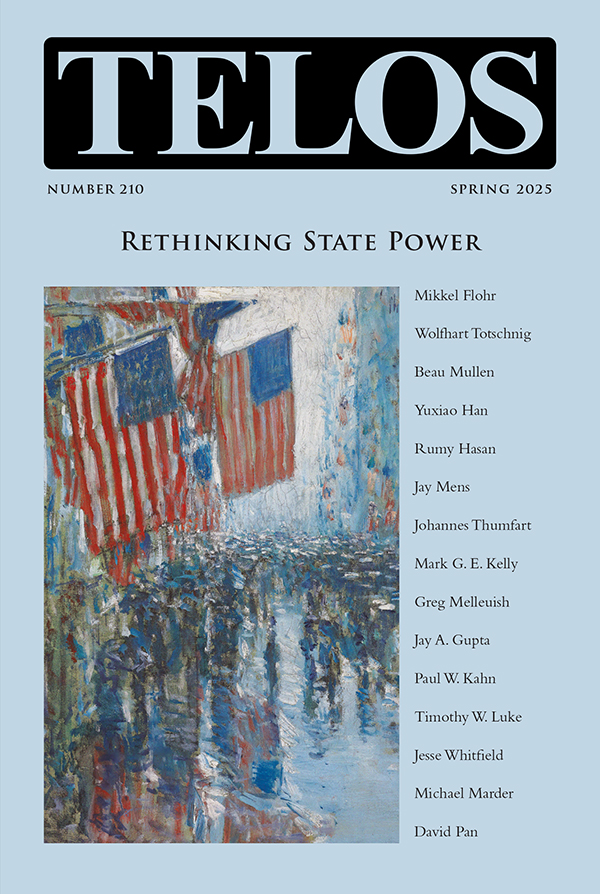 Frustrating the hopes of cosmopolitans and globalists, state power is back. Rather than imagining a replacement of sovereignty with law, political debates now revolve around the particular forms that state sovereignty might take. Even Europe, long seeing itself as the place from which a new international legal order might expand its reach, is reinvesting in military power to protect its sovereignty from the threats posed by Russia, China, and, in some ways, the United States. Yet this realization about the continuing centrality of the state does not mean an abandonment of the moral imperatives and prejudices of the people. On the contrary, state power is being recognized as the instrument through which the people can exercise their will, even as the state places constraints on popular sovereignty. The essays in this issue of Telos consider the ways in which state power interacts with popular attitudes and social institutions in order to establish the basis for sovereignty and law. Frustrating the hopes of cosmopolitans and globalists, state power is back. Rather than imagining a replacement of sovereignty with law, political debates now revolve around the particular forms that state sovereignty might take. Even Europe, long seeing itself as the place from which a new international legal order might expand its reach, is reinvesting in military power to protect its sovereignty from the threats posed by Russia, China, and, in some ways, the United States. Yet this realization about the continuing centrality of the state does not mean an abandonment of the moral imperatives and prejudices of the people. On the contrary, state power is being recognized as the instrument through which the people can exercise their will, even as the state places constraints on popular sovereignty. The essays in this issue of Telos consider the ways in which state power interacts with popular attitudes and social institutions in order to establish the basis for sovereignty and law.
Continue reading →
By David Pan · Monday, January 6, 2025 Telos 209 (Winter 2024): Democracy Today? is now available for purchase in our store. Individual subscriptions to Telos are also available in both print and online formats.
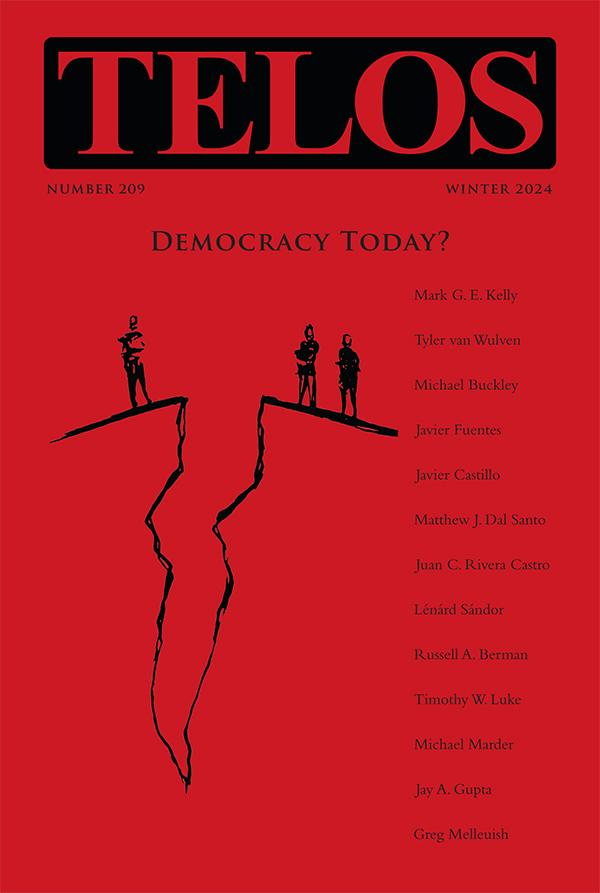 Since the supposed triumph of liberal democracy with the end of the Cold War, democracy seems now to be in retreat. The hung parliaments in France and Germany, reminiscent of the divides of Germany’s Weimar Republic; the just-in-time reversal of the declaration of martial law in South Korea; the increasing authoritarianism of China, Iran, and Russia; and the deterioration of democratic norms in the United States are all indications that the liberal democratic end of history was a chimera. Since the supposed triumph of liberal democracy with the end of the Cold War, democracy seems now to be in retreat. The hung parliaments in France and Germany, reminiscent of the divides of Germany’s Weimar Republic; the just-in-time reversal of the declaration of martial law in South Korea; the increasing authoritarianism of China, Iran, and Russia; and the deterioration of democratic norms in the United States are all indications that the liberal democratic end of history was a chimera.
What is the situation of democracy today? Are the present problems simply growing pains in the inevitable march of history, or are there fundamental limitations of this political form? Is democracy a stable form of government or a delicate balancing act that will always be at risk of deteriorating and being replaced by some form of authoritarianism?
These current indications of the precarity of democracy also coincide, however, with an intense concern for its future. Never has there been such a focus on democracy as a political goal. During the Cold War, the United States, more concerned about promoting capitalism than defending democracy, supported capitalist authoritarianism in places such as Chile, South Korea, and Taiwan. But as it turned out, capitalism did not really need such political backing. In the Cold War between capitalism and communism, the latter lost based on its inability to produce economic growth. Insofar as communism’s undermining of private property and market mechanisms proved to be economically catastrophic, even nominally communist governments in China and Vietnam have since voluntarily embraced capitalist economic policies. Aside from U.S. college campuses, the only diehard Marxists left are in Cuba, North Korea, and Venezuela, all of whose governments are presiding over the immiseration of their peoples.
While it was the Soviet Union, and not capitalism, that collapsed under the weight of its own contradictions, the general recognition of these contradictions meant that communism could only maintain itself by using repressive methods. Communism has been one of the surest ways of moving toward and cementing authoritarianism and totalitarianism. By contrast, capitalist authoritarianism has sometimes led to democratic reforms, and we can point again to Chile, South Korea, and Taiwan, but also to the countries of Eastern Europe, as successful transitioners to democracy within a capitalist framework. Unfortunately, while communism might correlate strongly with authoritarianism, the link between capitalism and democracy does not seem to be so tight.
Continue reading →
By David Pan · Friday, July 12, 2024 Telos 207 (Summer 2024): Politics and the University is now available for purchase in our store. Individual subscriptions to Telos are also available in both print and online formats.
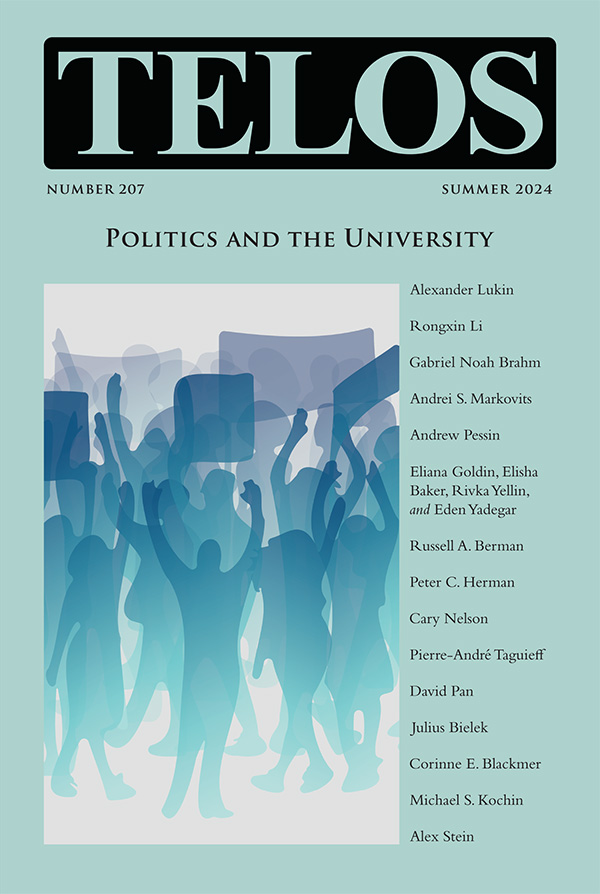 There is a fundamental arbitrariness about the work that is done at colleges and universities, which stems from the relationship between academic work and the political parameters of this work. The key issue is that the most basic aspect of our humanity involves having a sense of right and wrong. This sense of values sets the framework for all our other thoughts, actions, and decisions, providing direction and meaning for our lives. There is a fundamental arbitrariness about the work that is done at colleges and universities, which stems from the relationship between academic work and the political parameters of this work. The key issue is that the most basic aspect of our humanity involves having a sense of right and wrong. This sense of values sets the framework for all our other thoughts, actions, and decisions, providing direction and meaning for our lives.
The feeling that we are doing the right thing can motivate us to great achievements, and the loss of that feeling can lead us into inescapable despair. At the same time, when we perceive that others are doing wrong, we have a feeling of indignation at such injustice and seek to redress it. We will also judge the wrong doer in the same harsh light that we might use against ourselves when we fail to live up to our own ideals. Consequently, our sense of values will color all our perceptions and determine our decisions and judgments.
Continue reading →
|
|