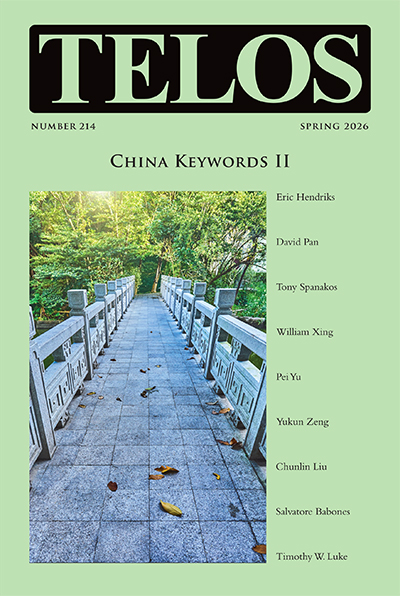
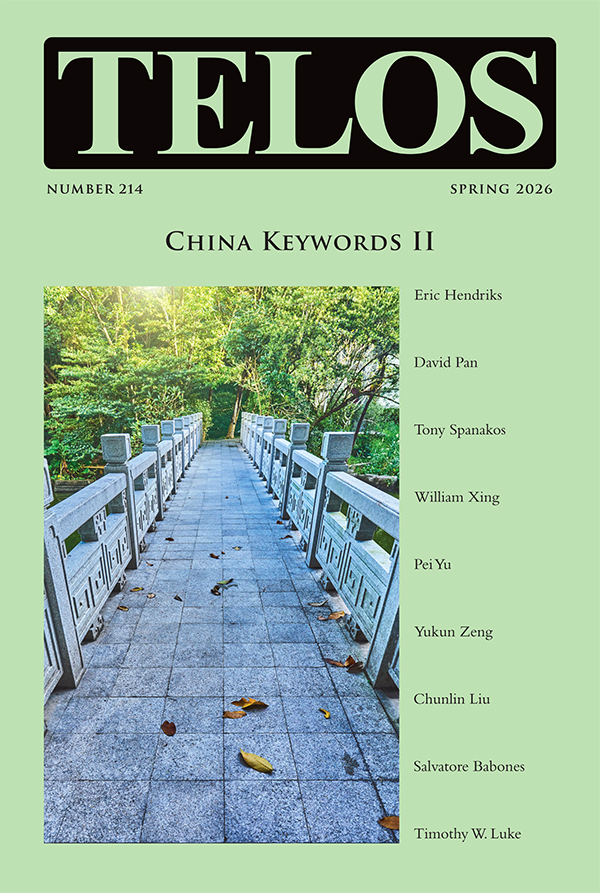
By Eric Hendriks and David Pan · Friday, April 3, 2026 Telos 214 (Spring 2026): China Keywords II is now available for purchase in our store. Individual subscriptions to Telos are also available in both print and online formats.
 Modern China emerged through the struggle with the customs and traditions of imperial China. This struggle continues in present-day attempts to think through how earlier customs, on the one hand, remain active in Chinese culture and, on the other, have been transformed by China’s modernization. And then there are the customs that have been cut off by modernity; to what extent and in which ways can or should they be revived? Modern China emerged through the struggle with the customs and traditions of imperial China. This struggle continues in present-day attempts to think through how earlier customs, on the one hand, remain active in Chinese culture and, on the other, have been transformed by China’s modernization. And then there are the customs that have been cut off by modernity; to what extent and in which ways can or should they be revived?
The central challenge is that China has undergone spectacular political and social transformations over the past century, meaning that older ideas and customs must now operate within an entirely new sociopolitical context. Consider how different the political imagination was in imperial (neo-)Confucian China, which placed the imperial court at the center of the cosmos. Before the late nineteenth and early twentieth centuries, China saw itself as Zhongguo (中国) or Zhonghua (中华), meaning the “Middle Kingdom” and the “central civilization,” respectively. Thus, far from conceiving itself as merely one country among others, it imagined itself as the morality-carrying center of the tianxia (天下), “all under heaven,” which could only be harmoniously ordered if its Chinese center itself was properly ordered.
Continue reading →
By Eric Hendriks and David Pan · Tuesday, December 30, 2025 Telos 213 (Winter 2025): China Keywords I is now available for purchase in our store. Individual subscriptions to Telos are also available in both print and online formats.
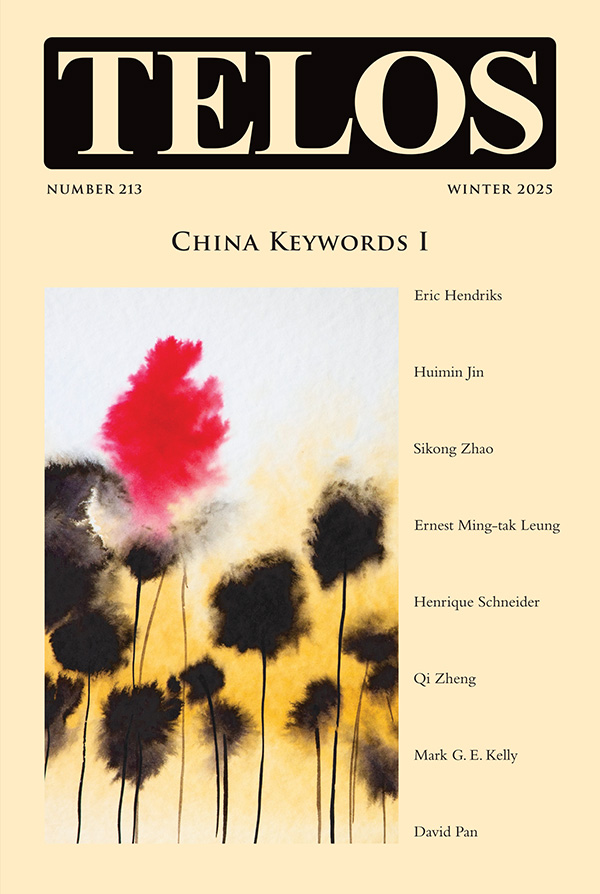 China saturates Western media and academic discourse, invoked incessantly as a force remaking the world, while the political and social-theoretical ideas through which China thinks, judges, and interprets that world remain largely unheard. Western discourses on China exhibit a persistent tendency toward objectification and reification. Chinese phenomena figure as objects of analysis, yet such analyses rarely delve into their subjective-interpretative depth. Were they to do so, they would encounter these “objects” as subjects who actively make sense of their worlds, carrying ideas, ideals, and self-conceptions embedded in distinct interpretive traditions. At the same time, Western media and academics are often unaware that their own views are actively influenced by the Chinese Communist Party (CCP), which spends $10 billion per year on international propaganda efforts that include advertising, news production, and social media campaigns. China saturates Western media and academic discourse, invoked incessantly as a force remaking the world, while the political and social-theoretical ideas through which China thinks, judges, and interprets that world remain largely unheard. Western discourses on China exhibit a persistent tendency toward objectification and reification. Chinese phenomena figure as objects of analysis, yet such analyses rarely delve into their subjective-interpretative depth. Were they to do so, they would encounter these “objects” as subjects who actively make sense of their worlds, carrying ideas, ideals, and self-conceptions embedded in distinct interpretive traditions. At the same time, Western media and academics are often unaware that their own views are actively influenced by the Chinese Communist Party (CCP), which spends $10 billion per year on international propaganda efforts that include advertising, news production, and social media campaigns.
Continue reading →
By Russell A. Berman · Wednesday, July 17, 2024 The following comments refer to the interview with Michael Wolffsohn that appeared in the Frankfurter Allgemeine Zeitung on July 8, 2024. The interview is published in English translation on TelosScope here.
 October 7 and its aftermath are matters primarily concerning regional security in the Middle East, including Israeli national security, the status of the Palestinians, but ultimately the root cause, Iranian hegemonic ambitions and Tehran’s hostility to the United States. But October 7 has simultaneously unleashed a revival of antisemitism across the West, and often enough especially in the universities in the form of a pernicious left-wing antisemitism. Telos and the Telos-Paul Piccone Institute have devoted considerable attention to this phenomenon. October 7 and its aftermath are matters primarily concerning regional security in the Middle East, including Israeli national security, the status of the Palestinians, but ultimately the root cause, Iranian hegemonic ambitions and Tehran’s hostility to the United States. But October 7 has simultaneously unleashed a revival of antisemitism across the West, and often enough especially in the universities in the form of a pernicious left-wing antisemitism. Telos and the Telos-Paul Piccone Institute have devoted considerable attention to this phenomenon.
Academic antisemitism is not fully congruent with antisemitism in other social sectors. What happens at Columbia is not exactly the same as what transpired notoriously at Charlottesville, but it would be foolish to deny the unmistakable affinities in the varieties of antisemitism. In the same vein, it is important to keep in mind differences between national settings, but comparative reflections can help tease out important strands common across current manifestations of antisemitism. National particularity in this matter is most salient for Germany, given the shadow of the Holocaust. Germany also incubated a far left that pursued a radically anti-Israel politics at least since the 1960s, and Germany more recently welcomed large numbers of refugees from the Middle East, countries where antisemitic views are widespread. At the same time, however, Germany, especially since the fall of the Berlin Wall and the subsequent unification, has witnessed the growth of a vibrant Jewish community. This combination of heterogeneous factors makes the German situation deserving of particular attention.
Continue reading →
The video of the seventh webinar in the Telos-Paul Piccone Institute’s Israel Initiative is now available and can be viewed here. Titled “Online Antisemitism after October 7,” the panel featured Matthias J. Becker, who discussed “Antisemitism after October 7: Insights from Social Media Studies,” and Günther Jikeli, who addressed “Antisemitic Mobilization across Ideological Borders through Social Media.” Their conversation was moderated by Israel Initiative director Gabriel Noah Brahm.
Continue reading →
The video of the sixth webinar in the Telos-Paul Piccone Institute’s Israel Initiative is now available and can be viewed here. Titled “Free Speech and Campus Antisemitism: Academic Freedom, to What End?,” the panel featured Michael S. Kochin, Geoff Shullenberger, and Jacob Siegel, and their conversation was moderated by Israel Initiative director Gabriel Noah Brahm.
The next webinar in the Israel webinar series will take place on July 7.
Continue reading →
In the latest episode of the Telos-Paul Piccone Institute podcast, Gabriel Noah Brahm, director of TPPI’s Israel Initiative, talks with German political scientist Dr. Matthias Küntzel about the Nazi roots of the Hamas atrocities of October 7, 2023, and about the dangers posed today by Iran. This conversation follows TPPI’s webinar of February 7, 2024, “Historians on Ideology and Politics in the 1948 War,” with Küntzel, Jeffrey Herf, and Benny Morris. The podcast is available in both video and audio-only formats.
Küntzel’s books Germany and Iran: From the Aryan Axis to the Nuclear Threshold and Jihad and Jew-Hatred: Islamism, Nazism and the Roots of 9/11 are available in the Telos Press store.
Continue reading →
|
|