By Paul Grenier · Friday, September 7, 2018 Are the divisions that fragment the United States primarily driven by some deep flaw in its political life, or was the United States doing just fine, thank you very much—until Russia came along during the 2016 presidential race and started sowing division and dissension?
Framed that way, the question answers itself. Whatever some state-sanctioned Russian actors may have done to pester the American political process, it is obvious that America’s deep divisions exist for reasons having essentially nothing to do with Russia. They long precede the last election.
Even if Russia’s interventions into American electoral politics turn out to be more significant than they presently appear, this cannot change the more fundamental reality that our confrontational posture, including vis-à-vis Russia, is by no means something external to the United States’ Lockean liberal political concept.
Continue reading →
By Matthias Küntzel · Wednesday, May 16, 2018 Matthias Küntzel’s book Germany and Iran: From the Aryan Axis to the Nuclear Threshold is available for purchase in our online store. Save 20% on the list price by using the coupon code BOOKS20 during checkout. Also available in Kindle format from Amazon.com.
On May 8, 2018, when U.S. President Donald Trump spoke to the press to make the case for the U.S. decision to leave the nuclear deal with Iran, he stated: “America will not be held hostage to nuclear blackmail.” With this sentence, Trump initiated a new phase to diplomacy with Iran. Up to this point, nuclear blackmail, the threat that Iran would otherwise build a bomb, had defined and shaped the dynamic of negotiations. This worst case hung like a sword of Damocles over the actors. In order to avert it and in order to secure the nuclear deal, Obama refused to support the Iranian protest movement in 2009, just as in 2013 he refused to make good on the red line he had drawn in the Syrian war.
Continue reading →
By Rufus Burrow, Jr. · Monday, April 23, 2018 Rufus Burrow, Jr.’s “Martin Luther King, Jr., and Ethical Leadership” appears in Telos 182 (Spring 2018), a special issue commemorating the life and thought of Martin Luther King, Jr. Read the full article at the Telos Online website, or purchase a print copy of the issue in our online store. Individual subscriptions to Telos are now available in both print and online formats.
James MacGregor Burns, a pioneer in leadership theory, was certain that many people lack clarity about the meaning and place of leadership. “The confusion,” he said, “will continue as long as we fail to distinguish leadership from brute power, leadership from propaganda, leadership from manipulation, leadership from pandering, leadership from coercion.” What we have seen during and after the 2016 presidential election cycle in the United States is evidence of this ambiguity and confusion. In addition, political operatives and other presumed leaders fail to exhibit integrity, character, civility, courage, and a sense of obligation to the highest and best values. Instead, what we see persistently, particularly in the Donald J. Trump presidency, are efforts to cater to the worst in citizens, especially uneducated, unemployed, and underemployed white working-class people. For a long time I have wondered whether a study of Martin Luther King, Jr., (1929–1968) might reveal important lessons about the nature and meaning of leadership, leadership that reasonable people eagerly follow. This essay seeks to clarify how King understood leadership.
Continue reading →
By Harriett Jernigan · Wednesday, April 4, 2018 Harriett Jernigan’s “‘Is there something wrong with that?’: The Transculturation of Martin Luther King, Jr., Schools in Germany” appears in Telos 182 (Spring 2018), a special issue commemorating the life and thought of Martin Luther King, Jr. Read the full article at the Telos Online website, or purchase a print copy of the issue in our online store. Individual subscriptions to Telos are now available in both print and online formats.
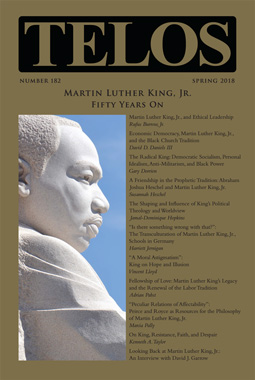 While it is common knowledge that a number of elementary, middle, and high schools in the United States are named after Martin Luther King, Jr., few people know that the Federal Republic of Germany is also home to a significant number of schools named in honor of him as well. The differences between American and German school systems, in particular the manner in which children are placed in special-needs schools in Germany, prompt a transculturation of the symbolic value of Martin Luther King, Jr., as the schools’ mission statements reflect. Although both American and German MLK schools are generally conspicuously diverse and underscore the importance of equality and diversity, their priorities diverge thereafter, with American MLK schools emphasizing academic preparation for upward mobility and global citizenship, and German MLK schools nonviolence and local integration, a divergence that arises partially from the priority German Leitkultur places on German-language proficiency. While it is common knowledge that a number of elementary, middle, and high schools in the United States are named after Martin Luther King, Jr., few people know that the Federal Republic of Germany is also home to a significant number of schools named in honor of him as well. The differences between American and German school systems, in particular the manner in which children are placed in special-needs schools in Germany, prompt a transculturation of the symbolic value of Martin Luther King, Jr., as the schools’ mission statements reflect. Although both American and German MLK schools are generally conspicuously diverse and underscore the importance of equality and diversity, their priorities diverge thereafter, with American MLK schools emphasizing academic preparation for upward mobility and global citizenship, and German MLK schools nonviolence and local integration, a divergence that arises partially from the priority German Leitkultur places on German-language proficiency.
Continue reading →
By Mitchell Dean · Tuesday, March 27, 2018 It is difficult to know what constitutes the latest social media “scandal” for the news organizations that promote it as such. Of course, it follows the seemingly unending political concerns around social and digital media since the election of President Trump and other cornerstone events such as the Brexit vote. It stands in the long line of concerns about email hacking, Russian “meddling,” “fake news,” undignified presidential tweeting, and bots, and the indictments of workers of a Russian internet agency. There is the more general, but somewhat vacuous, thesis that the “politics of truth” has been replaced by a “politics of untruth.” Within this framing, there is the sense that “democracy” is under attack through social media; that populists, the “alt-right,” shady billionaire donors, foreign authoritarians and nativist Svengalis have found secret pathways to sow discontent within Western democracies and tip elections and plebiscites to previously unconscionable leaders and unimaginable outcomes.
Continue reading →
By Kenneth D. Johnson · Monday, March 19, 2018 Telos 182 (Spring 2018), a special issue commemorating the life and thought of Martin Luther King, Jr., is now available for purchase in our store.
1968 was a tough year for the United States and for many around the world. The Tet Offensive in Vietnam started in January, and the My Lai massacre occurred there in March. In Paris, the student uprising started in May. The Prague Spring, during which Czechoslovakian activists sought a measure of greater freedom for their country from the Soviet Union, was crushed by Warsaw Pact military forces in August. Police rioted at the Democratic National Convention in Chicago in August, beating student protestors indiscriminately in the streets. The Weather Underground emerged in October, and black American sprinters Tommie Smith and John Carlos gave their gloved Black Power salute as a protest during the Mexico City Olympics that same month. Richard M. Nixon was elected as president in November. And, there were two pivotal deaths: Robert F. Kennedy in June, and Reverend King in April. After King’s assassination, many U.S. cities erupted in flames as their African American residents protested his killing and the moribund state of civil rights progress at the time of King’s death.
Continue reading →
|
|