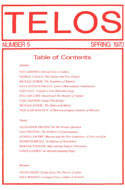
By Yonathan Listik · Tuesday, November 27, 2012 As an occasional feature on TELOSscope, we highlight a past Telos article whose critical insights continue to illuminate our thinking and challenge our assumptions. Today, Yonathan Listik looks at Georg Lukács’s “The Old Culture and the New Culture” from Telos 5 (Spring 1970).
 It would be simplistic to argue that behind the Marxist critiques of capitalist society there was only an objective intention simply to improve its effectiveness and avoid the political complications found in capitalist society. Despite its strict scientific tone, Marxism still carries a heavily moral intention. This is what Georg Lukács comes to argue in this essay on culture. In his analysis of capitalist cultural structure and its many differences from capitalist reality, Lukács points to what he regards as the ultimate goal behind communism: a new cultural order. It would be simplistic to argue that behind the Marxist critiques of capitalist society there was only an objective intention simply to improve its effectiveness and avoid the political complications found in capitalist society. Despite its strict scientific tone, Marxism still carries a heavily moral intention. This is what Georg Lukács comes to argue in this essay on culture. In his analysis of capitalist cultural structure and its many differences from capitalist reality, Lukács points to what he regards as the ultimate goal behind communism: a new cultural order.
Continue reading →
By Sevgi Doğan · Monday, November 26, 2012 This paper was presented at Telos in Europe: The L’Aquila Conference, held on September 7-9, 2012, in L’Aquila, Italy.
 The argument of this paper is inspired by the actual problem of the individual in the modern state, in other words, the relationship between the political life and the individual, or the relation of the individual with politics. The thesis would claim that the individual as one of the fundamental features of modern times does not exist—or is not considered—as political agent although the modern political institution is based on the existence of the individual with its economic, social, and political rights. In this context, the individual exists only as consumer both for him/herself and for another (capitalist) and as a producer for another (capitalist) but not as a creator for him/herself. Marx talks about the production and consumption dialectic in the “Introduction” to Grundrisse (1858, published 1939). In this context a brief survey is presented here of some well-known early writings of Marx in an effort to outline how this dialectic is revealed for the difference between Marx’s and Hegel’s philosophical perspectives of the individual existence. The statement claiming that Marx does not discuss the concept of individual as Hegel does is a delusion. The argument of this paper is inspired by the actual problem of the individual in the modern state, in other words, the relationship between the political life and the individual, or the relation of the individual with politics. The thesis would claim that the individual as one of the fundamental features of modern times does not exist—or is not considered—as political agent although the modern political institution is based on the existence of the individual with its economic, social, and political rights. In this context, the individual exists only as consumer both for him/herself and for another (capitalist) and as a producer for another (capitalist) but not as a creator for him/herself. Marx talks about the production and consumption dialectic in the “Introduction” to Grundrisse (1858, published 1939). In this context a brief survey is presented here of some well-known early writings of Marx in an effort to outline how this dialectic is revealed for the difference between Marx’s and Hegel’s philosophical perspectives of the individual existence. The statement claiming that Marx does not discuss the concept of individual as Hegel does is a delusion.
Continue reading →
By Maja Sidzinska · Tuesday, November 20, 2012 As an occasional feature on TELOSscope, we highlight a past Telos article whose critical insights continue to illuminate our thinking and challenge our assumptions. Today, Maja Sidzinska looks at Joan Landes’s “Feminism and the Internationals” from Telos 49 (Fall 1981).
 Although 2012 is being hailed as the new Year of the Woman and women’s votes were solicited and cited as pivotal to the outcome of the U.S. presidential election, Joan Landes’s 1981 article “Feminism and the Internationals” provides a timely reminder about the strategic ways that women’s and feminist movements have been deployed in service of political agendas in body politics past. Landes illustrates the historical subordination of women’s and feminist concerns in socialist paradigms and states, shows that the personal was treated as apolitical, and alludes to male epistemic authority as begetting these developments. From the vantage point of Marxist socialism, the problem with feminism is that it undermines the unified class struggle by introducing a competing concern—gender—that threatens the cohesion of the socialist movement. Although 2012 is being hailed as the new Year of the Woman and women’s votes were solicited and cited as pivotal to the outcome of the U.S. presidential election, Joan Landes’s 1981 article “Feminism and the Internationals” provides a timely reminder about the strategic ways that women’s and feminist movements have been deployed in service of political agendas in body politics past. Landes illustrates the historical subordination of women’s and feminist concerns in socialist paradigms and states, shows that the personal was treated as apolitical, and alludes to male epistemic authority as begetting these developments. From the vantage point of Marxist socialism, the problem with feminism is that it undermines the unified class struggle by introducing a competing concern—gender—that threatens the cohesion of the socialist movement.
Continue reading →
By Kyle Gingerich Hiebert · Monday, October 29, 2012 Kyle Gingerich Hiebert’s “The Architectonics of Hope: Apocalyptic Convergences and Constellations of Violence in Carl Schmitt and Johann Baptist Metz” appears in Telos 160 (Fall 2012). Read the full version online at the Telos Online website, or purchase a print copy of the issue here.
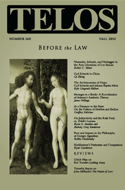 This essay traces the apocalyptic re-emergence of political theology in late modernity in the work of the jurist Carl Schmitt and the theologian Johann Baptist Metz. Broadly speaking, the intellectual fault line between these two German Catholics can be provisionally drawn with reference to Hegel. On the one hand, Schmitt¹s lineage can be traced back through the conservative Catholic political philosophers of the counterrevolution (Bonald, de Maistre, and Cortés) to what amounts to, in very broad strokes, a political theology of the Hegelian Right. On the other hand, Metz¹s sympathies in his development of the new political theology clearly lie with the revisionary Marxists of the Frankfurt School (Adorno, Benjamin, and Bloch), which binds his intellectual heritage, again in very broad strokes, to the Hegelian Left. This way of putting the matter quite easily lends itself to interpretations that argue the relationship between Schmitt and Metz is straightforwardly oppositional. While perhaps conceptually useful, I argue that any easy conservative/critical dichotomy here obscures as much as it illuminates because it proffers too undifferentiated an account of the interrelationship between Schmitt and Metz. Alternatively, I suggest that the apocalyptic tone that infuses their respective accounts of political theology is the most adequate key for understanding how they function as different expressions of what I call an architectonics of hope; a reconfiguration of political theology that is structural in nature, animated by a thoroughly negative theological anthropology and that tragically acquiesces to the ongoing necessity of violence. In the end, then, Schmitt and Metz stand much closer to each other than currently realized. This essay traces the apocalyptic re-emergence of political theology in late modernity in the work of the jurist Carl Schmitt and the theologian Johann Baptist Metz. Broadly speaking, the intellectual fault line between these two German Catholics can be provisionally drawn with reference to Hegel. On the one hand, Schmitt¹s lineage can be traced back through the conservative Catholic political philosophers of the counterrevolution (Bonald, de Maistre, and Cortés) to what amounts to, in very broad strokes, a political theology of the Hegelian Right. On the other hand, Metz¹s sympathies in his development of the new political theology clearly lie with the revisionary Marxists of the Frankfurt School (Adorno, Benjamin, and Bloch), which binds his intellectual heritage, again in very broad strokes, to the Hegelian Left. This way of putting the matter quite easily lends itself to interpretations that argue the relationship between Schmitt and Metz is straightforwardly oppositional. While perhaps conceptually useful, I argue that any easy conservative/critical dichotomy here obscures as much as it illuminates because it proffers too undifferentiated an account of the interrelationship between Schmitt and Metz. Alternatively, I suggest that the apocalyptic tone that infuses their respective accounts of political theology is the most adequate key for understanding how they function as different expressions of what I call an architectonics of hope; a reconfiguration of political theology that is structural in nature, animated by a thoroughly negative theological anthropology and that tragically acquiesces to the ongoing necessity of violence. In the end, then, Schmitt and Metz stand much closer to each other than currently realized.
Continue reading →
By Geoffrey Holsclaw · Thursday, October 25, 2012 Geoffrey Holsclaw’s “At a Distance to the State: On the Politics of Hobbes and Badiou” appears in Telos 160 (Fall 2012). Read the full version online at the Telos Online website, or purchase a print copy of the issue here.
Amid the contested status of the State, juxtaposing the political thought of Thomas Hobbes and Alain Badiou will facilitate a renewed questioning of the State itself. Hobbes stands near the beginning of the tradition of those using “State” as a term for the impersonal form of political authority between ruler and ruled, understanding politics as culminating in the State. Badiou, on the other hand, while assuming the basic conviction of the impersonal nature of the State, theorizes a space for politics at a distance to the State. This encounter is promising not only because of their differences, but because of their similarities. Both take mathematics as the key to their philosophical method. Both envision the primary situation as a tumultuous “multitude” or “multiplicity.” And both understand politics as the creation of a “One.” Yet their overriding difference is manifest in the position of the State in relation to the production of the One, and therefore politics itself. For Hobbes, politics culminates in the formation of the One within the State, or rather, as the State. For Badiou, politics occurs as the pronouncement of a One at a distance to the State. After showing how Badiou moves through and beyond Hobbes, this essay explores the upshot of Badiou’s understanding of politics in relation to other political theories, particularly how recent proposals from within a pragmatist-Hegelian framework hold a hidden alliance with Hobbesian contract theory.
Continue reading →
By Telos Press · Tuesday, October 23, 2012 The New York Times recently published a letter from Telos Editorial Associate Marcia Pally, who commends the paper for drawing attention to the work of “new evangelicals”:
Molly Worthen’s insightful review of “Moral Minority: The Evangelical Left in an Age of Conservatism,” by David R. Swartz (Sept. 30), is, I hope, the beginning of more coverage of the evangelicals who have left the right. Swartz’s fine scholarship illuminates a critical shift in our religio-political landscape: “new evangelical” activism in environmental protection, economic justice and immigration reform — a big change in where evangelical time and money are going. If we don’t read about changes like this, we accept old prejudices and remain blind to political realities.
Continue reading →
|
|