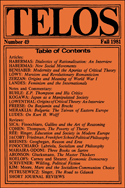
By Maja Sidzinska · Tuesday, November 20, 2012 As an occasional feature on TELOSscope, we highlight a past Telos article whose critical insights continue to illuminate our thinking and challenge our assumptions. Today, Maja Sidzinska looks at Joan Landes’s “Feminism and the Internationals” from Telos 49 (Fall 1981).
 Although 2012 is being hailed as the new Year of the Woman and women’s votes were solicited and cited as pivotal to the outcome of the U.S. presidential election, Joan Landes’s 1981 article “Feminism and the Internationals” provides a timely reminder about the strategic ways that women’s and feminist movements have been deployed in service of political agendas in body politics past. Landes illustrates the historical subordination of women’s and feminist concerns in socialist paradigms and states, shows that the personal was treated as apolitical, and alludes to male epistemic authority as begetting these developments. From the vantage point of Marxist socialism, the problem with feminism is that it undermines the unified class struggle by introducing a competing concern—gender—that threatens the cohesion of the socialist movement. Although 2012 is being hailed as the new Year of the Woman and women’s votes were solicited and cited as pivotal to the outcome of the U.S. presidential election, Joan Landes’s 1981 article “Feminism and the Internationals” provides a timely reminder about the strategic ways that women’s and feminist movements have been deployed in service of political agendas in body politics past. Landes illustrates the historical subordination of women’s and feminist concerns in socialist paradigms and states, shows that the personal was treated as apolitical, and alludes to male epistemic authority as begetting these developments. From the vantage point of Marxist socialism, the problem with feminism is that it undermines the unified class struggle by introducing a competing concern—gender—that threatens the cohesion of the socialist movement.
Continue reading →
By Kyle Gingerich Hiebert · Monday, October 29, 2012 Kyle Gingerich Hiebert’s “The Architectonics of Hope: Apocalyptic Convergences and Constellations of Violence in Carl Schmitt and Johann Baptist Metz” appears in Telos 160 (Fall 2012). Read the full version online at the Telos Online website, or purchase a print copy of the issue here.
 This essay traces the apocalyptic re-emergence of political theology in late modernity in the work of the jurist Carl Schmitt and the theologian Johann Baptist Metz. Broadly speaking, the intellectual fault line between these two German Catholics can be provisionally drawn with reference to Hegel. On the one hand, Schmitt¹s lineage can be traced back through the conservative Catholic political philosophers of the counterrevolution (Bonald, de Maistre, and Cortés) to what amounts to, in very broad strokes, a political theology of the Hegelian Right. On the other hand, Metz¹s sympathies in his development of the new political theology clearly lie with the revisionary Marxists of the Frankfurt School (Adorno, Benjamin, and Bloch), which binds his intellectual heritage, again in very broad strokes, to the Hegelian Left. This way of putting the matter quite easily lends itself to interpretations that argue the relationship between Schmitt and Metz is straightforwardly oppositional. While perhaps conceptually useful, I argue that any easy conservative/critical dichotomy here obscures as much as it illuminates because it proffers too undifferentiated an account of the interrelationship between Schmitt and Metz. Alternatively, I suggest that the apocalyptic tone that infuses their respective accounts of political theology is the most adequate key for understanding how they function as different expressions of what I call an architectonics of hope; a reconfiguration of political theology that is structural in nature, animated by a thoroughly negative theological anthropology and that tragically acquiesces to the ongoing necessity of violence. In the end, then, Schmitt and Metz stand much closer to each other than currently realized. This essay traces the apocalyptic re-emergence of political theology in late modernity in the work of the jurist Carl Schmitt and the theologian Johann Baptist Metz. Broadly speaking, the intellectual fault line between these two German Catholics can be provisionally drawn with reference to Hegel. On the one hand, Schmitt¹s lineage can be traced back through the conservative Catholic political philosophers of the counterrevolution (Bonald, de Maistre, and Cortés) to what amounts to, in very broad strokes, a political theology of the Hegelian Right. On the other hand, Metz¹s sympathies in his development of the new political theology clearly lie with the revisionary Marxists of the Frankfurt School (Adorno, Benjamin, and Bloch), which binds his intellectual heritage, again in very broad strokes, to the Hegelian Left. This way of putting the matter quite easily lends itself to interpretations that argue the relationship between Schmitt and Metz is straightforwardly oppositional. While perhaps conceptually useful, I argue that any easy conservative/critical dichotomy here obscures as much as it illuminates because it proffers too undifferentiated an account of the interrelationship between Schmitt and Metz. Alternatively, I suggest that the apocalyptic tone that infuses their respective accounts of political theology is the most adequate key for understanding how they function as different expressions of what I call an architectonics of hope; a reconfiguration of political theology that is structural in nature, animated by a thoroughly negative theological anthropology and that tragically acquiesces to the ongoing necessity of violence. In the end, then, Schmitt and Metz stand much closer to each other than currently realized.
Continue reading →
By Geoffrey Holsclaw · Thursday, October 25, 2012 Geoffrey Holsclaw’s “At a Distance to the State: On the Politics of Hobbes and Badiou” appears in Telos 160 (Fall 2012). Read the full version online at the Telos Online website, or purchase a print copy of the issue here.
Amid the contested status of the State, juxtaposing the political thought of Thomas Hobbes and Alain Badiou will facilitate a renewed questioning of the State itself. Hobbes stands near the beginning of the tradition of those using “State” as a term for the impersonal form of political authority between ruler and ruled, understanding politics as culminating in the State. Badiou, on the other hand, while assuming the basic conviction of the impersonal nature of the State, theorizes a space for politics at a distance to the State. This encounter is promising not only because of their differences, but because of their similarities. Both take mathematics as the key to their philosophical method. Both envision the primary situation as a tumultuous “multitude” or “multiplicity.” And both understand politics as the creation of a “One.” Yet their overriding difference is manifest in the position of the State in relation to the production of the One, and therefore politics itself. For Hobbes, politics culminates in the formation of the One within the State, or rather, as the State. For Badiou, politics occurs as the pronouncement of a One at a distance to the State. After showing how Badiou moves through and beyond Hobbes, this essay explores the upshot of Badiou’s understanding of politics in relation to other political theories, particularly how recent proposals from within a pragmatist-Hegelian framework hold a hidden alliance with Hobbesian contract theory.
Continue reading →
By Telos Press · Tuesday, October 23, 2012 The New York Times recently published a letter from Telos Editorial Associate Marcia Pally, who commends the paper for drawing attention to the work of “new evangelicals”:
Molly Worthen’s insightful review of “Moral Minority: The Evangelical Left in an Age of Conservatism,” by David R. Swartz (Sept. 30), is, I hope, the beginning of more coverage of the evangelicals who have left the right. Swartz’s fine scholarship illuminates a critical shift in our religio-political landscape: “new evangelical” activism in environmental protection, economic justice and immigration reform — a big change in where evangelical time and money are going. If we don’t read about changes like this, we accept old prejudices and remain blind to political realities.
Continue reading →
Kevin S. Amidon and Zachary Gray Sanderson’s “On Subjectivity and the Risk Pool; or, Žižek’s Lacuna” appears in Telos 160 (Fall 2012). Read the full version online at the Telos Online website, or purchase a print copy of the issue here.
In his In Defense of Lost Causes, Slavoj Žižek poses more than a few heavy-gauge questions. Foremost among them: “The only true question today is: do we endorse this ‘naturalization’ of capitalism, or does contemporary global capitalism contain antagonisms which are sufficiently strong to prevent its infinite reproduction?” Žižek’s analysis of this question, however, seems to us to be missing a crucial element. Where Žižek seems to posit a kind of reconvergence of the classical autonomous subject of the (neo-)liberal (and Frankfurt School) traditions with the class-based vocabulary of more radical Marxist and Lacanian analyses, we see another layer: the subject under the condition of the risk pool. The risk pool, protean and ubiquitous in today’s political economy, takes form in those meta-structures of institutionalized financial, political, and medical (i.e. bio-political) insurance and quasi-insurance that do not so much control the subject’s spheres of activity as regulate them. The (voluntarily or involuntarily) risk-pooled human being is thus in many ways neither subject nor class. She is always both, and navigating always between them in the sphere of financially and actuarially mediated risk. Such navigation in many ways evacuates the forms of political agency posited in both liberal and Marxist traditions, and focuses the individual centrally on the problem of uncertainty. Žižek’s complex analyses of topics as diverse as terrorism and Christianity approach reflections like these, but end where they must in fact begin.
Continue reading →
By Brendan O'Connor · Friday, October 19, 2012
-
Meehan Crist reviews Catharine Malabou’s The New Wounded, translated from the French by Steven Miller, for Book Forum. Malabou tackles Descartes’s distinction between the brain and the mind using developments in neuroscience and psychoanalysis.
-
“The revolution eats its own”: Jonathan Chait on the decline of moderates in the GOP for The New Republic.
-
At Aeon Magazine, Michael Ruse wonders how Humanism has come to operate much like the religions and ideologies it set out to undermine.
-
Ralph Harrington examines the Victorian roots of digital publishing for The Literary Platform.
Continue reading →
|
|