By João Pedro Cachopo · Monday, March 27, 2023 It happened on May 11, 1997. After a defeat, a victory, and three draws, Deep Blue, programmed by IBM, would eventually win the sixth and decisive game of the historic chess match against Garry Kasparov. The Russian chess player, incredulous and upset, did not take the defeat well. In fact, given the machine’s behavior during the game, he protested: some of its moves seemed to indicate human intervention.
Today, more than twenty-five years later, the most amazing thing is that Kasparov thought it possible to continue to beat a computer that was already capable of analyzing one hundred million moves per second at that time. Nevertheless, it is ironic that his defeat was later speculated to be due to the fact that Kasparov had interpreted a move resulting from a software bug as strategic. According to Nate Silver, who tells the anecdote in The Signal and the Noise, it was that move, enigmatic in its aims, that fatally distracted the chess player.
The controversy surrounding Artificial Intelligence is back. However, it is no longer just due to its ability to calculate that the machine, in the era of “big data” and “deep learning,” threatens to surpass human intelligence. Take the case of OpenAI. With Dall-E and ChatGPT, the uses of Artificial Intelligence invade the domains of creation and knowledge. In the former case, a program capable of creating images in the style of this or that artist, enlarging their masterpieces, and crossbreeding their styles. In the latter case, a program capable of producing text by gathering, synthesizing, and cross-referencing information in informal conversations with the user. Disbelief and unease are spreading. Human pride is wounded. Was Kasparov’s defeat not enough? Do they now want to dethrone Vermeer, Beethoven, Kant?
Continue reading →
By Telos Press · Monday, March 20, 2023 In today’s episode of the Telos Press Podcast, David Pan talks with Eric Hendriks-Kim about his article “The Polemics of China’s Counter Cosmopolitanism,” from Telos 201 (Winter 2022). An excerpt of the article appears here. In their conversation they discuss the impetus behind the current proliferation of Chinese theories of cosmopolitanism; how these new ideas about cosmopolitanism fit into a history of anti-Western forms of universalism in various parts of the world; the idea of tianxia, its meaning and history, and how it is used today; how Jiang Shigong’s idea of socialism with Chinese characteristics differs from the theories based on the idea of tianxia; how Jin Huimin conceives of the relationship between universalism and particularity; the relationship of these Chinese notions of cosmopolitanism to Western notions of cosmopolitanism; and whether any of these conceptions escape from an imperialist perspective. If your university has an online subscription to Telos, you can read the full article at the Telos Online website. For non-subscribers, learn how your university can begin a subscription to Telos at our library recommendation page. Print copies of Telos 201 are available for purchase in our online store.
Continue reading →
By John Croce-Renard · Monday, March 13, 2023 When the Supreme Court rules in Students for Fair Admissions v. Harvard, it will surely declare that the use of racial preferences in higher education admissions violates the U.S. Constitution. There is some uncertainty about the precise shape its arguments will take, and their scope, but the basic outcome is clear enough. Here are seven reasons to welcome it from the standpoint of some traditional concerns of Telos.
First, a ruling against race-based affirmative action will diminish the material interests at stake in racial identity politics. It will thereby undercut the racialism that lies at the ideological heart of the liberal managerial establishment. Individual good intentions notwithstanding, the Tories of the managerial class use this insidious set of principles and rhetorical moves to justify their power and to bludgeon the working- and private sector middle classes.
Second, the ruling may enable colleges and universities to overcome the morally degrading culture of lies that the existence of racial preferences has spread throughout higher education, beginning in the elaborate charade that all applicants for admission or employment are judged by common criteria. It will help individual members of those communities to live in truth.
Continue reading →
By Gabriel Noah Brahm · Monday, February 27, 2023 Israeli public intellectual Paul Gross was clearly right when he wrote in Fathom, last November, that the latest electoral defeat for the center-left in Israel “feels different” to the losers. It feels that way, as well, to many of his sympathizers in the United States, self-described “American liberals and liberal Zionists,” for whom this crisis is “a crisis for us, too, and for people like us.” People like them view what’s happening here now, in the Jewish state, as in their own words, “by definition a threat to stability.”
And why is that? Because, understandably, the liberals feel their monopoly on power, exercised through the deep state—or Israeli “deep shtetl”—slipping from their grasp, after decades of Ashkenormative rule by judicial fiat. As John Goodman sang in David Byrne’s 1996 film True Stories, “We don’t want freedom, we don’t want justice, we just want someone to love.” And that someone is themselves—in their ideal, Platonic form as moderate managers with correct opinions about everything.
Continue reading →
By David Pan · Friday, February 24, 2023 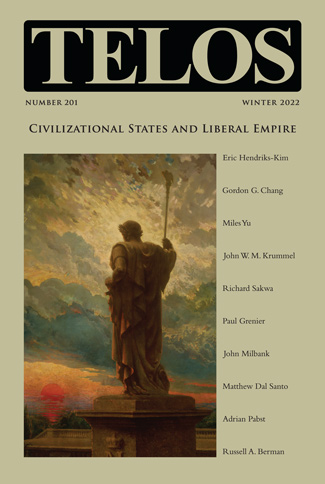 On the anniversary of the Russian invasion of Ukraine, the continuing war indicates that the foundations of a rules-based global order are not just the rules themselves but also the structure of sovereignty that supports those rules. Sovereignty includes both the use of power and the establishment of a legitimating vision of order. The challenges to the Westphalian system of global order consequently come not just from the Russian invasion but also from the Russian idea of its civilizational mission against Western secularism as well as China’s idea of a “shared humanity for mankind.” Telos 201 provides analyses of both of these alternative visions for global order. Matthew Dal Santo, for example, describes Russia’s stance as a defense of a spiritual rather than a secular conception of the basis of order. Gordon Chang analyzes the way in which China has been promoting its tianxia model of unified global governance against the chaos and conflict of separate sovereign nation-states. The frame within which to view these alternative visions is not the struggle between spirituality and secularism or between China and the West, but the global development of nationalism. On the anniversary of the Russian invasion of Ukraine, the continuing war indicates that the foundations of a rules-based global order are not just the rules themselves but also the structure of sovereignty that supports those rules. Sovereignty includes both the use of power and the establishment of a legitimating vision of order. The challenges to the Westphalian system of global order consequently come not just from the Russian invasion but also from the Russian idea of its civilizational mission against Western secularism as well as China’s idea of a “shared humanity for mankind.” Telos 201 provides analyses of both of these alternative visions for global order. Matthew Dal Santo, for example, describes Russia’s stance as a defense of a spiritual rather than a secular conception of the basis of order. Gordon Chang analyzes the way in which China has been promoting its tianxia model of unified global governance against the chaos and conflict of separate sovereign nation-states. The frame within which to view these alternative visions is not the struggle between spirituality and secularism or between China and the West, but the global development of nationalism.
Continue reading →
By Telos Press · Wednesday, February 8, 2023 In today’s episode of the Telos Press Podcast, David Pan talks with David A. Westbrook about his article “From the Ivory Tower to the Football Stadium: A Rueful Response to Michael Hüther,” from Telos 200 (Fall 2022). An excerpt of the article appears here. In their conversation they discuss Michael Hüther’s claim that the decline of truth at the university is due to moralization and economization; the traditional conception of the university that forms the background for Hüther’s critique and the function it played in society; how the role and function of the university today is different from that earlier conception and the reasons for this shift; how has university research moved from being a form of science to a form of investment; the political function of the university today; whether the ideals of merit and inclusion contradict each other; and how the university compares to a church. If your university has an online subscription to Telos, you can read the full article at the Telos Online website. For non-subscribers, learn how your university can begin a subscription to Telos at our library recommendation page. Print copies of Telos 200 are available for purchase in our online store.
Continue reading →
|
|