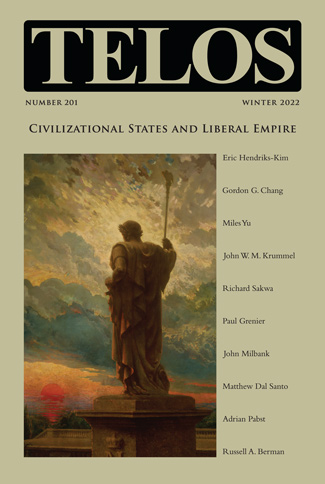
 On the anniversary of the Russian invasion of Ukraine, the continuing war indicates that the foundations of a rules-based global order are not just the rules themselves but also the structure of sovereignty that supports those rules. Sovereignty includes both the use of power and the establishment of a legitimating vision of order. The challenges to the Westphalian system of global order consequently come not just from the Russian invasion but also from the Russian idea of its civilizational mission against Western secularism as well as China’s idea of a “shared humanity for mankind.” Telos 201 provides analyses of both of these alternative visions for global order. Matthew Dal Santo, for example, describes Russia’s stance as a defense of a spiritual rather than a secular conception of the basis of order. Gordon Chang analyzes the way in which China has been promoting its tianxia model of unified global governance against the chaos and conflict of separate sovereign nation-states. The frame within which to view these alternative visions is not the struggle between spirituality and secularism or between China and the West, but the global development of nationalism.
|
In today’s episode of the Telos Press Podcast, David Pan talks with David A. Westbrook about his article “From the Ivory Tower to the Football Stadium: A Rueful Response to Michael Hüther,” from Telos 200 (Fall 2022). An excerpt of the article appears here. In their conversation they discuss Michael Hüther’s claim that the decline of truth at the university is due to moralization and economization; the traditional conception of the university that forms the background for Hüther’s critique and the function it played in society; how the role and function of the university today is different from that earlier conception and the reasons for this shift; how has university research moved from being a form of science to a form of investment; the political function of the university today; whether the ideals of merit and inclusion contradict each other; and how the university compares to a church. If your university has an online subscription to Telos, you can read the full article at the Telos Online website. For non-subscribers, learn how your university can begin a subscription to Telos at our library recommendation page. Print copies of Telos 200 are available for purchase in our online store. In today’s episode of the Telos Press Podcast, David Pan talks with Michael Hüther about his article “Tired of Science?! Notes on the Relationship between University and Society,” from Telos 200 (Fall 2022). An excerpt of the article appears here. In their conversation they discuss what has become problematic in the relationship between science and truth and the relationship between science and values; how we should understand the role of myth in human society and why it continues to be important; how moralization responds to the dissatisfaction with science and the continuing relevance of myth; the dangers of moralization for the university; the driving forces behind the economization of the university as well as the consequences of this economization; how the German constitution establishes the social and political roles of the university; and how the university fulfills these roles today. If your university has an online subscription to Telos, you can read the full article at the Telos Online website. For non-subscribers, learn how your university can begin a subscription to Telos at our library recommendation page. Print copies of Telos 200 are available for purchase in our online store. In today’s episode of the Telos Press Podcast, David Pan talks with Greg Melleuish and Susanna Rizzo about their article “Universities: Truth, Reason, or Emotion?” from Telos 200 (Fall 2022). An excerpt of the article appears here. If your university has an online subscription to Telos, you can read the full article at the Telos Online website. For non-subscribers, learn how your university can begin a subscription to Telos at our library recommendation page. Print copies of Telos 200 are available for purchase in our online store. Telos 201 (Winter 2022): Civilizational States and Liberal Empire is now available for purchase in our store. Individual subscriptions to Telos are also available in both print and online formats.
When we consider the way in which power functions on a global level, it will also be crucial to understand how a world order will reflect a particular way of structuring the relationship between values and power. Even the seemingly most egregious use of power can only take place within the framework of an attempt to realize values in the world, and realist accounts of global order must also recognize the importance of some ideology such as nationalism as a means of establishing political values. Accordingly, discussions of balance-of-power dynamics can only begin once great powers emerge as a consequence of the political will of certain peoples to understand themselves in a certain way. Based on such measures as GDP, population, and military spending, Russia does not rank particularly well in relation to countries such as Brazil and India, neither of which pretends to great power status. If Russia can be considered a great power today, it is primarily because of the goals and values that its government embodies. Values form the foundations of global order, and Russia only continues to project its power because it maintains a sense of the global reach of its values for determining order for others.
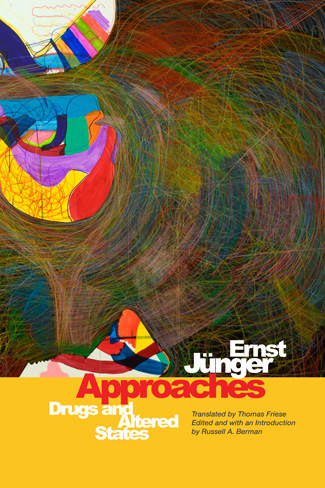
Jünger stands out in this counterculture company with his thoroughly different background. As a teenager, he ran away from his German home to join the French Foreign Legion. In the First World War he was wounded multiple times and became a highly decorated officer in the Kaiser’s army. He would serve again on the German side in the Second World War—even though he published a famous anti-Hitler novel. Yet alongside that military career, Jünger spent a lifetime with consciousness-enhancing experiments—hashish, cocaine, and morphine until he worked his way to LSD, psilocybin, and peyote. Jünger invites us to follow him on that mind-blowing path in an autobiography of his life with drugs: Approaches: Drugs and Altered States. This wide-ranging account documents an array of drug experiences, placing them in a richly intellectual context of cultural transformations and the literary history of drug use—Baudelaire, De Quincey, and Huxley—as well as art historical reflections on hallucinatory elements in Van Gogh, cubism, and surrealism. A great intellect meets psychedelics. |
   |
|||
|
Privacy Policy · Data Protection Copyright © 2026 Telos Press Publishing · All Rights Reserved |
||||