With the re-establishment of Bashar al-Assad’s power in Syria, the strengthening of Hezbollah in Lebanon, and finally the political and military victory of pro-Iranian forces in Iraq, it is clear that an Iranian axis now prevails in the Levant. The strength of this geopolitical axis is reinforced by the territorial continuity between Tehran and Beirut via Damascus and Baghdad: “the Iranian land bridge” or “Iranian corridor,” controlled by Iranian troops directly and by proxies. Since the Shia militias joined the Syrian-Iraqi border in May 2017, the Iranian land bridge has continued to expand, despite the U.S. troop presence on both sides, in the al-Tanef pocket and in northeastern Syria. Until spring 2017, the West seemed incredulous about this reality. However, at that time, it was already too late to block the Shiite militias in eastern Syria, and the Iranian land bridge became a reality.
|
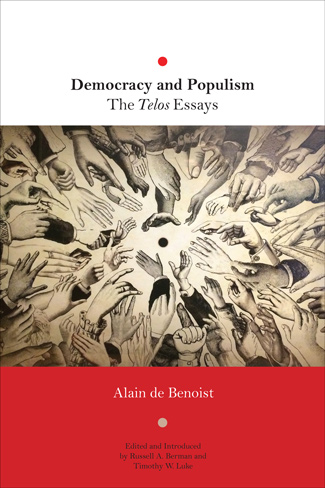
Are the divisions that fragment the United States primarily driven by some deep flaw in its political life, or was the United States doing just fine, thank you very much—until Russia came along during the 2016 presidential race and started sowing division and dissension? Framed that way, the question answers itself. Whatever some state-sanctioned Russian actors may have done to pester the American political process, it is obvious that America’s deep divisions exist for reasons having essentially nothing to do with Russia. They long precede the last election. Even if Russia’s interventions into American electoral politics turn out to be more significant than they presently appear, this cannot change the more fundamental reality that our confrontational posture, including vis-à-vis Russia, is by no means something external to the United States’ Lockean liberal political concept. New from Telos Press: Democracy and Populism: The Telos Essays, by Alain de Benoist. Edited by Russell A. Berman and Timothy W. Luke. Order your copy in our online store, and save 20% on the list price by using the coupon code BOOKS20 during the checkout process.
In a new opinion piece in the Jerusalem Post, Sean Durns discusses Matthias Küntzel’s Germany and Iran: From the Aryan Axis to the Nuclear Threshold, published by Telos Press. Pick up your copy of Germany and Iran in our online store, and save 20% with the coupon code BOOKS20.
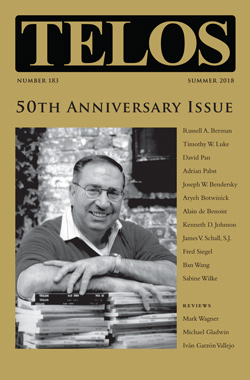
Telos 50th Anniversary Sale! To help celebrate the 50th anniversary of Telos, we are offering a 20% discount on individual subscriptions and books purchased through the Telos Press website! Just use the coupon code TELOS50 during the checkout process. Offer expires August 31, 2018. Writing at City Journal, Fred Siegel reports on the lively conversations at the Telos 50th anniversary event, held in June in New York City. An excerpt:
Ban Wang’s “Confucianism and Nature: Ecological Motifs in Kang Youwei’s Great Community” appears in Telos 183 (Summer 2018), our fiftieth anniversary issue. Read the full article at the Telos Online website, or purchase a print copy of the issue in our online store. Individual subscriptions to Telos are available in both print and online formats. Environmental writers have been turning to Chinese traditions for a harmonious relation between humans and nature. However, treating environmental crises as a metaphysical meditation on how humanity as a whole stands over against nature ignores the critical examination of power relations in the equal relation of production, social hierarchy, and political oppression. As Max Horkheimer and Theodor Adorno declared, humanity’s domination of nature stems from the domination by some humans over others as well as over human nature. Environmental injustice is social injustice. From this immanent critique, Kang Youwei’s recapture of Confucian cosmology proves to be a critical resource. An influential thinker and reformer in the transition from the empire to a modern nation, Kang Youwei (1858–1927) wrote The Great World Community (Datong shu) and proposed to abolish all boundaries of nation-state, class, hierarchy, gender, and race, in hopes of bringing diverse peoples and nations into a cosmopolitan community. Ecological motifs could be recovered in Kang’s critique of oppressive social, political, and gender relations. |
   |
|||
|
Privacy Policy · Data Protection Copyright © 2026 Telos Press Publishing · All Rights Reserved |
||||