By Timothy W. Luke · Wednesday, July 11, 2018 On June 8, 2018, Telos celebrated its fiftieth anniversary at a special event held in New York City. Speakers included Telos editors Russell Berman, Tim Luke, David Pan, and Adrian Pabst, as well as Jacob Siegel, who delivered a talk on “Telos, Post-liberal Politics, and a Veteran’s Reading of Ernst Jünger.” Videos of the event are available at the Telos-Paul Piccone Institute website. Telos 183 (Summer 2018), our fiftieth anniversary issue, is available for purchase in our store. Presented below is a transcript of Tim Luke’s remarks at the anniversary event.
To address the history of Telos, I will open this brief account tonight about the journal by recalling my history with Telos since 1975. As a new cadre in “the St. Louis TELOS group,” I began by unloading boxes of Telos 26 (Winter 1975–76) from a panel truck early on a Saturday morning during the winter break outside of McMillan Hall, where Paul Piccone and the Telos office were embedded in the Sociology Department of Washington University, St. Louis. Working then as what we call an “intern” today, I soon was translating “into” the American English various versions of different draft manuscripts. Many articles at that time came through the mail as pages of disorderly text that another individual, like the author or an associate, with some English skills translated “out of” Czech, German, Hungarian, Italian, or Polish into a global semi-Anglophonic creole.
Continue reading →
By Russell A. Berman · Monday, June 11, 2018 Telos 183 (Summer 2018), celebrating the fiftieth anniversary of the journal Telos, is now available for purchase in our store.
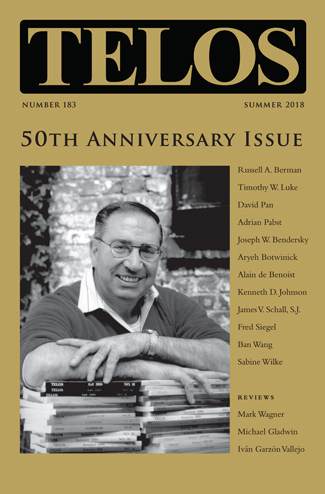 Telos began this anniversary year with our previous issue’s exploration of the legacy of Martin Luther King, Jr., tragically assassinated fifty years ago in April. That too was 1968, the excitement of profound social change and the bitter taste of disappointment. So much in our culture today remains framed by that specific polarity. Now, in this issue of the journal, we take stock more broadly: not a judgment on that one year but a return to some of the key themes that have defined Telos. We have been able to carry on these discussions thanks to the vision of the founder, Paul Piccone, the support of our publisher, Mary Piccone, the dedication of our editorial group, the intellectual agility of our authors, and the loyalty of our readers. Thanks to all. Telos began this anniversary year with our previous issue’s exploration of the legacy of Martin Luther King, Jr., tragically assassinated fifty years ago in April. That too was 1968, the excitement of profound social change and the bitter taste of disappointment. So much in our culture today remains framed by that specific polarity. Now, in this issue of the journal, we take stock more broadly: not a judgment on that one year but a return to some of the key themes that have defined Telos. We have been able to carry on these discussions thanks to the vision of the founder, Paul Piccone, the support of our publisher, Mary Piccone, the dedication of our editorial group, the intellectual agility of our authors, and the loyalty of our readers. Thanks to all.
Continue reading →
By Lillian Hingley · Thursday, May 31, 2018 As an occasional feature on TELOSscope, we highlight a past Telos article whose critical insights continue to illuminate our thinking and challenge our assumptions. Today, Lillian Hingley looks at Peter Bürger’s “Adorno’s Anti-Avant-Gardism” from Telos 86 (Winter 1990–91).
Peter Bürger’s Theory of the Avant-Garde (1984) is one of the landmark texts on aesthetic theory published in the twentieth century. One of the book’s significant claims is that modernism and the avant-garde should be defined as distinct aesthetic movements; specifically, he defines modernism as the less radical cousin of the avant-garde. This distinction is important to note because it is also the crux of Bürger’s thesis in a later article, “Adorno’s Anti-Avant-Gardism,” a historicist critique of Adorno’s “modernist” aesthetic theory that was published in Telos 86 (Winter 1990–91). By acknowledging the pre-established position Bürger was bringing to this article, we can question how useful his distinction may be when constructing an Adornian aesthetic theory today.
Continue reading →
By Jeffrey Herf · Tuesday, May 29, 2018 Can the same Trump who lies constantly, flouts the norms of the rule of law, fans the flames of racial resentment, and attacks basic notions of fact and evidence offered by journalists and his own law enforcement and intelligence agencies, can this same man be right about leaving the Joint Comprehensive Plan of Action (JCPOA) Iran nuclear deal of 2015? This instance of cognitive dissonance, of holding two or more contradictory beliefs in our minds at the same time, is staring us in the face. The serial liar, that man who has undermined our alliances and replaces rational explanations with conspiracy theories, has made the right decision to leave the JCPOA and to restore and intensify the economic sanctions on Iran in an effort to bring about a definitive end to both its nuclear program and its regional imperialism in the Middle East. In the polarized climate he has done so much to create, Trump supporters forget Trump the liar while agreeing on policy while those of us who oppose him reject any policy he advocates. The desire for consistency generally overwhelms the discomfort of cognitive dissonance. In the following, I make the case for living with the discomfort of accepting that this awful man who is wrong about most everything is right about this issue.
Continue reading →
By Matthias Küntzel · Wednesday, May 16, 2018 Matthias Küntzel’s book Germany and Iran: From the Aryan Axis to the Nuclear Threshold is available for purchase in our online store. Save 20% on the list price by using the coupon code BOOKS20 during checkout. Also available in Kindle format from Amazon.com.
On May 8, 2018, when U.S. President Donald Trump spoke to the press to make the case for the U.S. decision to leave the nuclear deal with Iran, he stated: “America will not be held hostage to nuclear blackmail.” With this sentence, Trump initiated a new phase to diplomacy with Iran. Up to this point, nuclear blackmail, the threat that Iran would otherwise build a bomb, had defined and shaped the dynamic of negotiations. This worst case hung like a sword of Damocles over the actors. In order to avert it and in order to secure the nuclear deal, Obama refused to support the Iranian protest movement in 2009, just as in 2013 he refused to make good on the red line he had drawn in the Syrian war.
Continue reading →
By Kenneth A. Taylor · Monday, May 14, 2018 Kenneth A. Taylor’s “On King, Resistance, Faith, and Despair” appears in Telos 182 (Spring 2018), a special issue commemorating the life and thought of Martin Luther King, Jr. Read the full article at the Telos Online website, or purchase a print copy of the issue in our online store. Individual subscriptions to Telos are now available in both print and online formats.
Martin Luther King, Jr.’s deep and abiding religious faith led him to believe that “the arc of the moral universe is long, but . . . bends toward justice.” Though he believed that God exercises providential guidance over the universe, he did not think that the work of bending the arc of the universe belongs to God alone, with no need for human agency. We humans are urgently called by God to cooperate in the struggle for justice through “vigorous and positive action.” And King knew firsthand how arduous this struggle could be. We toil for justice in a darkened world that creaks and groans under the weight of many and diverse forms of injustice. Heeding the call may cost us much that is dear—including, as it did for King himself, our lives. King was convinced, however, that if our efforts are anchored in faith, we can rest assured that if we do heed the call, we will struggle neither alone nor in vain. The God who calls to us will struggle with us. “Evil dies on the seashore,” says King, “not merely because of man’s endless struggle against it, but because of God’s power to defeat it.” His faith that this is so not only spurred him to action but sustained him in his darkest hours and functioned as a bulwark against a potentially paralyzing despair.
Continue reading →
|
|