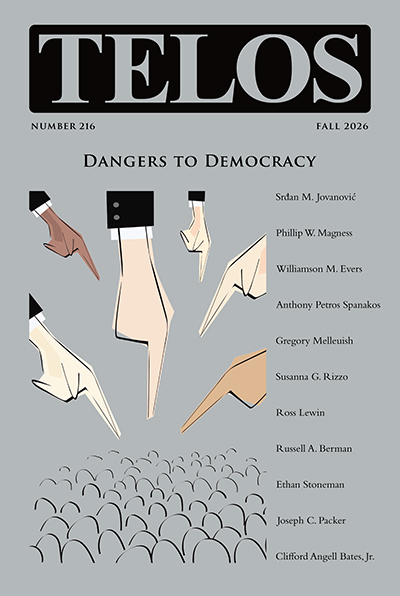
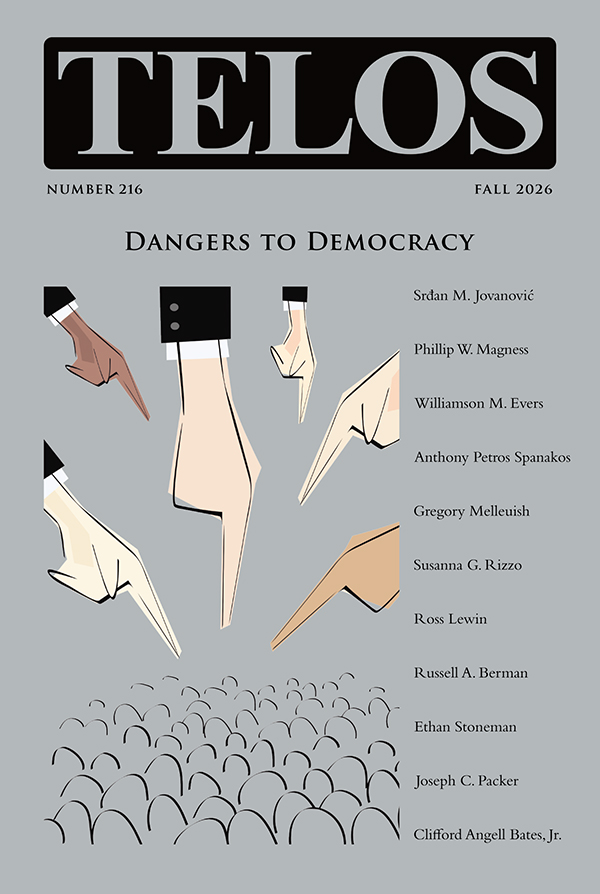
Telos 216 (Fall 2026): Dangers to Democracy is now available for purchase in our store. Individual subscriptions to Telos are also available in both print and online formats.
 We are still living in the shadow of the eighteenth-century European Enlightenment, when the theological and monarchical justifications for political authority began to lose legitimacy. Individual autonomy, open debate, and evidence-based reasoning were to replace adherence to traditions and established authorities as the basis for political order and decision-making in a democracy. Almost immediately after the enunciation of this new perspective, though, left-wing and right-wing reactions developed. On the left, there was a critique of liberal proceduralism on the part of those French revolutionaries who sought to engineer egalitarian social outcomes, even against democratic majorities. On the right, thinkers such as Joseph de Maistre defended established religions and traditions, which were held to be essential for maintaining moral constraints on otherwise purely self-interested decision-making in a democracy. While religious conservatives continually lost ground in the process of secularization, socialism and nationalism gained importance to the extent that they provided secular theologies to replace the religious ones.
Socialism and fascism became important in the twentieth century but then were discredited as key political theologies. Meanwhile, the victory of liberalism at the end of the Cold War actually presaged its crisis. When liberalism could finally implement the Enlightenment project on a global scale, the focus on rational methods in fact could not answer the political theological question of legitimacy. In the twenty-first century, nationalism, religion, and a revived socialism have reasserted themselves as the mythic bases for political identity, while liberal rationalism deteriorated into the ideology of the new class of bureaucratic managers of human life. Against the liberal new class, populist identity politics has gained ground in nationalist, religious, socialist, and anti-imperialist variants, or combinations thereof.
In all these cases, populism has arisen through an insistence on a transcendent meaning that would form the basis of political identity. If “the enemy is the embodiment of one’s own question,” populism is in effect an answer to the political theological question that is left unanswered by liberal proceduralism. Nationalism and religion provide the political theological foundation for right-wing populisms, which have directed their energies against the administrative state and internationalism, both established in growing expert-driven bureaucracies that deny the importance of such substantive commitments. But the left-wing variants of populism potentially pose a more immediate threat to liberal democratic institutions today, precisely because they lack prior transcendent frameworks and must manufacture them within their politics. Left-wing populisms, eschewing nationalism and religion, have created replacements for such political theologies by moving away from universalist goals toward a Manichaean worldview focused on racial identity and victim status as the basis for moral judgments.
Because they have shifted ultimate meaning into their political commitments, left-wing movements have been arguably more emphatic about suppressing debate, enforcing speech restrictions, and engaging in moral absolutism. The Left has also had more success in co-opting new class bureaucracies because they both share an inherent deficit of transcendent meaning. To the extent that these bureaucracies still adhere to a liberal internationalism of laws to replace substantive moral commitments, they continue to underestimate the importance of political theology and overestimate their own ability to manage social life.
Where does this leave democracy?
As a form of government that depends on the people for decision-making, democracy requires, on the one hand, a basic unity of the people in terms of their political theological goals and, on the other hand, the procedural mechanisms that can translate popular sentiments into political decisions. A breakdown of the former can lead to civil war. A deterioration of the latter can lead to the suppression of independent associations by a demagogue or a faction. Democracies can thus die either through too little unity or too much. The key is to maintain a broad unity in terms of the overarching political theology while allowing for open debate and possible variation within the decision-making about how to achieve the common goals.
While our investigations of politics in these pages have often focused on the issue of political theology, Telos 216 is devoted to the dangers to democracy posed by the declining commitment to open debate, evidence-based reasoning, and pluralism.
Srđan M. Jovanović describes a trajectory of the Western Left in which the epistemological methods it used to challenge established authority—debate, universal standards of justification, and the willingness to revise beliefs in response to evidence—have since been abandoned. Instead, left-wing thinking is now dominated by ideological conformity, privileging of identity over universality, and moral certainty. The Left often treats criticism as offensive speech and consequently suppresses debate through restrictions such as speech codes and safe spaces. Moreover, the focus on racism has created a shift away from the ideal of universal equality and toward racial essentialism. Finally, anti-imperialism, particularly left-wing responses to Hamas after October 7, has led to an idealization of victims in which opposition to Western power becomes itself a form of moral legitimacy, regardless of the methods and goals of those granted such victim status. Jovanović argues that the far left and the far right, though they pursue different goals, both apply similar methods of moral absolutism and suppression of dissent. He advocates for a return to liberalism understood not as an ideology but as a method grounded in universal justification, allowance for disagreement, and falsifiable claims.
Given these problems with left-wing ideologies, Phillip W. Magness and Williamson M. Evers provide an explanation of how critical race theory developed from a fringe intellectual movement to a key aspect of left-wing politics. They argue that the emergence and rise of critical race theory must be understood as a reaction to the failures of K–12 school reform. The persistence of the Black–White achievement gap drove pessimism about American institutions, even as progressives and teachers’ unions undermined initiatives such as No Child Left Behind and charter schools that demonstrated real gains for Black students. The lack of progress provided the context in which critical race theory could claim that structural racism was the underlying cause. An ideology partly generated by the failure to improve Black education eventually prevented reforms that demonstrated measurable improvements in academic achievement.
Anthony Petros Spanakos evaluates contemporary dangers to democracy by looking at the conflict between a liberal ideal of a small state administration and the populist push to involve the state in creating equality of social conditions. Tocqueville remained on the liberal side of this debate and warned against the populist temptation to grow the state apparatus to create social welfare outcomes. Yet in a context in which the growth of the administrative state has already occurred, populism is divided today between those who would further expand the state to create social equality and those who seek to dismantle administrative structures that they regard as obstacles to popular sovereignty and individual freedom. Spanakos downplays this particular conflict by describing both versions as manifestations of the same dissatisfaction with existing institutions, leading both sides to seek a restructuring of state and society in the name of democracy. While the two versions of populism have led to intensified polarization, Spanakos resists the idea that these tendencies might lead today to the dissolution of democracy.
Gregory Melleuish and Susanna G. Rizzo use Thucydides’s account of Athenian democracy to illuminate the dangers inherent to any democracy. Populism arises as a defect of democracy when both truth and custom are overturned through rhetoric, and Melleuish and Rizzo point to Athenian populists such as Cleon, whose rise reflected institutional decay and alienation between elites and ordinary citizens. When rhetoric and emotional appeals become detached from truth and the customs that justify moral restraints, democratic energy can produce hubris. Athens’s destruction of Melos and the disastrous Sicilian expedition illustrate this danger, which the authors compare to Trump’s assertive foreign policy. Because democracy contains structural tendencies toward populism and excess, America needs to recover phronesis—practical wisdom—which promotes restraint and civil deliberation.
Melleuish and Rizzo direct their criticisms against right-wing rhetoric for undermining the search for truth, and we might be tempted into criticizing both left-wing and right-wing rhetoric equally. The difficulty in grouping the left-wing and right-wing populisms together in the current context, though, is that it obscures a key difference between the two in their relationship to values. The focus on maintaining academic methods of debate, evidence-based reasoning, and universal standards ensures that values do not distort our thinking, and the decline of these methods has led to false conclusions and the deterioration of academic debate. While we might associate such faulty thinking with the uneducated, Jovanović argues that this problem now pervades academia and the college-educated population, dominated by the Left. The reasons for this involve both the influence of post-structuralist attacks on the notion of truth as well as the virtual disappearance of conservative voices at universities, creating an ideological echo chamber that favors extremism rather than truth. In this context, the defenders of objectivity and universal standards are now often attacked by the Left as conservative and racist. This places conservatives in the difficult position of having to attack academia in order to defend academic standards.
Yet it would be a mistake to simply reject all discussion of values and attack all rhetoric for undermining rational objectivity. As Magness and Evers contend, the maintenance of a particular belief in structural racism in spite of countervailing evidence clearly erodes both academic integrity and democratic decision-making by allowing rhetoric to overwhelm objective standards. Such use of rhetoric is clearly harmful. Yet it would not be possible or desirable to prevent all discussion of values from democratic or academic discourse. Rhetoric rightly includes discussions of values as the framework for our decision-making. Academics as well as politicians need to be clear about the overarching values that guide their analyses and decision-making. We need religious and national values to orient the goals of our thinking and our actions, and it is necessary to be clear about those values and their consequences. While much of our academic and political discourse is oriented around maintaining and strengthening our democracy, most of the discourse in China is structured by the goal of buttressing totalitarianism. This difference is obviously crucial, regardless of the quality of the debate and the research methods being used. Rhetoric highlights such differences.
We must distinguish between, on the one hand, the belief in values, such as democracy, that we agree should guide the goals of our thinking and choices and, on the other hand, the belief in phenomena, such as structural racism, or specific solutions, such as socialism, that would incline us to prejudge evidence to fit it into a preconceived conclusion. Rhetoric includes both of these ways of influencing our search for truth. The dangers to our democracy as well as truth-seeking arise not only when we allow our values to subvert our objective appraisal of evidence but also when we lose sight of the values that should orient our endeavors. The next essay in our issue focuses on this second problem.
Ross Lewin argues that the program of the Democratic Socialists of America is organized in such a way that the obstacle to solving the problems that it imagines is an identifiable antagonist, which turns out to be the Jewish state. The DSA program begins by imagining a utopian world liberated from exploitation, inequality, insecurity, and war, then asks what prevents its realization. The narrative then blames “the bosses” and ultimately Israel as a concrete antagonist. Because the DSA program does not include a concrete vision of what political freedom would look like, its underlying unity depends on the positing of a common adversary whose removal promises redemption. Though Lewin refrains from drawing this conclusion, the DSA, as the would-be agent of this removal, has become the closest equivalent to the kind of totalitarianisms that arose in the twentieth century, in effect combining the socialist demonization of capitalists with the fascist targeting of Jews.
Russell A. Berman argues that the wars in Ukraine and Gaza are accelerating a fundamental transformation of American strategic thinking. There is a growing gap between international norms and geopolitical realities that encourage a shift from values-based foreign policy toward a more transactional pursuit of national interests. The two wars represent fundamentally different kinds of conflict. Ukraine is primarily a conventional, “Westphalian” war between sovereign states over internationally recognized territory. Gaza, by contrast, pits Israel against Hamas, a non-state actor employing terrorist and asymmetric warfare. This difference exposes weaknesses in international law because legal norms designed primarily for states cannot be applied or enforced equally against non-state actors. The conflicts show how the “rules-based order” is giving way to renewed emphasis on geography, territorial control, material interests, and great-power competition. Though international institutions and abstract norms are losing authority, the importance of information warfare and propaganda indicates that the moral dimension is still crucial for the development of political will.
Ethan Stoneman and Joseph Packer argue that generative AI threatens not merely academic employment or intellectual property but the human character of writing itself. Large language models transform language into decontextualized data that can be extracted, recombined, and reproduced without the embodied experience and responsibility of human authorship. As opposed to writing that is oriented toward legibility, Stoneman and Packer propose reviving Leo Strauss’s concept of esoteric writing. Traditionally, esoteric writers concealed meanings “between the lines,” communicating them only to attentive readers capable of recognizing deliberate contradictions, omissions, and indirections. The hidden meaning can only be revealed by someone who can exercise the judgments that would identify the true meaning behind the explicit ones. Esoteric texts consequently offer the possibility of an alternative mode of language that would remain unintelligible to the operations of generative AI, which works exclusively with the explicit text and therefore remains on the surface level of language.
Clifford Angell Bates, Jr., examines Marcel Gauchet’s account of modern democracy within the context of the “theological-political” question. Gauchet argues that secularization did not eliminate the sacred but relocated it from transcendent religious authority to political structures. In the first place, Nazism and Stalinism replaced religious authority with “quasi-religious” political movements. After their collapse, the individual became sacred within democratic society. But the organization of society around the individual weakens collective solidarity and fragments political identity. Globalization and neoliberalism further intensify these tensions by orienting activity around individual self-interest. Nevertheless, Gauchet regards democracy’s pluralism and adaptable institutions as the best means of reconciling individual autonomy with collective governance in a secular age.
David Pan is Professor of European Languages and Studies at the University of California, Irvine, and has previously held positions at Washington University in St. Louis, Stanford University, Penn State University, and McKinsey and Company. He is the author of Primitive Renaissance: Rethinking German Expressionism (2001) and Sacrifice in the Modern World: On the Particularity and Generality of Nazi Myth (2012). He has also published on J. G. Herder, Heinrich von Kleist, Friedrich Nietzsche, Franz Kafka, Walter Benjamin, Ernst Jünger, Bertolt Brecht, Carl Schmitt, and Theodor Adorno. He is the Editor of Telos.