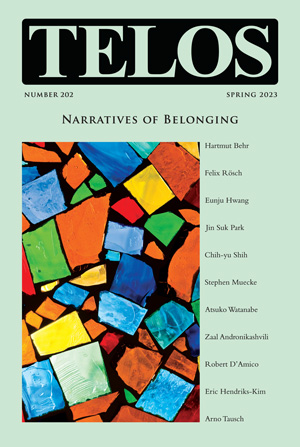
In today’s episode of the Telos Press Podcast, David Pan talks with Chih-yu Shih about his article “Loving Hong Kong: Unity and Solidarity in the Politics of Belonging,” from Telos 202 (Spring 2023). An excerpt of the article appears here. In their conversation they discuss why liberalism is based on universal love rather than universal rights; the relationship between a rights-based liberalism and communitarianism in the West; the difference between Western universal love and Confucian benevolent love; solidarity love and role-embedded love; the Confucian critique of universal love; the meaning of “One Country, Two Systems” in Hong Kong; how the idea of benevolent love affects the understanding of “One Country, Two Systems” in comparison with the liberal idea of it; the different interpretations, based on universal love and benevolent love, of the 2014 and 2019 protests in Hong Kong; the links between benevolent love and stability and prosperity and between universal love with autonomy and political rights, and why there is a conflict between these two sets of goals. If your university has an online subscription to Telos, you can read the full article at the Telos Online website. For non-subscribers, learn how your university can begin a subscription to Telos at our library recommendation page. Print copies of Telos 202 are available for purchase in our online store.
|
In today’s episode of the Telos Press Podcast, David Pan talks with Stephen Muecke about his article “Belonging in Aboriginal Australia: A Political ‘Cosmography,'” from Telos 202 (Spring 2023). An excerpt of the article appears here. In their conversation they discuss how cosmography rather than ethnography allows for a focus on epistemological and ontological pluralism, and what such pluralism means for the essay’s cosmographic analysis; whether ontological pluralism is fundamentally incompatible with monotheistic religion and the institutions that have derived from it; how important for the essay’s analysis is institutional belonging, and whether the centering effect of such belonging could conflict with an ontological pluralism; how Native Title in the Australian legal system is grounded in the idea of genealogy, and whether this orientation undermines or contradict the forms of title and territorial sovereignty documented in Goolarabooloo practices; and the key differences between the Goolarabooloo practices and Yawuru nationalism. If your university has an online subscription to Telos, you can read the full article at the Telos Online website. For non-subscribers, learn how your university can begin a subscription to Telos at our library recommendation page. Print copies of Telos 202 are available for purchase in our online store. In today’s episode of the Telos Press Podcast, David Pan talks with Matthew Dal Santo about his article “Russia, the Ukraine War, and the West’s Empire of Secularization,” from Telos 201 (Winter 2022). An excerpt of the article appears here. In their conversation they discuss Augusto Del Noce’s view of twentieth-century secularization as the unfolding of the philosophy of atheism; how Del Noce understood secularization; why, if Marxism is atheistic, Del Noce sees the West as more atheistic than the Soviet Union; why the alliance between the United States and Ukraine is a secularist one; why it is necessary to link religion and politics to avoid secularization; how the idea of the Holy Rus’ presents a politics that realizes a religious project rather than one that replaces a religious project with a nationalist political one, and how we might differentiate between the two possibilities; the distinction between the causality of (or immediate reasons for) the war in Ukraine and its meaning (or higher causality); and how to make sense of a contradiction between the two in the case of the Russian invasion of Ukraine. If your university has an online subscription to Telos, you can read the full article at the Telos Online website. For non-subscribers, learn how your university can begin a subscription to Telos at our library recommendation page. Print copies of Telos 201 are available for purchase in our online store. In today’s episode of the Telos Press Podcast, David Pan talks with John Milbank about his article “A Tale of Two Monsters and Four Elements: Variations of Carl Schmitt and the Current Global Crisis,” from Telos 201 (Winter 2022). An excerpt of the article appears here. In their conversation they discuss the three idioms into which Milbank divides Carl Schmitt’s thought; why they should be seen as separate idioms rather than different aspects of a single perspective; the extent of overlap between the idioms; whether the decisionist Schmitt is as arbitrary as he is made out to be; the characteristics of a medieval European conception of nomos that Schmitt wishes to retrieve; the similarities between Schmitt’s third idiom of global regions and both Nazism and Russian theorists like Gumilev, Panarin, and Dugin; Schmitt’s decisionism, basic values, identity, and thinking through popular sovereignty. If your university has an online subscription to Telos, you can read the full article at the Telos Online website. For non-subscribers, learn how your university can begin a subscription to Telos at our library recommendation page. Print copies of Telos 201 are available for purchase in our online store. In today’s episode of the Telos Press Podcast, David Pan talks with Paul Grenier about his article “Konstantin Krylov’s Ethical Theory and What It Reveals about the Propensity for Conflict between Russia and the West,” from Telos 201 (Winter 2022). An excerpt of the article appears here. In their conversation they discuss Russian conservative thinkers, including Konstantin Krylov, Vadim Tsymburski, and Vladimir Solovyov, and their attitudes toward the West; how Krylov differentiates between different civilizational types as well as how he differentiates between liberalism and Russian civilization; how Krylov frames his critique of liberalism and of Russian civilization; how his view of liberalism compares with other definitions; how else we can interpret the weaknesses of liberalism, aside from Krylov’s view of a good and bad version; the relationship between liberalism and tradition; and what Krylov’s thought tells us about the development of Russian perspectives on its relationship to the West today. If your university has an online subscription to Telos, you can read the full article at the Telos Online website. For non-subscribers, learn how your university can begin a subscription to Telos at our library recommendation page. Print copies of Telos 201 are available for purchase in our online store. Telos 202 (Spring 2023): Narratives of Belonging is now available for purchase in our store. Individual subscriptions to Telos are also available in both print and online formats. Online subscribers have access to the full issue at the Telos Online website. The following is an excerpt from the issue’s introduction by Hartmut Behr and Felix Rösch, who are the issue’s guest editors. Introduction: Narratives of Belonging—The Interrelation between Ontological-Epistemological Observations and Narrative MethodologyHartmut Behr and Felix Rösch 1. Introduction
|
   |
|||
|
Privacy Policy · Data Protection Copyright © 2026 Telos Press Publishing · All Rights Reserved |
||||