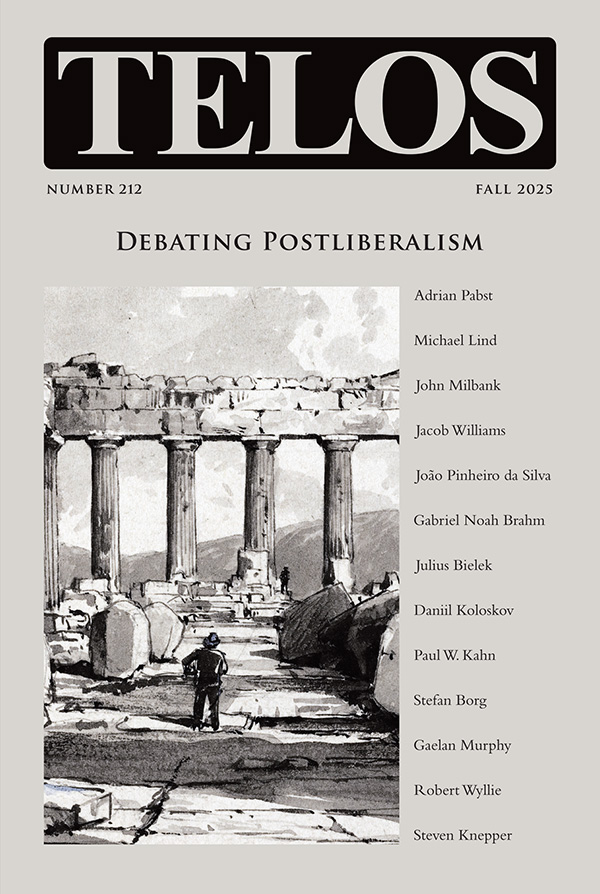
By Adrian Pabst · Friday, October 3, 2025 Telos 212 (Fall 2025): Debating Postliberalism is now available for purchase in our store. Individual subscriptions to Telos are also available in both print and online formats.
 In 1998, Alan Wolfe remarked that “the right won the economic war, the left won the cultural war, and the center won the political war.” It was the age of triumphant liberalism, freed from the shackles of the Cold War confrontation between the capitalist West and the Communist East. Capitalism was now the uncontested model, as Western countries increasingly abandoned a more embedded social market economy in favor of the global market-state while emerging market economies embraced the state-market. In each case, society was the loser. Even as countries converged internationally and China morphed into an economic powerhouse, asset and income inequality increased within countries, and so did regional disparities—between the former heartlands of the Rust Belt and the new metropolitan hubs exemplified by Silicon Valley. Building on the writings of Paul Piccone and Christopher Lasch, critics of liberalism such as Christophe Guilluy, Nancy Fraser, Michael Lind, and Quinn Slobodian have highlighted the growing gulf between elite enclaves and peripheral wastelands, or hubs vs. heartlands, but their analysis has mostly been dismissed as nostalgic or downright reactionary. Something similar applies to politicians on both sides of the spectrum who have questioned liberal economics—whether Pat Buchanan in the past or JD Vance and Josh Hawley more recently on the Republican right, or Bernie Sanders, Ro Khanna, and Chris Murphy on the Democratic left. In 1998, Alan Wolfe remarked that “the right won the economic war, the left won the cultural war, and the center won the political war.” It was the age of triumphant liberalism, freed from the shackles of the Cold War confrontation between the capitalist West and the Communist East. Capitalism was now the uncontested model, as Western countries increasingly abandoned a more embedded social market economy in favor of the global market-state while emerging market economies embraced the state-market. In each case, society was the loser. Even as countries converged internationally and China morphed into an economic powerhouse, asset and income inequality increased within countries, and so did regional disparities—between the former heartlands of the Rust Belt and the new metropolitan hubs exemplified by Silicon Valley. Building on the writings of Paul Piccone and Christopher Lasch, critics of liberalism such as Christophe Guilluy, Nancy Fraser, Michael Lind, and Quinn Slobodian have highlighted the growing gulf between elite enclaves and peripheral wastelands, or hubs vs. heartlands, but their analysis has mostly been dismissed as nostalgic or downright reactionary. Something similar applies to politicians on both sides of the spectrum who have questioned liberal economics—whether Pat Buchanan in the past or JD Vance and Josh Hawley more recently on the Republican right, or Bernie Sanders, Ro Khanna, and Chris Murphy on the Democratic left.
Some political and policy differences notwithstanding, the mainstream left and right—in the United States, Europe, and other Western countries such as Japan, South Korea, Australia, and New Zealand—took a progressive turn and embraced untrammeled markets, hyper-individualism, and foreign military adventures. The ruling elites felt vindicated by the “end of history” utopia of a global convergence toward liberal market democracy and the inevitable forward march of globalization. Both liberal interventionists and neoconservative crusaders advanced the vision of America as a liberal Leviathan that secures the social contract at home and U.S. supremacy abroad.
Continue reading →
By Telos Press · Monday, April 25, 2022 The Telos Student Seminars provide a forum for students around the world to engage with critical theory by discussing a common set of paired texts from Telos—one current essay and one pertinent essay from our archives. In our second cycle of seminars, we are discussing Huimin Jin’s “Cultural Self-Confidence and Constellated Community: An Extended Discussion of Some Speeches by Xi Jinping” (Telos 195, Summer 2021) and an excerpt from Cornelius Castoriadis’s “The Crisis of Western Societies” (Telos 53, Fall 1982). The following reports are from the Telos Student Seminars groups in Budapest, Hungary, and Nanjing, China. For more details about the Telos Student Seminars, including summaries of the two essays under discussion, click here.
Continue reading →
By Telos Press · Thursday, January 6, 2022 The Telos Student Seminars provide a forum for students around the world to engage with critical theory by discussing a common set of paired texts from Telos—one current essay and one pertinent essay from our archives. The following reports from our first Telos Student Seminars at Concordia University in Irvine, California, and the Hopkins-Nanjing Center in Nanjing, China, compare Paul Kahn’s “Law and Representation: Observations from an American Constitutionalist” (Telos 195, Summer 2021) and Paul Piccone’s “The Crisis of Liberalism and the Emergence of Federal Populism” (Telos 89, Fall 1991). The Irvine seminar advocates addressing the political challenges highlighted by Kahn and Piccone through a new American civil religion “built on mysticism,” while the Nanjing group took the seminar as an occasion for a wide-ranging, cross-cultural discussion about society and politics. Telos Student Seminars participants across the globe will gather virtually for a discussion with Paul Kahn at the end of this month. For more details about the Telos Student Seminars, including summaries of the two essays under discussion, click here.
Read the reports here.
Continue reading →
By Telos Press · Sunday, December 12, 2021 In today’s episode of the Telos Press Podcast, David Pan talks with Kyle Baasch about his article “Critical Theory in the Flesh: Adorno and Foucault in San Francisco,” from Telos 196 (Fall 2021). An excerpt of the article appears here. In their conversation they discussed how Foucault’s aversion to Marxism relates to his notion of the individual as endlessly transfiguring itself through acts of creative self-invention; how Adorno interprets the freedom of the subject within the context of consumer culture and exchange society; the influence of Adorno’s experience as a heartbroken lover on his conception of happiness, particularly in Minima Moralia; how Adorno’s notion of happiness relates to the conception of harmony that Foucault criticizes; and the extent to which the two thinkers can be put into conversation. If your university has an online subscription to Telos, you can read the full article at the Telos Online website. For non-subscribers, learn how your university can begin a subscription to Telos at our library recommendation page. Print copies of Telos 196 are available for purchase in our online store.
Listen to the podcast here.
Continue reading →
By Telos Press · Wednesday, June 23, 2021 Writing in the current issue of New Political Science, Saladdin Ahmed reviews Timothy W. Luke’s Screens of Power: Ideology, Domination, and Resistance in Informational Society, recently published in a new edition by Telos Press. Purchase your copy of Screens of Power today in our online store and save 25% off the list price.
An excerpt of the review:
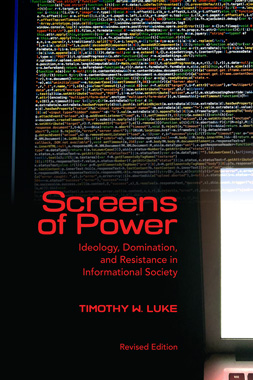 Screens of Power first came out in 1989, a time that would turn out to be the most significant historical turn in global politics after World War II. The book’s author, Timothy W. Luke, offers a concrete account of the history of neoconservatism, grounding his claims in critical analyses of the production of signs, codes, and mass opinion that were at the time making evident their systematic role in the perpetuation of what would emerge as capitalist absolutism. Luke’s book offers a groundbreaking view of both the macro levels of social mobilization and micro processes of ideological hegemony under which corporate capitalist actors would eventually achieve this end. . . . About three decades later, the soundness of Luke’s analysis barely needs any defense. To be clear though, as an exemplary work of critical theory, Screens of Power did not engage in the business of prophecies and game of predictions. Instead, it had the ability to look directly into the actually existing, and one might say with hindsight, ever-growing abyss of capitalist absolutism. The book may have seemed pessimistic in 1989, but now it reads as a faithfully realistic analysis of the neoliberal age. Screens of Power first came out in 1989, a time that would turn out to be the most significant historical turn in global politics after World War II. The book’s author, Timothy W. Luke, offers a concrete account of the history of neoconservatism, grounding his claims in critical analyses of the production of signs, codes, and mass opinion that were at the time making evident their systematic role in the perpetuation of what would emerge as capitalist absolutism. Luke’s book offers a groundbreaking view of both the macro levels of social mobilization and micro processes of ideological hegemony under which corporate capitalist actors would eventually achieve this end. . . . About three decades later, the soundness of Luke’s analysis barely needs any defense. To be clear though, as an exemplary work of critical theory, Screens of Power did not engage in the business of prophecies and game of predictions. Instead, it had the ability to look directly into the actually existing, and one might say with hindsight, ever-growing abyss of capitalist absolutism. The book may have seemed pessimistic in 1989, but now it reads as a faithfully realistic analysis of the neoliberal age.
Continue reading →
By Telos Press · Tuesday, April 20, 2021 In today’s episode of the Telos Press Podcast, David Pan talks with David A. Westbrook about his article “Social Capitalism: A Descriptive Sketch,” from Telos 194 (Spring 2021). An excerpt of the article appears here, and we are providing free open access to the full article at the Telos Online website. To learn how your university can subscribe to Telos, visit our library recommendation page. Print copies of Telos 194 are available for purchase in our online store.
Listen to the podcast here.
Continue reading →
|
|