By Linas Jokubaitis · Tuesday, December 3, 2013 As an occasional feature on TELOSscope, we highlight a past Telos article whose critical insights continue to illuminate our thinking and challenge our assumptions. Today, Linas Jokubaitis looks at Joseph Bendersky’s “Carl Schmitt and the Conservative Revolution” from Telos 72 (Summer 1987).
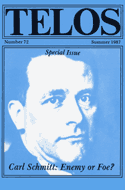 In his last book, Political Theology II, Carl Schmitt wrote that some books are fated to become academic legends, but contrary to the etymological meaning of the word Legende, they are not read, only cited. He knew that his persona was surrounded by many mythologies and that after his death an even greater complex of mythologies would develop around his personality and works. Today there seems to be no end to the multiplication of legends about Schmitt. Joseph Bendersky’s essay “Carl Schmitt and the Conservative Revolution” is a meticulous attempt to understand if there is any truth in the popular legend, according to which Schmitt belonged to a diverse group of intellectuals who were labeled as conservative revolutionaries. In his last book, Political Theology II, Carl Schmitt wrote that some books are fated to become academic legends, but contrary to the etymological meaning of the word Legende, they are not read, only cited. He knew that his persona was surrounded by many mythologies and that after his death an even greater complex of mythologies would develop around his personality and works. Today there seems to be no end to the multiplication of legends about Schmitt. Joseph Bendersky’s essay “Carl Schmitt and the Conservative Revolution” is a meticulous attempt to understand if there is any truth in the popular legend, according to which Schmitt belonged to a diverse group of intellectuals who were labeled as conservative revolutionaries.
Continue reading →
By Robert Wyllie · Tuesday, July 30, 2013 As an occasional feature on TELOSscope, we highlight a past Telos article whose critical insights continue to illuminate our thinking and challenge our assumptions. Today, Robert Wyllie looks at Richard Faber’s “The Rejection of Political Theology: A Critique of Hans Blumenberg,” from Telos 72 (Summer 1987).
In “The Rejection of Political Theology: A Critique of Hans Blumenberg,” Richard Faber reconstructs two alternatives to Carl Schmitt’s political theology. Faber draws the first alternative from Hans Blumenberg. Blumenberg, whose later work explores how metaphor orients thought, proposes a “polytheistic” alternative to “monotheistic” political theology. Polytheism is an early modern metaphor for plural sovereignty, underlying the checks and balances of liberalism. Sympathetically, Blumenberg believes a polytheistic political theology turns away from Schmitt’s “monotheistic” picture of sovereignty where one sovereign decides the state of exception. After expositing Blumenberg’s polytheistic political theology, Faber rejects it. Instead, he turns to Walter Benjamin’s eschatological political theology. Monotheists have been promised an apocalypse, a violent divine intervention, to restore justice in the future. Unlike the Schmittian state of exception, this hoped-for intervention would ground no new legal constitution. Benjamin radicalizes the state of exception into the “pure violence” of a Marxist revolution aimed at destroying the political state altogether.
Continue reading →
By Rebecca Gould · Wednesday, April 10, 2013 Rebecca Gould’s “Laws, Exceptions, Norms: Kierkegaard, Schmitt, and Benjamin on the Exception” appears in Telos 162 (Spring 2013). Read the full version online at the Telos Online website, or purchase a print copy of the issue in our store.
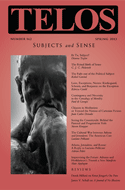 The concept of the exception has heavily shaped modern political theory. In modernity, Kierkegaard was one of the first philosophers to propound the exception as a facilitator of metaphysical transcendence. Merging Kierkegaard’s metaphysical exception with early modern political theorist Jean Bodin’s theory of sovereignty, Carl Schmitt introduced sovereignty to metaphysics. He thereby made an early modern concept usable in a post-metaphysical world. This essay carries Schmitt’s appropriation one step further. Drawing on Walter Benjamin’s replacement of transcendental metaphysics with contingent creaturehood, it reintroduces the anti-foundationalist concept of repetition that was implicit in Kierkegaard’s paradigm but which was not made lucid until Benjamin crafted from the Schmittian exception a vision of political life grounded in creaturely existence. The concept of the exception has heavily shaped modern political theory. In modernity, Kierkegaard was one of the first philosophers to propound the exception as a facilitator of metaphysical transcendence. Merging Kierkegaard’s metaphysical exception with early modern political theorist Jean Bodin’s theory of sovereignty, Carl Schmitt introduced sovereignty to metaphysics. He thereby made an early modern concept usable in a post-metaphysical world. This essay carries Schmitt’s appropriation one step further. Drawing on Walter Benjamin’s replacement of transcendental metaphysics with contingent creaturehood, it reintroduces the anti-foundationalist concept of repetition that was implicit in Kierkegaard’s paradigm but which was not made lucid until Benjamin crafted from the Schmittian exception a vision of political life grounded in creaturely existence.
Continue reading →
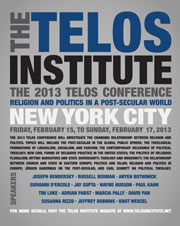
By Jeffrey W. Robbins · Friday, April 5, 2013 The following paper was presented at the Seventh Annual Telos Conference, held on February 15–17, 2013, in New York City.
 With the confirmation hearings of John Brennan as director of the CIA fresh in the news, who can doubt the accuracy, or at least the resonance, of Carl Schmitt’s conception of the sovereign—the sovereign is “he who decides on the exception.” With sovereignty so conceived, it has effectively been cast outside the law, introducing a certain arbitrariness and creating a legal limbo that undermine the principles of a liberal democracy. With the confirmation hearings of John Brennan as director of the CIA fresh in the news, who can doubt the accuracy, or at least the resonance, of Carl Schmitt’s conception of the sovereign—the sovereign is “he who decides on the exception.” With sovereignty so conceived, it has effectively been cast outside the law, introducing a certain arbitrariness and creating a legal limbo that undermine the principles of a liberal democracy.
Enhanced interrogation. Drone attacks on foreign soil. Targeted assassinations. And now, a 16-page white paper from the Department of Justice outlining the legal authority to kill a U.S. citizen without trial. In the words of the New York Times report, the legal brief “adopts an elastic definition of an ‘imminent’ threat, saying it is not necessary for a specific attack to be in process when a target is found.” It also asserts that the decision to kill is not subject to judicial review or restraint.
Continue reading →
By Michael Marder · Friday, March 29, 2013 Today concludes the series of five blog entries aimed at understanding the current political crisis in the European Union through a Schmittian lens. (For the previous posts, see part 1, part 2, part 3, and part 4.) In this post, Michael Marder asks what it would take for the EU to overcome the crisis. The answer, he argues, is nothing less than the EU constituting itself anew, by way of contesting the meaning of the European political subjectivity.
Toward a New Self-Constitution of Europe?
What remains, within the framework the European Union, is the constitution in a relative sense, dissolved “into a multitude of individual, formally equivalent constitutional laws.”[1] We face an expression without anything to express, devoid if not of meaning then of a connection to the sources of meaningfulness. The relegation of constitutional unity to the background and its substitution with constitutional details suits well that institutional arrangement where unity does not actually exist, that is, one where it is not bound to the texture of political existence. The multitude of EU laws is groundless in a different sense from the groundlessness of the absolute concept of the constitution, which is rooted in actual existence and, therefore, self-grounded: “Every existing political unity has its value and its ‘right to existence’ not in the rightness or usefulness of norms, but rather in its existence.”[2] Assuming that this necessary precondition for constitutionality has not been set in place, the main challenge Europe is facing, one that is more fundamental than solving the financial and political crises it is embroiled in, is to attain its political existence, to constitute itself.
Continue reading →
By Michael Marder · Wednesday, March 27, 2013 This is the fourth in a series of five blog entries aimed at understanding the current political crisis in the European Union through a Schmittian lens. (For the previous posts, see part 1, part 2, and part 3.) The hollowness of the EU’s political institutions implies that they are not lively enough to re-constitute themselves so as to cope with new challenges and changing circumstances. That is why the current crisis strikes so deeply at the foundations of the EU and threatens to overwhelm the order it had attempted to institute without taking the question of sovereignty into account.
Europe’s Dynamic De-Constitution
In line with the existential provenance of the form of constitution, such a form cannot be conceived as a static thing but, rather, as a process of formation, or, in Schmitt’s words, “the principle of the dynamic emergence of political unity, of the process of constantly renewed formation and emergence of this unity from a fundamental or ultimately effective power and energy.”[1] It would appear that this dynamic concept of constitution holds a redemptive hope for the EU, which prides itself on being a work-in-progress oriented by the still incomplete tasks of European integration. But this dynamism is just that—a mere appearance. First, as a “union,” the European Union postulates the apriori conditions of unity, those pre-established guidelines with which candidate states must comply and which do not dynamically (organically) emerge in the heat of political life. An incomplete project of unification, it adds on new members in the manner of mineral accretion, as extraneous layers superimposed on an equally dead core. Second, the inherent limits of unity are determined by the limits of the EU competence that acknowledge an irreducible fragmentation of political existence, as diverse as the distinct constitutional traditions of member states make it out to be. The feigned dynamism of the Union’s expansion occludes from view the stagnation of its ossified form, drained of “effective power and energy.”
Continue reading →
|
|