By Michael Marder · Monday, March 25, 2013 This is the third in a series of five blog entries aimed at understanding the current political crisis in the European Union through a Schmittian lens. (For the previous posts, see part 1 and part 2.) The argument of the third installment is simple: Because the European Union lacks a political existential vibrancy, its institutions—the formal stratum of its constitution—are equally hollow. In other words, what we get in the EU is form without substance, provided that substance is understood in a markedly existential sense, as the underlying subject of political existence.
Europe’s Formal De-Constitution
The constitution conceived as “a special type of political and social order” is the second meaning of the term Schmitt isolates in Constitutional Theory.[1] It is important to understand that he operates with a deformalized concept of form as a direct expression of existential content; constitution is “a special form of rule not detachable from . . . political existence.”[2] If so, then everything we said about the existential vacuum of the EU applies to its substantial form: since this does not exist, empty procedural formalism laboriously creates a façade of order, a speculative arrangement not grounded in actual political life. As a result, an artificial division of competences is established between national and European laws, putting in place an abstract order with the indispensable formulation of the relations of supremacy and subordination. (Hence, the Articles 3.a.1 and 3.b.1 of the Treaty of Lisbon: “The limits of Union competences are governed by the principle of conferral. The use of Union competences is governed by the principles of subsidiarity and proportionality.”)
Continue reading →
By Michael Marder · Friday, March 22, 2013 This is the second in a series of five blog entries aimed at understanding the current political crisis in the European Union through a Schmittian lens. (Read part 1 here.) In this post, Michael Marder suggests that a profound source of the problem is that the EU is not rooted in the collective existence of its citizens. In place of a political constituting subject, we find nothing but crass economic interests, covered over with a thin rhetorical veil. For a more extensive discussion of Schmitt, see Michael Marder’s Groundless Existence: The Political Ontology of Carl Schmitt.
Europe’s Existential De-Constitution
The “absolute concept of the constitution” refers to the constitution as a whole,[1] united not by virtue of an external system of basic laws but thanks to the pre-constitutional source from which these laws emanate and derive their legitimacy. Schmitt notes that “constitution in the absolute sense can mean, to begin with, the concrete manner of existence that is given with every political unity,”[2] whereby the “state does not have a constitution” but “is constitution, in other words, an actually present condition, a status of unity and order.”[3] In light of the already mentioned political existential vacuum at the core of the European Union, combined with the fact that it is neither a state nor a confederation of states, we may surmise that it is not a constitution, even though it claims the right to determine the conditions of its unity and order. Since there is no “concrete manner of existence” to draw upon, the status of the EU is equivalent to the formal guidelines, to which potential member states must adhere if they are to gain the right of admission. The deficit of actual unity is remedied by the imposition of ideal unity, procedural at worst and metaphysical at best. Instead of strengthening the status of the EU, this imposition makes it ever more precarious: it sets the stage for a violent standoff between the emergent realities of political existence and the idealities of an alien form foisted upon them.
Continue reading →
By Michael Marder · Wednesday, March 20, 2013 This is the first in a series of five blog entries aimed at understanding the current political crisis in the European Union through a Schmittian lens. The thesis I advance here is that speculative bubbles can burst not only in the economic domain but also on the political arena. The failure of constituting the EU on a political foundation—that is to say, on the basis of the collective existence of EU citizens—is a precipitating factor for the bursting of what I call its “speculative constitutional bubble.”
A Speculative Constitutional Bubble
In a 2000 Cardozo Law Review article, “Carl Schmitt and the Constitution of Europe,” which developed out of the International Symposium titled “Carl Schmitt: Legacy and Prospects” and held in New York City a year prior to the paper’s publication, Jan Müller raised a question we can finally respond to today, over a decade after its original formulation. “[D]oes European integration prove,” he asks, “how useless the Schmittian intellectual tool kit has become, and, in particular, that ‘Schmittian sovereignty’ remains caught in existentialist, concretist ways of thinking, which have long lost touch with the intricate ‘legitimation through procedure’ or the legitimation through prosperity which some see at the heart of the EU?”[1] In the intervening period, we have witnessed, among other things, a spectacular failure of the Treaty Establishing a Constitution for Europe, signed in the end of 2004 and rejected at the French and Dutch referendums half a year thereafter; the coming into effect, in 2009, of the Treaty of Lisbon, which focused on institutional procedures at the expense of actual constitution-making; and the ongoing Euro zone crisis, which, as I shall argue, stands for the culmination of a certain economic and political speculation on the meaning, role, and form of the European Union.
Continue reading →
By Juan Carlos Donado · Tuesday, January 22, 2013 As an occasional feature on TELOSscope, we highlight a past Telos article whose critical insights continue to illuminate our thinking and challenge our assumptions. Today, Juan Carlos Donado looks at Carl Schmitt’s “The Age of Neutralizations and Depoliticizations,” from Telos 96 (Summer 1993).
 Perhaps Carl Schmitt would agree: more than ever before, we live today immersed within the spirit of technicity. Coined by Schmitt, the notion of the spirit of technicity serves the analytical purpose of allowing him to distinguish between the belief in technology and technology itself. Whereas technology signals the factual development of mechanistic progress and its link to natural science, the spirit of technicity, in Schmitt’s own words, is “perhaps an evil and demonic spirit, but not one which can be dismissed as mechanistic and attributed to technology” (141). Perhaps Carl Schmitt would agree: more than ever before, we live today immersed within the spirit of technicity. Coined by Schmitt, the notion of the spirit of technicity serves the analytical purpose of allowing him to distinguish between the belief in technology and technology itself. Whereas technology signals the factual development of mechanistic progress and its link to natural science, the spirit of technicity, in Schmitt’s own words, is “perhaps an evil and demonic spirit, but not one which can be dismissed as mechanistic and attributed to technology” (141).
Continue reading →
By Andrea Salvatore · Monday, January 21, 2013 Andrea Salvatore’s “The Tragic Theory of Carl Schmitt” appears in Telos 161 (Winter 2012). Read the full version online at the Telos Online website, or purchase a print copy of the issue in our store.
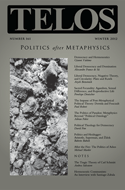 The present note aims to suggest a tragic reading of Carl Schmitt’s thought within a post-metaphysical perspective. The argument is divided into two parts. In the first—the meaning of the tragic dimension—I deal with Schmitt as a theorist of the tragic, that is, with the concept of tragedy that can be induced from Schmitt’s philosophy as a unitary whole. In the second part—the actuality of the tragic era—I will consider Schmitt as a pathologist of the tragic, by summarizing the diagnosis of the modernity he explicitly points out in his major works. The first thesis states that any normative and/or political order constitutively depends on a fundamental set of factual pre-conditions, whose actual enforcement in turn depends on a contextual and epochal contingency, beyond human control. If so, the range of human agency is determined by a super-human contextual contingency, to such an extent that we have to abandon the illusion of being able to decide everything. The second thesis states that the contemporary era is irretrievably characterized by a set of factual pre-conditions that makes any ultimate decision and political order unfeasible. If so, late modernity’s contingency is determined by the lack of any ordering principle and foundational reality, with the consequence that we have to abandon the illusion of being able to decide something. The awareness of the vital necessity of something lacking, and still impossible to restore, marks the tragic character of Schmitt’s thought considered in its consistent whole. The present note aims to suggest a tragic reading of Carl Schmitt’s thought within a post-metaphysical perspective. The argument is divided into two parts. In the first—the meaning of the tragic dimension—I deal with Schmitt as a theorist of the tragic, that is, with the concept of tragedy that can be induced from Schmitt’s philosophy as a unitary whole. In the second part—the actuality of the tragic era—I will consider Schmitt as a pathologist of the tragic, by summarizing the diagnosis of the modernity he explicitly points out in his major works. The first thesis states that any normative and/or political order constitutively depends on a fundamental set of factual pre-conditions, whose actual enforcement in turn depends on a contextual and epochal contingency, beyond human control. If so, the range of human agency is determined by a super-human contextual contingency, to such an extent that we have to abandon the illusion of being able to decide everything. The second thesis states that the contemporary era is irretrievably characterized by a set of factual pre-conditions that makes any ultimate decision and political order unfeasible. If so, late modernity’s contingency is determined by the lack of any ordering principle and foundational reality, with the consequence that we have to abandon the illusion of being able to decide something. The awareness of the vital necessity of something lacking, and still impossible to restore, marks the tragic character of Schmitt’s thought considered in its consistent whole.
Continue reading →
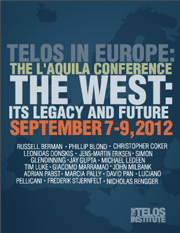
By David Pan · Wednesday, January 2, 2013 The following paper was presented at Telos in Europe: The L’Aquila Conference, held on September 7-9, 2012, in L’Aquila, Italy.
 Since the Treaty of Westphalia, sovereignty in the West has been imagined in terms of the nation-state and its ability to provide a universal basis for political relations both within state boundaries and in relations with other similarly organized entities. On the one hand, the nation-state originates as a means of overcoming the religious civil wars, and its establishment coincides with the attempt to relegate theological disputes to a private sphere that does not threaten the structure of the state. In this way, the state as opposed to the church becomes the primary form for defining the political. On the other hand, the development and stability of the nation-state system seems to have been inextricably linked to the dynamic of colonialism. As Carl Schmitt lays out in The Nomos of the Earth, the establishment of a jus publicum europaeum that created guidelines for limiting war between European states was accompanied and indeed predicated upon a complementary establishment of the amity lines that distinguished Europe from the rest of the world as the place of such limited war as against the “freedom” of the spaces beyond the line in which restrictions on warfare did not apply. For Schmitt, the relationship between these two dynamics, the coalescence of nation-state relations in Europe on the basis of a limitation of war and the establishment of unlimited war in those areas outside of Europe without nation-state structures, has not been coincidental but in fact constitutive for both the rise of the West and the structure of international relations in the modern world. Since the Treaty of Westphalia, sovereignty in the West has been imagined in terms of the nation-state and its ability to provide a universal basis for political relations both within state boundaries and in relations with other similarly organized entities. On the one hand, the nation-state originates as a means of overcoming the religious civil wars, and its establishment coincides with the attempt to relegate theological disputes to a private sphere that does not threaten the structure of the state. In this way, the state as opposed to the church becomes the primary form for defining the political. On the other hand, the development and stability of the nation-state system seems to have been inextricably linked to the dynamic of colonialism. As Carl Schmitt lays out in The Nomos of the Earth, the establishment of a jus publicum europaeum that created guidelines for limiting war between European states was accompanied and indeed predicated upon a complementary establishment of the amity lines that distinguished Europe from the rest of the world as the place of such limited war as against the “freedom” of the spaces beyond the line in which restrictions on warfare did not apply. For Schmitt, the relationship between these two dynamics, the coalescence of nation-state relations in Europe on the basis of a limitation of war and the establishment of unlimited war in those areas outside of Europe without nation-state structures, has not been coincidental but in fact constitutive for both the rise of the West and the structure of international relations in the modern world.
Continue reading →
|
|