By Russell A. Berman · Wednesday, November 11, 2020 The President of France, Emmanuel Macron, delivered this speech on September 4, 2020. I discussed it in a TelosScope post here, putting it in dialogue with President Trump’s Mount Rushmore speech of July 4. There has been interest on the part of some readers in a full translation of Macron’s text, so it is offered below.
The context: Macron is welcoming a group of newly naturalized citizens into the national community. Hence his double agenda: on the one hand, highlighting the diversity of France as an immigrant nation, while on the other insisting on the unity of French history, culture, language, and above all the Republic. This is a speech about the Republican values that Macron expects all French citizens to share and, what’s more, to uphold actively and vigorously. “Liberty, Equality, Fraternity” have a standing in French political culture similar to “life, liberty, and the pursuit of happiness” from the American Declaration of Independence.
Continue reading →
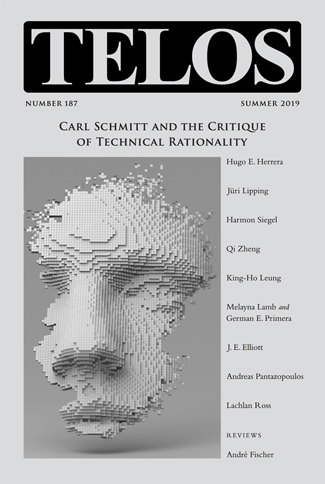
By King-Ho Leung · Thursday, July 18, 2019 King-Ho Leung’s “Living Paradoxes: On Agamben, Taylor, and Human Subjectivity” appears in Telos 187 (Summer 2019). Read the full article at the Telos Online website, or purchase a print copy of the issue in our online store. Individual subscriptions to Telos are available in both print and online formats.
 Over the last two decades, Giorgio Agamben and Charles Taylor have produced important and influential genealogical works on the philosophical and political conceptions of secularity. Yet in their recent work, both of these thinkers have respectively returned to a prominent theme in their earlier works: human life. This essay offers a parallel reading of Agamben and Taylor as post-Heideggerian critics of the modern conception of human subjectivity. Through examining these their respective characterizations of modern subjectivity—namely, Taylor’s account of the “disengaged self” and Agamben’s conception of the “excluded-included” bare life—this essay seeks to highlight not only the Heideggerian currents underlying the philosophical anthropologies of Agamben and Taylor, but also the ontological paradoxicalities they detect in the conception of human existence and subjectivity in politico-philosophical modernity. After reviewing the different aspects of Agamben’s and Taylor’s critiques of modern subjectivity as well as the traditional metaphysical conception of humans as “language animals,” this essay concludes by sketching a robust and affirmative “paradoxical” conception of human beings as “language animals” that simultaneously takes into account the insights from Taylor’s (post)analytic philosophical renewal of Aristotelianism and Agamben’s critical analysis of contemporary biopolitics in the continental philosophical tradition. Over the last two decades, Giorgio Agamben and Charles Taylor have produced important and influential genealogical works on the philosophical and political conceptions of secularity. Yet in their recent work, both of these thinkers have respectively returned to a prominent theme in their earlier works: human life. This essay offers a parallel reading of Agamben and Taylor as post-Heideggerian critics of the modern conception of human subjectivity. Through examining these their respective characterizations of modern subjectivity—namely, Taylor’s account of the “disengaged self” and Agamben’s conception of the “excluded-included” bare life—this essay seeks to highlight not only the Heideggerian currents underlying the philosophical anthropologies of Agamben and Taylor, but also the ontological paradoxicalities they detect in the conception of human existence and subjectivity in politico-philosophical modernity. After reviewing the different aspects of Agamben’s and Taylor’s critiques of modern subjectivity as well as the traditional metaphysical conception of humans as “language animals,” this essay concludes by sketching a robust and affirmative “paradoxical” conception of human beings as “language animals” that simultaneously takes into account the insights from Taylor’s (post)analytic philosophical renewal of Aristotelianism and Agamben’s critical analysis of contemporary biopolitics in the continental philosophical tradition.
Continue reading →
By Agata Bielik-Robson · Wednesday, April 24, 2019 Agata Bielik-Robson’s “Marrano Universalism: Benjamin, Derrida, and Buck-Morss on the Condition of Universal Exile” appears in Telos 186 (Spring 2019). Read the full article at the Telos Online website, or purchase a print copy of the issue in our online store. Individual subscriptions to Telos are available in both print and online formats.
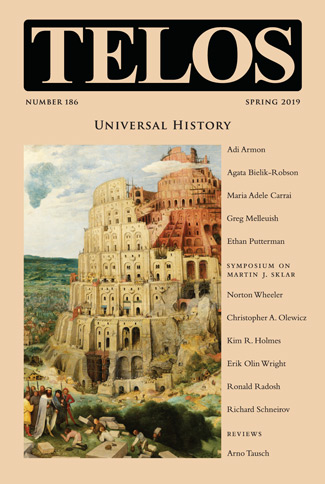 In this article, I would like to outline a new strategy for the universalization of history, which emerges from an analysis of the modern Jewish practice of philosophizing. I call it a Marrano strategy, building an analogy between the religious practices of the late-medieval Sephardic Jewry, which was forced to convert to Christianity but kept Judaism “undercover,” and the philosophical intervention of modern Jewish thinkers who spoke the seemingly universal idiom of Western philosophy but, at the same time, impregnated it “secretly” with the motives deriving from their “particular” background. This secret particularist lining did not serve to abolish the universalist perspective, but merely to transform it; for the last heirs of this “Marrano” line, Walter Benjamin and Jacques Derrida, the proper universalism amounts to an after-Babel project of mending the broken whole from within, horizontally, without assuming the abstract position of a general meta-language, but through the multilingual “task of translation.” In this article, I would like to outline a new strategy for the universalization of history, which emerges from an analysis of the modern Jewish practice of philosophizing. I call it a Marrano strategy, building an analogy between the religious practices of the late-medieval Sephardic Jewry, which was forced to convert to Christianity but kept Judaism “undercover,” and the philosophical intervention of modern Jewish thinkers who spoke the seemingly universal idiom of Western philosophy but, at the same time, impregnated it “secretly” with the motives deriving from their “particular” background. This secret particularist lining did not serve to abolish the universalist perspective, but merely to transform it; for the last heirs of this “Marrano” line, Walter Benjamin and Jacques Derrida, the proper universalism amounts to an after-Babel project of mending the broken whole from within, horizontally, without assuming the abstract position of a general meta-language, but through the multilingual “task of translation.”
Continue reading →
By Marco Andreacchio · Thursday, January 31, 2019 Marco Andreacchio’s “Epistemology’s Political-Theological Import in Giambattista Vico” appears in Telos 185 (Winter 2018). Read the full article at the Telos Online website, or purchase a print copy of the issue in our online store. Individual subscriptions to Telos are available in both print and online formats.
The twentieth-century rise to fame of Giambattista Vico as anticipator of historical relativism obscures essential elements of the eighteenth-century philosopher’s message. Vico’s stringent argumentation points well beyond contemporary expectations, offering a classical alternative to both a political depreciation of metaphysics and a metaphysical depreciation of politics. Carrying on a Renaissance tradition inaugurated most notably by Dante Alighieri, Vico invites us to rediscover or return to the poetic language of pagan antiquity as political-theological key to philosophical reflection upon the nature of the human mind. What Vico intends to defend are not old myths as such, but the essential independence of the human mind from any and all myths, be they ancient, medieval, or modern.
Continue reading →
By Melody Yunzi Li · Tuesday, September 19, 2017 Melody Yunzi Li’s “‘At Home in the World”: Hong Kong as a Cosmopolitan City in Xu Xi’s The Unwalled City” appears in Telos 180 (Fall 2017), a special issue on Cosmopolitanism and China. Read the full article at the Telos Online website, or purchase a print copy of the issue in our online store.
Hong Kong is unique for its hybrid nature in language and culture. Drawing upon Ulf Hannerz’s model of cosmopolitans and locals, this paper argues that Hong Kongese are cosmopolitans and locals in one, other than the dichotomy raised by Hannerz. The paper considers how Xu Xi’s novel The Unwalled City questions any overarching or simplified understanding of cosmopolitanism and its utopian parlance of seamless linguistic-cultural coexistence. For Xu Xi, writing in English provides a crucially literary tactic with which to construct her multiple ethnic identities and eclectic images.
Continue reading →
By Telos Press · Tuesday, September 13, 2016 “Today words like ‘persevere’ and ‘hero’s death’ had been so ceaselessly bandied about that they had long since acquired an ironic sound—at least wherever there was actual fighting. . . . Once, before an attack, Sturm had heard an old sergeant say the following: ‘Kids, we’re going over there now to gobble up the Englishmen’s rations.’ It was the best battle address that he had ever heard. That was surely something good in the war—that it destroyed glorious-sounding phrases. Concepts that hung fleshless in the void were overcome by laughter.”
—Ernst Jünger, Sturm, describing the Battle of the Somme, whose centenary is this year.
Continue reading →
|
|