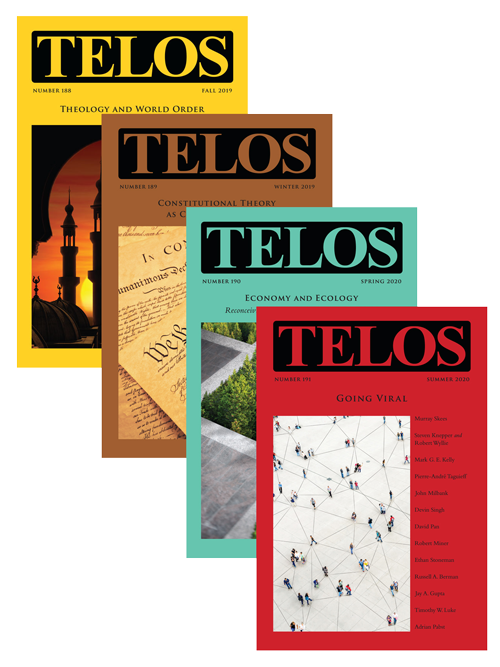
In today’s episode of the Telos Press Podcast, Camelia Raghinaru talks with David Pan about his article “Unalienable Rights, the 1619 Project, and Nation-State Sovereignty,” one of a group of essays from Telos 192 (Fall 2020) on the U.S. State Department’s Commission on Unalienable Rights. An excerpt of the article appears here. If your university has an online subscription to Telos, you can read the full article at the Telos Online website. For non-subscribers, learn how your university can begin a subscription to Telos at our library recommendation page. Purchase a print copy of Telos 192 in our online store.
|
In today’s episode of the Telos Press Podcast, Camelia Raghinaru talks with Takahiro Nakajima about his article “Constitutionalism and Sovereignty: On Constitutional Problems in Japan,” from Telos 189 (Winter 2019). An excerpt of the article appears here. If your university has an online subscription to Telos, you can read the full article at the Telos Online website. For non-subscribers, learn how your university can begin a subscription to Telos at our library recommendation page. Purchase a print copy of Telos 189 in our online store. In today’s episode of the Telos Press Podcast, Camelia Raghinaru talks with Qin Wang about his article “Constitution and Literariness: Takeuchi Yoshimi’s Critique of the Postwar Japanese Constitution,” from Telos 189 (Winter 2019). An excerpt of the article appears here. If your university has an online subscription to Telos, you can read the full article at the Telos Online website. For non-subscribers, learn how your university can begin a subscription to Telos at our library recommendation page. Purchase a print copy of Telos 189 in our online store. In today’s episode of the Telos Press Podcast, Camelia Raghinaru talks with Devin Singh about his article “Exceptional Economy: Sovereign Exchanges in Carl Schmitt and Giorgio Agamben,” from Telos 191 (Summer 2020). An excerpt of the article appears here. If your university has an online subscription to Telos, you can read the full article at the Telos Online website. For non-subscribers, learn how your university can begin a subscription to Telos at our library recommendation page. Purchase a print copy of Telos 191 in our online store. In today’s episode of the Telos Press Podcast, Camelia Raghinaru talks with Telos editor David Pan about his article “Economy and Ecology: Federal Populism and the Devil in the Details of Universal Basic Income,” from Telos 191 (Summer 2020). An excerpt of the article appears here. If your university has an online subscription to Telos, you can read the full article at the Telos Online website. For non-subscribers, learn how your university can begin a subscription to Telos at our library recommendation page. Purchase a print copy of Telos 191 in our online store. In 1972, Irving Kristol noted the striking fact that the New Left seemed to lack a coherent economic critique of the status quo, besides occasional Marxist platitudes borrowed from the Old Left:
What really ailed American society, and what the New Left could sense but not articulate, Kristol wrote, was a spiritual malady. Despite the efforts of Burkean conservatives, the “accumulated moral capital of traditional religion and traditional moral philosophy” had been steadily depleting since the French Revolution, and with its depletion, so too society’s abilities to cope with the material inequalities, resentments, and indignities made inevitable by the free exchange of goods and services. |
   |
|||
|
Privacy Policy · Data Protection Copyright © 2026 Telos Press Publishing · All Rights Reserved |
||||