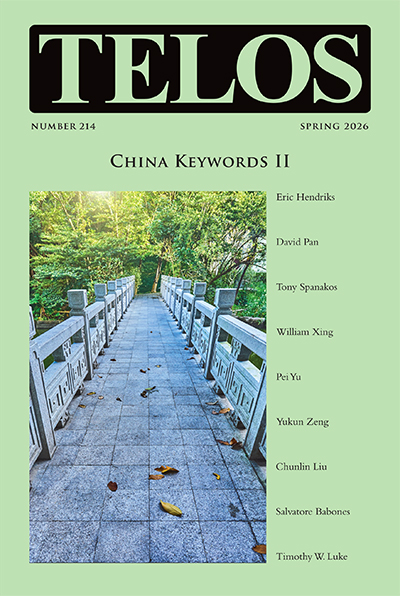
By Eric Hendriks and David Pan · Tuesday, December 30, 2025 Telos 213 (Winter 2025): China Keywords I is now available for purchase in our store. Individual subscriptions to Telos are also available in both print and online formats.
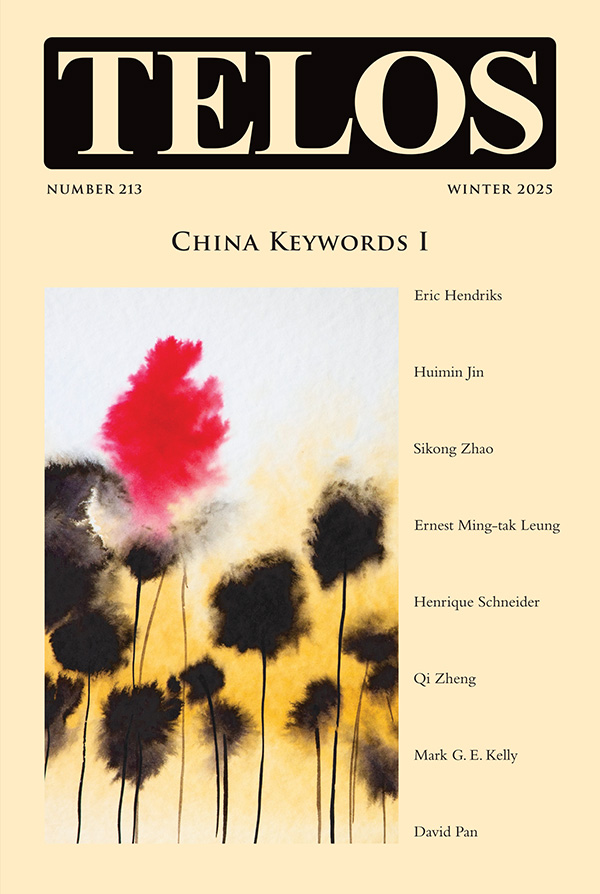 China saturates Western media and academic discourse, invoked incessantly as a force remaking the world, while the political and social-theoretical ideas through which China thinks, judges, and interprets that world remain largely unheard. Western discourses on China exhibit a persistent tendency toward objectification and reification. Chinese phenomena figure as objects of analysis, yet such analyses rarely delve into their subjective-interpretative depth. Were they to do so, they would encounter these “objects” as subjects who actively make sense of their worlds, carrying ideas, ideals, and self-conceptions embedded in distinct interpretive traditions. At the same time, Western media and academics are often unaware that their own views are actively influenced by the Chinese Communist Party (CCP), which spends $10 billion per year on international propaganda efforts that include advertising, news production, and social media campaigns. China saturates Western media and academic discourse, invoked incessantly as a force remaking the world, while the political and social-theoretical ideas through which China thinks, judges, and interprets that world remain largely unheard. Western discourses on China exhibit a persistent tendency toward objectification and reification. Chinese phenomena figure as objects of analysis, yet such analyses rarely delve into their subjective-interpretative depth. Were they to do so, they would encounter these “objects” as subjects who actively make sense of their worlds, carrying ideas, ideals, and self-conceptions embedded in distinct interpretive traditions. At the same time, Western media and academics are often unaware that their own views are actively influenced by the Chinese Communist Party (CCP), which spends $10 billion per year on international propaganda efforts that include advertising, news production, and social media campaigns.
Continue reading →
Reckoning with October 7: Israel, Hamas, and the Problem of Critical Theory
A TPPI Conference
November 8–9, 2024
New York City
 The Telos-Paul Piccone Institute welcomes paper proposals for a conference that reckons with the response, both within higher education at large and especially from the precincts of critical theory, to the atrocities perpetrated by Hamas on October 7, 2023. The conference will cap a year of webinars, podcasts, blog posts, and publications about the topic, and will form the basis of a special memorial issue of the journal Telos. Full papers intended for that special issue will also be considered at this time. The Telos-Paul Piccone Institute welcomes paper proposals for a conference that reckons with the response, both within higher education at large and especially from the precincts of critical theory, to the atrocities perpetrated by Hamas on October 7, 2023. The conference will cap a year of webinars, podcasts, blog posts, and publications about the topic, and will form the basis of a special memorial issue of the journal Telos. Full papers intended for that special issue will also be considered at this time.
Beginning in the immediate, politicized aftermath of the Hamas atrocities, theory has been present—in ways that should give us pause. It was present in sublimated ways, as widespread presuppositions and “narratives” infused with charismatic authority by a popularized postcolonial jargon. It was there in kinetic, emotionally charged, intellectually unsophisticated responses, in “mass” demonstrations, public statements by groups and institutions, and individual social media campaigns. It was there in “intersectional” ideology. Yet above all, it was manifest in considered, open, intentional ways within universities, as well as among educated elites taught and credentialed by them. The college campus, the traditional home of critical theory—which emerged in the twentieth century most powerfully as a response to fascism and Nazism—has become a nodal point for the dramatic unfolding of a cognitively, morally, and politically deficient discourse about a present-day Kristallnacht.
Continue reading →
By The Telos-Paul Piccone Institute · Tuesday, February 20, 2024 The third webinar in the Telos-Paul Piccone Institute’s yearlong series reckoning with the response to October 7 will take place on Thursday, March 7, 2024, at noon Eastern Time.
Click here to register for the event.
All subsequent panels are likewise scheduled for noon Eastern Time on the seventh day of each month. Panels will run between 90 to 120 minutes, followed by a colloquy among the panelists and audience Q&A.
Our third webinar considers feminist perspectives on sex and violence in the Israel–Hamas conflict. Our panelists are Mariam Memarsadeghi and Batya Ungar-Sargon. Our respondent is Nina Power.
Continue reading →
On today’s episode of the Telos-Paul Piccone Institute podcast, TPPI’s Mark G. E. Kelly, organizer of the 2024 Telos conference on “Democracy Today?,” speaks with Salvator Babones of the University of Sydney about democracy in India, asking him in particular about his sympathetic reading of the Bharatiya Janata Party (BJP) of Prime Minister Narendra Modi. The podcast is available in both video and audio-only formats.
Continue reading →
|
|