By Gabriel Noah Brahm · Wednesday, January 31, 2024 For the accompanying essay by Casey Spinks, click here.
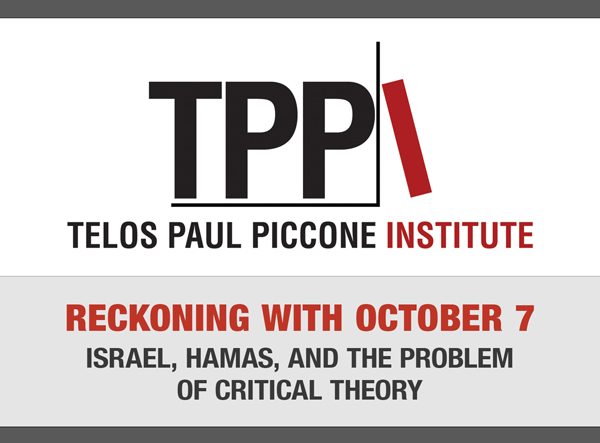 On January 7, 2024, we began a series of webinars, “Reckoning with October 7: Israel, Hamas, and the Problem of Critical Theory,” with the first installment of that projected 12-part, yearlong endeavor. Our question, to start, was how might critical theory have contributed to softening the ground, or paving the way, for the perverse reception of 10/7 on the American college campus in particular, which actually celebrated [sic!] the Hamas torture, murder, rape, and kidnapping spree as a “liberation” movement on behalf the wretched of earth? And how, if at all, might theory redeem itself from such charges of complicity with evil? On January 7, 2024, we began a series of webinars, “Reckoning with October 7: Israel, Hamas, and the Problem of Critical Theory,” with the first installment of that projected 12-part, yearlong endeavor. Our question, to start, was how might critical theory have contributed to softening the ground, or paving the way, for the perverse reception of 10/7 on the American college campus in particular, which actually celebrated [sic!] the Hamas torture, murder, rape, and kidnapping spree as a “liberation” movement on behalf the wretched of earth? And how, if at all, might theory redeem itself from such charges of complicity with evil?
Continue reading →
By Casey Spinks · Wednesday, January 31, 2024 For Gabriel Noah Brahm’s preface to this essay, click here.
In the first panel of TPPI’s Israel Initiative webinar series devoted to discussing the atrocities of October 7, one of the chief points of debate was whether critical theory—or any other theory—was up to the task of reckoning with Hamas’s massacre of Jews and its ensuing embrace from certain parts of academia.
Abe Silberstein cautioned that it is not helpful to emphasize the disruptive character of these attacks or the notion that something new has happened. Instead, violence like this is, unfortunately, what human beings have been doing to each other for a long time. And Silberstein, thus, seems committed to the tough work of theorizing about these events and distinguishing carefully where their academic boosters have erred in their theorizing about them.
Cary Nelson, Gabriel Noah Brahm, and Manuela Consonni, however, held that there is not much theory going on. Nelson even admitted that “no theory that I’ve been working with for the past sixty years” is up to the job of understanding or explaining this event. Consonni also cautioned that it’s not a matter of “whether or not Franz Fanon is being followed.” They agree that there is something more sinister at work than bad theory.
Continue reading →
By The Telos-Paul Piccone Institute · Saturday, January 27, 2024 As part of its Israel initiative, the Telos-Paul Piccone Institute has published a podcast conversation with Prof. Cary Nelson, former president of the American Association of University Professors, about the role of critical theory in the response within higher education to the Hamas atrocities of October 7. This conversation follows TPPI’s webinar on January 7 on the same subject with Nelson, Abe Silberstein, and Manuela Consonni. The podcast is available in both video and purely audio forms. TPPI will be publishing podcasts featuring open-ended conversations with individual participants in its Israel initiative webinar series throughout the year.
Continue reading →
By The Telos-Paul Piccone Institute · Thursday, January 25, 2024 REMINDER:
Our next webinar takes place on February 7. Register today!
The second webinar in the Telos-Paul Piccone Institute’s yearlong series reckoning with the response to October 7 will take place on Wednesday, February 7, 2024, at noon Eastern Standard Time. The title of the panel will be “Historians on Ideology and Politics in the 1948 War: October 7 and the Aftershocks of World War II.”
Click here to register for the event.
All subsequent panels are likewise scheduled for noon EST on the seventh day of each month throughout 2024. Panels will run between 90 to 120 minutes long, followed by colloquy among panelists and audience Q&A.
Building on the success of our thought-provoking first panel, which laid the groundwork for ongoing discussion of critical theory and the Israel–Hamas conflict, our next panel features renowned historians, Jeffrey Herf, Matthias Küntzel, and Benny Morris. Herf’s presentation is titled “Israel’s Moment: The Forgotten International Politics Regarding the Establishment of the State of Israel.” Küntzel will present on “Nazi Antisemitism and the Hamas Massacre.” Morris will consider October 7 and the 1948 Arab–Israeli war as jihad. Series organizer Gabriel Noah Brahm will moderate.
Continue reading →
By Gabriel Noah Brahm · Friday, January 19, 2024 Collin May’s essay “Critical Theory as an Anti-Emancipatory Project” appeared earlier this week in TelosScope.
Collin May would not seem like an ideal target for cancelation—if by that one means someone relatively defenseless, inarticulate or unable to speak for himself, lacking in intellectual resources to understand his predicament, uncredentialed, without elite professional training in the subject he is accused of mishandling, or ready access to legal counsel. Or if by that one means someone accused of having done something wrong under murky circumstances, in any way nebulous, difficult to check, or hard to prove one way or the other.
To the contrary. May is himself a lawyer, trained philosopher, theologian, and scholar of Islam. Yet he ran afoul of the powers of “woke” that be, over the publication of an academic book review on the subject of Islamic history, published years ago in a prestigious outlet, just when he had stepped into a prominent role as a Canadian civil servant.
Continue reading →
By Collin May · Monday, January 15, 2024 Gabriel Noah Brahm’s interview with Collin May appears here.
The rapid expansion of woke ideology and its attendant cancel culture has produced both a popular and an academic backlash. The recent appearance by the trio of university presidents before the House of Representatives Education Committee has only served to focus that backlash against the conformism and anti-free speech culture that dominate many university campuses.
On a popular level, we are all familiar with concepts such as anti-racism, settler colonialism, and the ubiquitous EDI—equity, diversity, and inclusion. On the intellectual level, the backlash focuses on a growing sense of scholarly puritanism attributed to anti-Enlightenment theories that underly these public concepts. The theories include: neo-feminism; postmodernism, often with a Foucauldian inspiration; and critical theory. As far as critical theory is concerned, the spotlight shines on German-American critical theorist Herbert Marcuse.
Marcuse is famous for an essay he wrote in 1965 entitled “Repressive Tolerance.” In it, he argued that tolerance in the liberal capitalist West was simply a veil that oppressive right-wing movements and state institutions used to dominate public discourse while silencing left-leaning activism. In response, Marcuse called for the outright suppression of speech and discourse deemed right-wing. In other words, intolerance for allegedly right-leaning narratives, with untrammeled promotion of the supposedly emancipatory left-leaning narratives.
Continue reading →
|
|