By Gabriel Noah Brahm · Friday, January 19, 2024 Collin May’s essay “Critical Theory as an Anti-Emancipatory Project” appeared earlier this week in TelosScope.
 Collin May would not seem like an ideal target for cancelation—if by that one means someone relatively defenseless, inarticulate or unable to speak for himself, lacking in intellectual resources to understand his predicament, uncredentialed, without elite professional training in the subject he is accused of mishandling, or ready access to legal counsel. Or if by that one means someone accused of having done something wrong under murky circumstances, in any way nebulous, difficult to check, or hard to prove one way or the other. Collin May would not seem like an ideal target for cancelation—if by that one means someone relatively defenseless, inarticulate or unable to speak for himself, lacking in intellectual resources to understand his predicament, uncredentialed, without elite professional training in the subject he is accused of mishandling, or ready access to legal counsel. Or if by that one means someone accused of having done something wrong under murky circumstances, in any way nebulous, difficult to check, or hard to prove one way or the other.
To the contrary. May is himself a lawyer, trained philosopher, theologian, and scholar of Islam. Yet he ran afoul of the powers of “woke” that be, over the publication of an academic book review on the subject of Islamic history, published years ago in a prestigious outlet, just when he had stepped into a prominent role as a Canadian civil servant.
Continue reading →
By Collin May · Monday, January 15, 2024 Gabriel Noah Brahm’s interview with Collin May appears here.
The rapid expansion of woke ideology and its attendant cancel culture has produced both a popular and an academic backlash. The recent appearance by the trio of university presidents before the House of Representatives Education Committee has only served to focus that backlash against the conformism and anti-free speech culture that dominate many university campuses.
On a popular level, we are all familiar with concepts such as anti-racism, settler colonialism, and the ubiquitous EDI—equity, diversity, and inclusion. On the intellectual level, the backlash focuses on a growing sense of scholarly puritanism attributed to anti-Enlightenment theories that underly these public concepts. The theories include: neo-feminism; postmodernism, often with a Foucauldian inspiration; and critical theory. As far as critical theory is concerned, the spotlight shines on German-American critical theorist Herbert Marcuse.
Marcuse is famous for an essay he wrote in 1965 entitled “Repressive Tolerance.” In it, he argued that tolerance in the liberal capitalist West was simply a veil that oppressive right-wing movements and state institutions used to dominate public discourse while silencing left-leaning activism. In response, Marcuse called for the outright suppression of speech and discourse deemed right-wing. In other words, intolerance for allegedly right-leaning narratives, with untrammeled promotion of the supposedly emancipatory left-leaning narratives.
Continue reading →
The second webinar in the Telos-Paul Piccone Institute’s yearlong series reckoning with the response to October 7 will take place on Wednesday, February 7, 2024, at noon Eastern Standard Time. The title of the panel will be “Historians on Ideology and Politics in the 1948 War: October 7 and the Aftershocks of World War II.”
Click here to register for the event.
Continue reading →
By David Pan · Friday, January 12, 2024 Telos 205 (Winter 2023): Forms of War is now available for purchase in our store. Individual subscriptions to Telos are also available in both print and online formats.
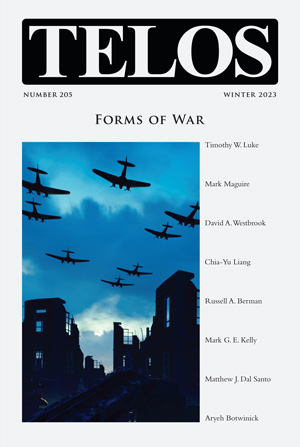 One of the most challenging aspects of the wars in Ukraine and Israel is the way in which the conflicts have been constantly shifting in form. In the first place, there is a conventional ground war between Russia and Ukraine, in which the identity and will of the two peoples are at stake. Yet Russia has used weapons supplied by Iran and North Korea, and Ukraine relies on NATO for its own supplies, indicating that this war depends on the maintenance and expansion of alliances. The stability of these alliances in turn depends on a combination of Realpolitik and shared values as the glue that holds them together. This logic of alliances motivates the energy war that Russia is waging with Europe, revealing that, unbeknownst to Europe, Russian energy policy over the last decade was an early form of the war. Similarly, the threat of nuclear war also tests the resolve of NATO, forcing it to consider the values at stake in the conflict. Is the war about Ukraine’s sovereignty or the principle of nation-state sovereignty itself? Is it about human rights for Ukrainians or the entire human rights project? For Russia, is it about self-defense or a pan-Slavic identity? Is it about the protection of Russian minorities in Ukraine or the threat of Western secularization? The answers to these questions will determine the will to fight on each side and thus the length and ferocity of the war. One of the most challenging aspects of the wars in Ukraine and Israel is the way in which the conflicts have been constantly shifting in form. In the first place, there is a conventional ground war between Russia and Ukraine, in which the identity and will of the two peoples are at stake. Yet Russia has used weapons supplied by Iran and North Korea, and Ukraine relies on NATO for its own supplies, indicating that this war depends on the maintenance and expansion of alliances. The stability of these alliances in turn depends on a combination of Realpolitik and shared values as the glue that holds them together. This logic of alliances motivates the energy war that Russia is waging with Europe, revealing that, unbeknownst to Europe, Russian energy policy over the last decade was an early form of the war. Similarly, the threat of nuclear war also tests the resolve of NATO, forcing it to consider the values at stake in the conflict. Is the war about Ukraine’s sovereignty or the principle of nation-state sovereignty itself? Is it about human rights for Ukrainians or the entire human rights project? For Russia, is it about self-defense or a pan-Slavic identity? Is it about the protection of Russian minorities in Ukraine or the threat of Western secularization? The answers to these questions will determine the will to fight on each side and thus the length and ferocity of the war.
Similarly, the war between Israel and Hamas began with Hamas’s use of terror and rape as instruments of war. The idea was to provoke Israel into attacking Hamas and causing civilian casualties. Because the terrain of war extends to public opinion in the West, Hamas’s use of Israeli hostages and Palestinian human shields becomes part of its strategy of increasing civilian casualties in the war. Even though Hamas is the ultimate cause of such casualties, Hamas is able to pressure Israel by placing civilians in the path of Israel’s war effort. The conflict on the ground in Gaza is thus overshadowed by the struggle for hearts and minds across the globe.
Continue reading →
By The Telos-Paul Piccone Institute · Wednesday, January 10, 2024 The first webinar in our yearlong series reckoning with the response to October 7 is available here. Panelists included Cary Nelson, Abe Silberstein, and Manuela Consonni. Their conversation was moderated by Israel initiative director Gabriel Noah Brahm. Eighty audience members heard their illuminating conversation, which provided a model of respectful engagement amidst disagreement, and many stayed for another hour for a casual, after-panel discussion.
The next webinar in the Israel webinar series will take place on Wednesday, February 7, at noon ET.
Continue reading →
By Telos Press · Friday, December 22, 2023 Now available: Shards and Specters of the New World Order, by Timothy W. Luke. Order the paperback edition today in our online store and save 20% by using the coupon code BOOKS20. Also available in Kindle ebook format at Amazon.com.
Shards and Specters of the New World Order: Casting Soviet and Post-Soviet Studies as Critique
by Timothy W. Luke
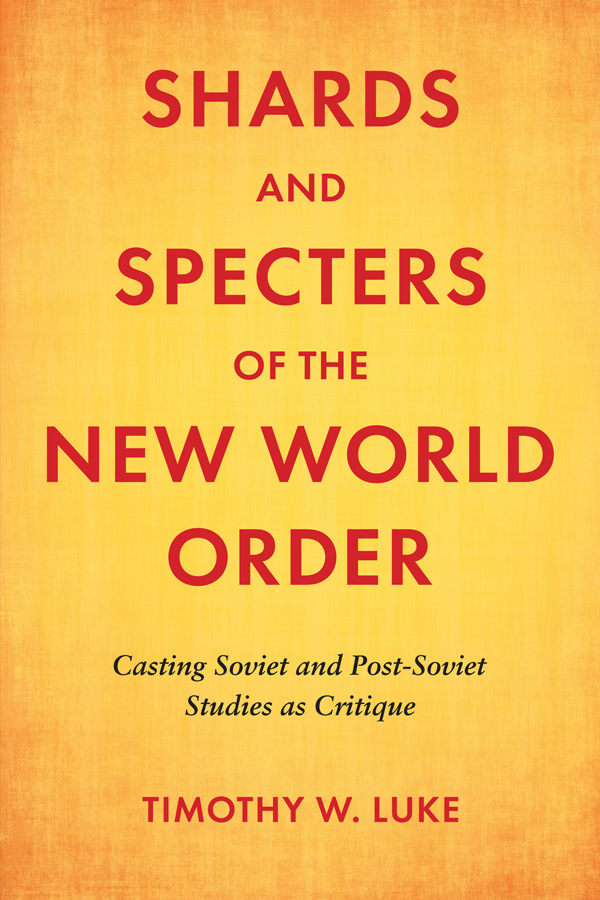 From ideological dynamics in revolutionary Russia, cultural stagnation in the USSR, and ineffective Soviet governance in the 1980s to the USSR’s institutional collapse in 1991, the emergence of the Russian Federation under Boris Yeltsin, and Vladimir Putin’s wars in Ukraine since 2014, Timothy W. Luke’s Shards and Specters of the New World Order investigates how the geopolitical clout of the United States has worked to contain, but at other times sustain, the Soviet Union and later the Russian Federation. Luke’s critical studies also examine how Moscow’s strategies provoked radical Islamic resistance movements in Afghanistan and aided anti-Western client states, like Iraq and Syria, that threatened the New World Order envisioned in Washington after 1991. From ideological dynamics in revolutionary Russia, cultural stagnation in the USSR, and ineffective Soviet governance in the 1980s to the USSR’s institutional collapse in 1991, the emergence of the Russian Federation under Boris Yeltsin, and Vladimir Putin’s wars in Ukraine since 2014, Timothy W. Luke’s Shards and Specters of the New World Order investigates how the geopolitical clout of the United States has worked to contain, but at other times sustain, the Soviet Union and later the Russian Federation. Luke’s critical studies also examine how Moscow’s strategies provoked radical Islamic resistance movements in Afghanistan and aided anti-Western client states, like Iraq and Syria, that threatened the New World Order envisioned in Washington after 1991.
Continue reading →
|
|