By Chantal Bax · Friday, January 24, 2014 This is the second of three papers delivered at a seminar on religion and politics that was organized with Rowan Williams, the former archbishop of Canterbury, on the occasion of his recent book Faith in the Public Square. The seminar was held at Radboud University in December 2013. The first paper, by Martijn de Koning, appears here. The third paper, by Herman Westerink, will be posted here shortly.
According to the publisher of Faith in the Public Square, “Archbishop Rowan Williams is the most gifted Anglican priest of his generation. His views are consistent and orthodox and yet he has been consistently misunderstood.” Now maybe this is just another case of misunderstanding, but I doubt, not whether Rowan Williams is the most gifted priest of his generation, but whether his views are really that orthodox. In my understanding of that term—though I should stress that my vocabulary is not first and foremost theological—Faith in the Public Square is far from an orthodox book. It is unafraid to challenge received opinions, both religious and other kinds. This for instance shows itself in Williams’s consistent challenging of a dichotomy that has long shaped Western social and political thought, namely that of Gemeinschaft versus Gesellschaft, or of community versus society. What I am referring to is the idea that there is a sharp distinction between, on the one hand, traditional social bonds based on a robust shared identity resulting in organic solidarity—that would be Gemeinschaft—and on the other hand typically modern organizations of collective life in the form of negotiated interests and impersonal contracts—which would be Gesellschaft (and I’ll stick to the German terms because these bring out the contrast most clearly).
Continue reading →
By Beau Mullen · Wednesday, January 22, 2014 As an occasional feature on TELOSscope, we highlight a past Telos article whose critical insights continue to illuminate our thinking and challenge our assumptions. Today, Beau Mullen looks at Martin Jay’s “Hierarchy and the Humanities: The Radical Implications of a Conservative Idea” from Telos 62 (Winter 1984).
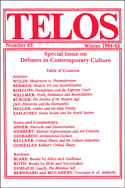 The notion of “high culture” has been under attack in different ways by critics, academics, and the general public for generations. Moreover, as Western culture becomes increasingly commercialized, egalitarian impulses have exiled much of what was considered by many to be high culture to obscurity, appreciated mainly by a minority who are themselves regarded as cultural elitists. Popular or mass culture appears to now reign supreme, but this does not mean that cultural hierarchy has been brought to an end. Cultural hierarchy still has its defenders, and as Martin Jay suggests in his 1984 Telos article “Hierarchy and the Humanities: The Radical Implications of a Conservative Idea,” it clearly has a place in current cultural evaluations. The notion of “high culture” has been under attack in different ways by critics, academics, and the general public for generations. Moreover, as Western culture becomes increasingly commercialized, egalitarian impulses have exiled much of what was considered by many to be high culture to obscurity, appreciated mainly by a minority who are themselves regarded as cultural elitists. Popular or mass culture appears to now reign supreme, but this does not mean that cultural hierarchy has been brought to an end. Cultural hierarchy still has its defenders, and as Martin Jay suggests in his 1984 Telos article “Hierarchy and the Humanities: The Radical Implications of a Conservative Idea,” it clearly has a place in current cultural evaluations.
Continue reading →
By Joseph Diaz · Tuesday, January 21, 2014 Joseph Diaz’s “Schmitt and Marcuse: Friends, Force, and Quality” appears in Telos 165 (Winter 2013). Read the full version online at the Telos Online website, or purchase a print copy of the issue in our store.
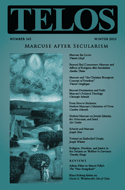 This article aims at exploring the potential for a politically operative theory of opposition to liberalism’s stultifying politics of process. Given their formal political positionality as critics of liberal neutrality, as well as their historically particular relationship to some of the most volatile politics of the twentieth century, Marcuse and Schmitt cannot but be brought into discourse with one another in the most pressing of times, for three reasons. First, by exploring the modalities of their respective criticisms, this article locates an enemy common to both thinkers in the neutralization of the political through the attempted elimination of the decision. Second, in using Schmitt’s framework of the friend-enemy distinction, further investigation into the potential complicities between anti-liberal thought illuminates the limitations of founding political friendship on mere enemy identification alone. This article aims at exploring the potential for a politically operative theory of opposition to liberalism’s stultifying politics of process. Given their formal political positionality as critics of liberal neutrality, as well as their historically particular relationship to some of the most volatile politics of the twentieth century, Marcuse and Schmitt cannot but be brought into discourse with one another in the most pressing of times, for three reasons. First, by exploring the modalities of their respective criticisms, this article locates an enemy common to both thinkers in the neutralization of the political through the attempted elimination of the decision. Second, in using Schmitt’s framework of the friend-enemy distinction, further investigation into the potential complicities between anti-liberal thought illuminates the limitations of founding political friendship on mere enemy identification alone.
Continue reading →
By Martijn de Koning · Monday, January 20, 2014 This is the first of three papers delivered at a seminar on religion and politics that was organized with Rowan Williams, the former archbishop of Canterbury, on the occasion of his recent book Faith in the Public Square. The seminar was held at Radboud University in December 2013. The second and third papers will be posted in the near future.
Rowan Williams’ book Faith in the Public Square, which is based upon several lectures, should not be read as a compendium of political theology, but instead as a “series of worked examples of trying to find the connecting points between various public questions and the fundamental beliefs about creation and salvation” (p. 2). I read the book as an attempt by Williams to provide the reader with themes, thoughts, and questions which are relevant to current debates about what kind of society we want to construct, how we should deal with pluralism, and how we might engage with any conflict between the religious and the secularist in contemporary society. And that is exactly what it does.
Continue reading →
By Robert Wyllie · Tuesday, January 14, 2014 As an occasional feature on TELOSscope, we highlight a past Telos article whose critical insights continue to illuminate our thinking and challenge our assumptions. Today, Robert Wyllie looks at Norberto Bobbio’s “Is There a Marxist Theory of the State?” from Telos 35 (Spring 1978).
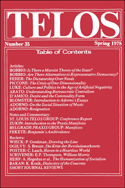 Norberto Bobbio’s 1978 article “Is There a Marxist Theory of the State?” marks a turning point in the history of Telos. The “red decade” was coming to a close in the mid-1970s, and the New Left was falling into disarray. Hence, Bobbio writes an epitaph in this 1978 article, which makes the convincing case that the Left was never able to develop a political theory that included a positive concept of the political state. In the years following Bobbio’s article, the Telos group would begin to look elsewhere. As Paul Piccone and Gary Ulmen later explained, “Telos‘ initial interest in [Carl] Schmitt’s work was triggered in the 1980s by the realization, in the collapse of the New Left and under the influence of Norberto Bobbio’s criticism, that the Left in general and Marxism in particular had no political theory.”[1] Bobbio moved Telos away from “revolution, dialectic, commodity fetishism, liberation, alienation, and monopoly capitalism”[2] to Carl Schmitt, federalism, and populism. Norberto Bobbio’s 1978 article “Is There a Marxist Theory of the State?” marks a turning point in the history of Telos. The “red decade” was coming to a close in the mid-1970s, and the New Left was falling into disarray. Hence, Bobbio writes an epitaph in this 1978 article, which makes the convincing case that the Left was never able to develop a political theory that included a positive concept of the political state. In the years following Bobbio’s article, the Telos group would begin to look elsewhere. As Paul Piccone and Gary Ulmen later explained, “Telos‘ initial interest in [Carl] Schmitt’s work was triggered in the 1980s by the realization, in the collapse of the New Left and under the influence of Norberto Bobbio’s criticism, that the Left in general and Marxism in particular had no political theory.”[1] Bobbio moved Telos away from “revolution, dialectic, commodity fetishism, liberation, alienation, and monopoly capitalism”[2] to Carl Schmitt, federalism, and populism.
Continue reading →
By Vincent Geoghegan · Monday, January 13, 2014 Vincent Geoghegan’s “Marcuse and ‘the Christian Bourgeois Concept of Freedom'” appears in Telos 165 (Winter 2013). Read the full version online at the Telos Online website, or purchase a print copy of the issue in our store.
Current talk of the post-secular necessarily invites analysis of the nature of the secular, particularly its historical genesis and subsequent development. The task is to reject what Charles Taylor in A Secular Age has termed “subtraction stories” of the emergence of secularism, involving simplistic assumptions about the inexorable evaporation and attenuation of the religious, and instead understand the complex constitutive role religion has played in the construction of the secular. Marcuse’s work is of interest in this respect because beginning with his 1930s analysis of what he terms “the Christian bourgeois concept of freedom” within the Protestant Reformation, he explores the ways in which he believes modern secular society emerged out of Christianity.
Continue reading →
|
|