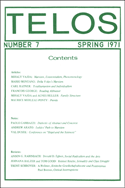
By James Santucci · Tuesday, April 9, 2013 As an occasional feature on TELOSscope, we highlight a past Telos article whose critical insights continue to illuminate our thinking and challenge our assumptions. Today, James Santucci looks at François George’s “Reading Althusser,” from Telos 7 (Spring 1971).
François George believes that Louis Althusser does not deserve his reputation, and he wants to prove it to you. He writes:
 Since the mainstay of [Althusser’s] thought is its “rigor,” we will demonstrate that it is the least rigorous of all, taking as the principal example his recent work, Lenine et la Philosophic. The occasion for the following discussion is a conference in an extremely academic context: the French Society of Philosophy. Naturally, Althusser feels uneasy in this situation. Marxists, for whom thought should be practical, must seek to transform society rather than to exert themselves in these closed contexts. Was he forced to attend? Althusser accepts his role only by dismissing it. . . . Why has he come, if he rejects this degraded form of philosophy and human relations? He is interested only in the justification of this rejection or, in his own words, this denial: “the only possible communications and discussions are scientific ones.” Under the pretext of attacking the meaninglessness of the philosophical gatherings in which he participates, Althusser rejects all non-scientific human communications as a scientist addressing a “scientific society.” Evidently, then, Althusser attends the French Society of Philosophy conference because he lacks the qualifications required by the international congress on astrophysics. All would go well, said Proudhon, when the government’s power was replaced by that of the Academy of Sciences—which should not be confused with the workers’ councils. (73–74) Since the mainstay of [Althusser’s] thought is its “rigor,” we will demonstrate that it is the least rigorous of all, taking as the principal example his recent work, Lenine et la Philosophic. The occasion for the following discussion is a conference in an extremely academic context: the French Society of Philosophy. Naturally, Althusser feels uneasy in this situation. Marxists, for whom thought should be practical, must seek to transform society rather than to exert themselves in these closed contexts. Was he forced to attend? Althusser accepts his role only by dismissing it. . . . Why has he come, if he rejects this degraded form of philosophy and human relations? He is interested only in the justification of this rejection or, in his own words, this denial: “the only possible communications and discussions are scientific ones.” Under the pretext of attacking the meaninglessness of the philosophical gatherings in which he participates, Althusser rejects all non-scientific human communications as a scientist addressing a “scientific society.” Evidently, then, Althusser attends the French Society of Philosophy conference because he lacks the qualifications required by the international congress on astrophysics. All would go well, said Proudhon, when the government’s power was replaced by that of the Academy of Sciences—which should not be confused with the workers’ councils. (73–74)
Continue reading →
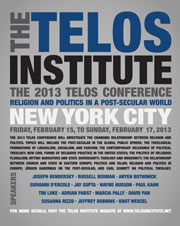
By Jeffrey W. Robbins · Friday, April 5, 2013 The following paper was presented at the Seventh Annual Telos Conference, held on February 15–17, 2013, in New York City.
 With the confirmation hearings of John Brennan as director of the CIA fresh in the news, who can doubt the accuracy, or at least the resonance, of Carl Schmitt’s conception of the sovereign—the sovereign is “he who decides on the exception.” With sovereignty so conceived, it has effectively been cast outside the law, introducing a certain arbitrariness and creating a legal limbo that undermine the principles of a liberal democracy. With the confirmation hearings of John Brennan as director of the CIA fresh in the news, who can doubt the accuracy, or at least the resonance, of Carl Schmitt’s conception of the sovereign—the sovereign is “he who decides on the exception.” With sovereignty so conceived, it has effectively been cast outside the law, introducing a certain arbitrariness and creating a legal limbo that undermine the principles of a liberal democracy.
Enhanced interrogation. Drone attacks on foreign soil. Targeted assassinations. And now, a 16-page white paper from the Department of Justice outlining the legal authority to kill a U.S. citizen without trial. In the words of the New York Times report, the legal brief “adopts an elastic definition of an ‘imminent’ threat, saying it is not necessary for a specific attack to be in process when a target is found.” It also asserts that the decision to kill is not subject to judicial review or restraint.
Continue reading →
By Luciano Pellicani · Thursday, April 4, 2013 Luciano Pellicani ‘s “The Cultural War between Athens and Jerusalem: The American Case” appears in Telos 162 (Spring 2013). Read the full version online at the Telos Online website, or purchase a print copy of the issue in our store.
 Despite what Harold Berman claimed, the writers of the American Constitution were not inspired by strong religious convictions. On the contrary, as typical men of the Enlightenment they were severe critics of Christianity, considering it an obscurantist and intolerant tradition in all its versions. Hence their cultural battle to achieve the institutionalization of what Thomas Jefferson called “the wall of separation between State and Church” that would guarantee the greatest religious freedom. A freedom that was periodically threatened by fundamentalist movements which, in the name of Jerusalem, sought—and still seek—to establish a confessional state governed by the truth revealed in the Bible whereas the founding fathers hoped that “what Athens was in miniature, America will be in magnitude.” It is not true that America was born modern and progressive, as Ernest Gellner has maintained. It became so through the cultural war between Athens and Jerusalem that began in the eighteenth century and is still in progress. Despite what Harold Berman claimed, the writers of the American Constitution were not inspired by strong religious convictions. On the contrary, as typical men of the Enlightenment they were severe critics of Christianity, considering it an obscurantist and intolerant tradition in all its versions. Hence their cultural battle to achieve the institutionalization of what Thomas Jefferson called “the wall of separation between State and Church” that would guarantee the greatest religious freedom. A freedom that was periodically threatened by fundamentalist movements which, in the name of Jerusalem, sought—and still seek—to establish a confessional state governed by the truth revealed in the Bible whereas the founding fathers hoped that “what Athens was in miniature, America will be in magnitude.” It is not true that America was born modern and progressive, as Ernest Gellner has maintained. It became so through the cultural war between Athens and Jerusalem that began in the eighteenth century and is still in progress.
Continue reading →
By Frederick H. Pitts · Tuesday, April 2, 2013 This is the second of two blog posts by Frederick H. Pitts that reassess the importance and impact of Jean Baudrillard’s The Mirror of Production. Read the first post here. Where the first post dealt with Baudrillard’s criticism of the productivism of political economy and its Marxist critique, the second deals with the implications of Baudrillard’s critical analysis for any radical alternative to production.
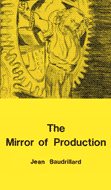 In the first post, we explored Baudrillard’s critique of productivism. The attributing of some kind of essential humanity to labor is identified by Baudrillard as one of the most pernicious effects of the productivism in political economy, Marx included. Indeed, humanism itself can be seen as the “product” of political economy (Baudrillard, 22). Taking over the “phantasm” of “labor as the human essence” from political economy, Baudrillard suggests Marx projected this understanding upon the working class as “their central means of self-comprehension.” Rather than maintaining a narrow fixation on the condition of one’s exploitation as labor as the means by which this exploitation can be transcended, Baudrillard argues that workers must liberate themselves from the status of “labor-power,” and “think themselves under another sign than that of production” (Poster, 3). In the first post, we explored Baudrillard’s critique of productivism. The attributing of some kind of essential humanity to labor is identified by Baudrillard as one of the most pernicious effects of the productivism in political economy, Marx included. Indeed, humanism itself can be seen as the “product” of political economy (Baudrillard, 22). Taking over the “phantasm” of “labor as the human essence” from political economy, Baudrillard suggests Marx projected this understanding upon the working class as “their central means of self-comprehension.” Rather than maintaining a narrow fixation on the condition of one’s exploitation as labor as the means by which this exploitation can be transcended, Baudrillard argues that workers must liberate themselves from the status of “labor-power,” and “think themselves under another sign than that of production” (Poster, 3).
Continue reading →
By Michael Marder · Friday, March 29, 2013 Today concludes the series of five blog entries aimed at understanding the current political crisis in the European Union through a Schmittian lens. (For the previous posts, see part 1, part 2, part 3, and part 4.) In this post, Michael Marder asks what it would take for the EU to overcome the crisis. The answer, he argues, is nothing less than the EU constituting itself anew, by way of contesting the meaning of the European political subjectivity.
Toward a New Self-Constitution of Europe?
What remains, within the framework the European Union, is the constitution in a relative sense, dissolved “into a multitude of individual, formally equivalent constitutional laws.”[1] We face an expression without anything to express, devoid if not of meaning then of a connection to the sources of meaningfulness. The relegation of constitutional unity to the background and its substitution with constitutional details suits well that institutional arrangement where unity does not actually exist, that is, one where it is not bound to the texture of political existence. The multitude of EU laws is groundless in a different sense from the groundlessness of the absolute concept of the constitution, which is rooted in actual existence and, therefore, self-grounded: “Every existing political unity has its value and its ‘right to existence’ not in the rightness or usefulness of norms, but rather in its existence.”[2] Assuming that this necessary precondition for constitutionality has not been set in place, the main challenge Europe is facing, one that is more fundamental than solving the financial and political crises it is embroiled in, is to attain its political existence, to constitute itself.
Continue reading →
By Michael Marder · Wednesday, March 27, 2013 This is the fourth in a series of five blog entries aimed at understanding the current political crisis in the European Union through a Schmittian lens. (For the previous posts, see part 1, part 2, and part 3.) The hollowness of the EU’s political institutions implies that they are not lively enough to re-constitute themselves so as to cope with new challenges and changing circumstances. That is why the current crisis strikes so deeply at the foundations of the EU and threatens to overwhelm the order it had attempted to institute without taking the question of sovereignty into account.
Europe’s Dynamic De-Constitution
In line with the existential provenance of the form of constitution, such a form cannot be conceived as a static thing but, rather, as a process of formation, or, in Schmitt’s words, “the principle of the dynamic emergence of political unity, of the process of constantly renewed formation and emergence of this unity from a fundamental or ultimately effective power and energy.”[1] It would appear that this dynamic concept of constitution holds a redemptive hope for the EU, which prides itself on being a work-in-progress oriented by the still incomplete tasks of European integration. But this dynamism is just that—a mere appearance. First, as a “union,” the European Union postulates the apriori conditions of unity, those pre-established guidelines with which candidate states must comply and which do not dynamically (organically) emerge in the heat of political life. An incomplete project of unification, it adds on new members in the manner of mineral accretion, as extraneous layers superimposed on an equally dead core. Second, the inherent limits of unity are determined by the limits of the EU competence that acknowledge an irreducible fragmentation of political existence, as diverse as the distinct constitutional traditions of member states make it out to be. The feigned dynamism of the Union’s expansion occludes from view the stagnation of its ossified form, drained of “effective power and energy.”
Continue reading →
|
|