By Andrea Salvatore · Monday, January 21, 2013 Andrea Salvatore’s “The Tragic Theory of Carl Schmitt” appears in Telos 161 (Winter 2012). Read the full version online at the Telos Online website, or purchase a print copy of the issue in our store.
 The present note aims to suggest a tragic reading of Carl Schmitt’s thought within a post-metaphysical perspective. The argument is divided into two parts. In the first—the meaning of the tragic dimension—I deal with Schmitt as a theorist of the tragic, that is, with the concept of tragedy that can be induced from Schmitt’s philosophy as a unitary whole. In the second part—the actuality of the tragic era—I will consider Schmitt as a pathologist of the tragic, by summarizing the diagnosis of the modernity he explicitly points out in his major works. The first thesis states that any normative and/or political order constitutively depends on a fundamental set of factual pre-conditions, whose actual enforcement in turn depends on a contextual and epochal contingency, beyond human control. If so, the range of human agency is determined by a super-human contextual contingency, to such an extent that we have to abandon the illusion of being able to decide everything. The second thesis states that the contemporary era is irretrievably characterized by a set of factual pre-conditions that makes any ultimate decision and political order unfeasible. If so, late modernity’s contingency is determined by the lack of any ordering principle and foundational reality, with the consequence that we have to abandon the illusion of being able to decide something. The awareness of the vital necessity of something lacking, and still impossible to restore, marks the tragic character of Schmitt’s thought considered in its consistent whole. The present note aims to suggest a tragic reading of Carl Schmitt’s thought within a post-metaphysical perspective. The argument is divided into two parts. In the first—the meaning of the tragic dimension—I deal with Schmitt as a theorist of the tragic, that is, with the concept of tragedy that can be induced from Schmitt’s philosophy as a unitary whole. In the second part—the actuality of the tragic era—I will consider Schmitt as a pathologist of the tragic, by summarizing the diagnosis of the modernity he explicitly points out in his major works. The first thesis states that any normative and/or political order constitutively depends on a fundamental set of factual pre-conditions, whose actual enforcement in turn depends on a contextual and epochal contingency, beyond human control. If so, the range of human agency is determined by a super-human contextual contingency, to such an extent that we have to abandon the illusion of being able to decide everything. The second thesis states that the contemporary era is irretrievably characterized by a set of factual pre-conditions that makes any ultimate decision and political order unfeasible. If so, late modernity’s contingency is determined by the lack of any ordering principle and foundational reality, with the consequence that we have to abandon the illusion of being able to decide something. The awareness of the vital necessity of something lacking, and still impossible to restore, marks the tragic character of Schmitt’s thought considered in its consistent whole.
Continue reading →
By J. F. Dorahy · Tuesday, January 15, 2013 As an occasional feature on TELOSscope, we highlight a past Telos article whose critical insights continue to illuminate our thinking and challenge our assumptions. Today, J. F. Dorahy looks at Agnes Heller’s “The Marxist Theory of Revolution and the Revolution of Everyday Life,” from Telos 6 (Fall 1970).
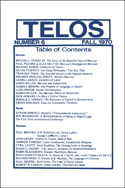 The category of “everyday life” is a relatively new addition to the critical framework of Marxism. Since it was formally introduced by the French theorist Henri Lefèbvre (Critique de la vie quotidienne I, 1947; The Critique of Everyday Life, 1991), the critique of everyday life emerged in the post-1945 period as a response to the continuing stability of late capitalism and the integration of formerly radical elements of society within its logic of containment. From within the orbit of “actually existing socialism,” Agnes Heller’s critical anthropology of everyday life illuminates the integrative tendencies of both “great systems” during the Cold War via the prism of the alienated personality. While “The Marxist Theory of Revolution and the Revolution of Everyday Life” touches on numerous practical issues confronting the radical political movements on the late-1960s—including analysis of the ideological relevance of Che Guevara and the role of the sexual liberation movement in the formation non-alienated communities—its greatest and most enduring aspect is Heller’s focused and concise delineation of the phenomenology of personhood in the world-historical epoch of alienation. The category of “everyday life” is a relatively new addition to the critical framework of Marxism. Since it was formally introduced by the French theorist Henri Lefèbvre (Critique de la vie quotidienne I, 1947; The Critique of Everyday Life, 1991), the critique of everyday life emerged in the post-1945 period as a response to the continuing stability of late capitalism and the integration of formerly radical elements of society within its logic of containment. From within the orbit of “actually existing socialism,” Agnes Heller’s critical anthropology of everyday life illuminates the integrative tendencies of both “great systems” during the Cold War via the prism of the alienated personality. While “The Marxist Theory of Revolution and the Revolution of Everyday Life” touches on numerous practical issues confronting the radical political movements on the late-1960s—including analysis of the ideological relevance of Che Guevara and the role of the sexual liberation movement in the formation non-alienated communities—its greatest and most enduring aspect is Heller’s focused and concise delineation of the phenomenology of personhood in the world-historical epoch of alienation.
Continue reading →
By Chantal Bax · Monday, January 14, 2013 The following paper was presented at Telos in Europe: The L’Aquila Conference, held on September 7-9, 2012, in L’Aquila, Italy.
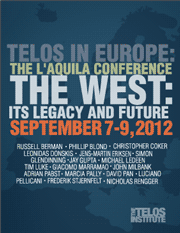 Should national identity be considered to be an outdated concept in this day and age? Have the adjectives “French,” “Italian,” “German,” and so on become meaningless terms over the last couple of decades? Both practical and theoretical developments may seem to suggest that this question should be answered in the affirmative. Processes of globalization, including increased mobility and migration, have made it unmistakably clear that the human world cannot be divided into discrete social units. In addition, much philosophical effort has been devoted to destabilizing notions like “community,” “sameness,” and “identity.” Should national identity be considered to be an outdated concept in this day and age? Have the adjectives “French,” “Italian,” “German,” and so on become meaningless terms over the last couple of decades? Both practical and theoretical developments may seem to suggest that this question should be answered in the affirmative. Processes of globalization, including increased mobility and migration, have made it unmistakably clear that the human world cannot be divided into discrete social units. In addition, much philosophical effort has been devoted to destabilizing notions like “community,” “sameness,” and “identity.”
Continue reading →
By Aryeh Botwinick · Friday, January 11, 2013 Aryeh Botwinick’s “Liberal Democracy, Negative Theory, and Circularity: Plato and Rawls” appears in Telos 161 (Winter 2012). Read the full version online at the Telos Online website, or purchase a print copy of the issue in our store.
This paper argues that the best kind of philosophical defense of democracy is one that is worked out within the framework of negative theory. The phrase “negative theory” is being used on analogy with the term negative theology. Just as negative theology argues that we can only indefinitely say what God is not but cannot pinpoint in a positive sense what He is, so, too, negative theory advocates that we can only ceaselessly explore and highlight the limitations of reason, without being able to arrive at a positive content that is incontrovertible and uncontestable.
Continue reading →
By Damien Booth · Tuesday, January 8, 2013 As an occasional feature on TELOSscope, we highlight a past Telos article whose critical insights continue to illuminate our thinking and challenge our assumptions. Today, Damien Booth looks at Pier Aldo Rovatti’s “Critical Theory and Phenomenology,” from Telos 15 (Spring 1973).
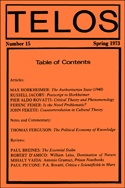 The relationship between phenomenology and critical theory is a complex one that deserves a great deal of attention. On the one hand, Marcuse, as a student of Heidegger, maintained a certain level of affiliation with his thought, while, on the other, Lukács and Adorno were critical of phenomenology, with Heidegger in particular coming under criticism. In “Critical Theory and Phenomenology,” Pier Aldo Rovatti attempts to show how these two modes of thought may have a meaningful encounter. The relationship between phenomenology and critical theory is a complex one that deserves a great deal of attention. On the one hand, Marcuse, as a student of Heidegger, maintained a certain level of affiliation with his thought, while, on the other, Lukács and Adorno were critical of phenomenology, with Heidegger in particular coming under criticism. In “Critical Theory and Phenomenology,” Pier Aldo Rovatti attempts to show how these two modes of thought may have a meaningful encounter.
Continue reading →
By Simon Glendinning · Monday, January 7, 2013 The following paper was presented at Telos in Europe: The L’Aquila Conference, held on September 7-9, 2012, in L’Aquila, Italy.
How should we conceive the distinctive character, the “particular rarity,” of the wearing and growing of the contemporary world? How should we come to terms with our time? What words can we find that are fitting for its specificity when so many of the words we have found fitting hitherto, especially promising words about the course of human history and its political hopes, its hopes in the political (modernity, Enlightenment, civilization, socialism, etc.) sound more and more like the road signs of another age?
Are we not floundering today? Isn’t this, at least in part, what we need to understand, to make intelligible? So we might look out for writings, wherever they come from, that speak to and speak from this world, a world which today, it seems, more than ever, “wears as it grows.”
Continue reading →
|
|