By Charles Kollmer · Thursday, January 19, 2012 As an occasional feature on TELOSscope, we highlight a past Telos article whose critical insights continue to illuminate our thinking and challenge our assumptions. Today, Charles Kollmer looks at Stephanie Frank’s “Re-imagining the Public Sphere: Malebranche, Schmitt’s Hamlet, and the Lost Theater of Sovereignty,” from Telos 153 (Winter 2010).
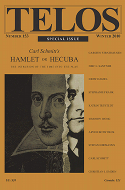
In “Re-imagining the Public Sphere: Malebranche, Schmitt’s Hamlet, and the Lost Theater of Sovereignty,” Stephanie Frank outlines a compelling approach to Carl Schmitt’s complex oeuvre. She sets out to rectify a common mistake made in existing treatments of Schmitt; in studies of Schmitt’s early work Roman Catholicism and Political Form (1923), scholars tend to rely on a later work, Constitutional Theory (1928), as an explanatory crutch. Both texts model representation, but a conflation of their respective models obscures how Schmitt’s project changes between the works. As a corrective, Frank traces the nuances of Roman Catholicism‘s model back to the influence of seventeenth-century theologian Malebranche, who in turn influenced the eighteenth-century revolutionary Abbé Sieyès. By grounding Roman Catholicism in this historical context, Frank not only sidesteps the circularity of her colleagues’ interpretations but also lays the groundwork for a persuasive reading of Schmitt’s turn to aesthetics in Hamlet or Hecuba (1956).
Continue reading →
By Telos Press · Tuesday, January 17, 2012 The West: Its Legacy and Future
September 7–10, 2012
L’Aquila, Italy
DEADLINE FOR ABSTRACT SUBMISSIONS: MARCH 15, 2012
Conference Theme
Recent developments appear to end the “end of history” and foreshadow instead the end of the West. After 1989, many expected a gradual convergence toward Western models of liberal market democracy. But Western responses to 9/11 and the 2007–8 transatlantic “credit crunch” have exposed the limits of U.S. international primacy and accelerated the global shift of power from West to East and North to South—as evinced by the rise of China, India, and other emerging markets.
Continue reading →
By Wesley Phillips · Tuesday, January 17, 2012 Wesley Phillips’s “Melancholy Science? German Idealism and Critical Theory Reconsidered” appears in Telos 157 (Winter 2011). Read the full version online at the TELOS Online website, or purchase a print copy of the issue here.
 What is the relationship between theory and praxis today? During the 1960s, Adorno’s melancholy science was reproached with the charge of resignation, echoes of which have continued up to the present day—whether in Agamben or in praxis-oriented radical thought. In what is the most substantial critique to date, Gillian Rose initially sympathized with Adorno only to reject his neo-Kantian Marxism—the problem being that the melancholy science would involve a masochistically infinite task concerned with the recovery of an irretrievable utopia, leading to a methodological detachment from the social object. Understood in this way, the question of finite social praxis becomes an immanently philosophical matter. While following Rose’s orientation toward German idealism—for its imagined critique of neo-Kantianism and theory-ism—this article argues that, due to his unsatisfactory treatment of historical suffering, a return to Hegel alone (albeit after Marx) is insufficient. Rather, a dialectic of Hegel and his adversary Schelling suggests a distinctive account of determinate activity that avoids Melancholia without rejoicing the actuality of world spirit. This is made possible by way of an affinity between conceptions of melancholy and history in Schelling and Benjamin, from whom Adorno develops his traurige Wissenschaft. What is the relationship between theory and praxis today? During the 1960s, Adorno’s melancholy science was reproached with the charge of resignation, echoes of which have continued up to the present day—whether in Agamben or in praxis-oriented radical thought. In what is the most substantial critique to date, Gillian Rose initially sympathized with Adorno only to reject his neo-Kantian Marxism—the problem being that the melancholy science would involve a masochistically infinite task concerned with the recovery of an irretrievable utopia, leading to a methodological detachment from the social object. Understood in this way, the question of finite social praxis becomes an immanently philosophical matter. While following Rose’s orientation toward German idealism—for its imagined critique of neo-Kantianism and theory-ism—this article argues that, due to his unsatisfactory treatment of historical suffering, a return to Hegel alone (albeit after Marx) is insufficient. Rather, a dialectic of Hegel and his adversary Schelling suggests a distinctive account of determinate activity that avoids Melancholia without rejoicing the actuality of world spirit. This is made possible by way of an affinity between conceptions of melancholy and history in Schelling and Benjamin, from whom Adorno develops his traurige Wissenschaft.
Continue reading →
By Jakob Norberg · Thursday, January 12, 2012 Jakob Norberg’s “Day-to-Day Politics: Carl Schmitt on the Diary” appears in Telos 157 (Winter 2011). Read the full version online at the TELOS Online website, or purchase a print copy of the issue here.
Early on in his career, Carl Schmitt articulated a cultural critique of the diary. He saw the personal journal as a manifestation and reinforcement of the writing subject’s vanity and self-importance in a sterile modern world. The resulting record, moreover, offered up the diarist’s inner life to the gaze of dissecting readers, who tended to convert polemical arguments into psychological symptoms. Yet Schmitt also kept something like a daily journal and was thus forced to struggle against the diary from within the genre itself. His post-1945 notebooks, entitled Glossarium, constitute a cultural battlefield upon which this struggle takes place. By means of strategies such as scathing portraits of famous diarists and displays of sententious concision, Schmitt sought to expel the diary from his own notebooks, or stage a paradoxical day-to-day resistance to the pathologies of the age emblematized in the diary form itself. The study of Schmitt’s non-diary ultimately sheds light on his political understanding of writing. For him, genres are never neutral vehicles of ideas but rather inflect thought in ideologically relevant ways.
Continue reading →
By David Randall · Wednesday, January 11, 2012 David Randall’s “Humean Aesthetics and the Rhetorical Public Sphere” appears in Telos 157 (Winter 2011). Read the full version online at the TELOS Online website, or purchase a print copy of the issue here.
This article aims to locate in the writings of David Hume the rhetorical aesthetics and philosophy of judgment that, under the name of “the conversable world,” constituted, in its essentials, the discursive, political, and moral project of Jürgen Habermas’s public sphere. Here the idea of the public sphere was shorn of the Kantian imperative to reason. Instead, Hume’s “conversable world” registered rhetorical assumptions—the key words reflecting the influence of rhetoric, and departing from Kantian strictures, were “disposition,” “pleasure,” and “best manner.” The existence of this Humean rhetorical aesthetics, as capable as Kant’s rationalizing aesthetics to claim itself as representative of the bourgeois public sphere, allows for the displacement of Kant’s aesthetics, in its historical aspect, from the conception of the public sphere. Humean rhetorical aesthetics, in turn, provide the essential historical component for the various ahistorical rhetorical critiques and revisions of Habermas’s public sphere theory, and of his philosophy writ large. It also allows for the formulation of what we may call a Humean public sphere. In contradistinction to the Kantian public sphere, the rhetorical philosophy of Hume associated the public sphere with a very different standard of judgment, a very different aesthetics, and a very different approach to teleology.
Continue reading →
By Russell A. Berman · Monday, January 9, 2012 Now posted at the Inside Higher Ed website, an excerpt from Russell A. Berman’s presidential address at the 2012 meeting of the Modern Language Association.
Not all doctorate recipients will become faculty members, but all future faculty will come out of graduate programs. Do these programs serve the needs of graduate students well?
In light of the rate of educational debt carried by humanities doctoral recipients, twice that of their peers in sciences or engineering; in light of the lengthy time to degree in the humanities, reaching more than nine years; and in light of the dearth of opportunities on the job market, the system needs to be changed significantly. I want to begin to sketch out an agenda for reform.
The major problem on all of our minds is the job market, the lack of sufficient tenure-track openings for recent doctorate recipients. One response I have heard is the call to reduce the flow of new applicants for jobs by limiting access to advanced study in the humanities. If we prevent some students from pursuing graduate study—so the argument goes—we will protect the job market for others. I disagree.
Read the full essay here.
Continue reading →
|
|