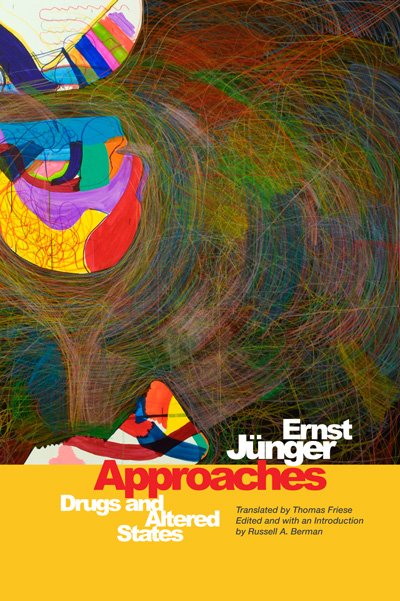
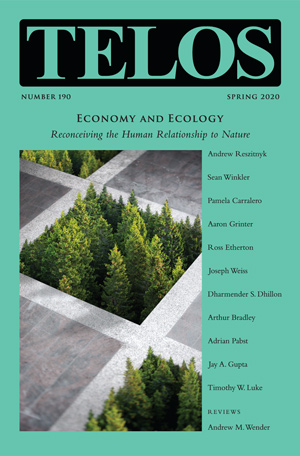
By Ross Etherton · Wednesday, April 29, 2020 Ross Etherton’s “Reading against the Gun: The Machine Gun and Sturm” appears in Telos 190 (Spring 2020): Economy and Ecology: Reconceiving the Human Relationship to Nature. Read the full article at the Telos Online website, or purchase a print copy of the issue in our online store. Individual subscriptions to Telos are available in both print and online formats. Ernst Jünger’s Sturm, published in English translation by Telos Press, is also available in our store.
 This essay examines the role of the machine gun in Ernst Jünger’s 1923 serially published novella Sturm, arguing that an examination of the novella’s key technological actant is at least as beneficial as an examination of the text’s human protagonists. It posits that reading Sturm in light of the machine gun and in the context of the material and cultural conditions of its original serial publication allows for a different understanding of the novella’s treatment of reading and writing under the conditions of modern mechanized warfare. The essay not only links the technical process at the heart of the gun (continuity derived from explosive interruption) to the explosive interruptions within the novella; it also links this interruptive continuity to the arbitrary, irregular breaks in its original serial publication. This technical-literary approach connects the literary scholarship on Sturm (primarily by Peter Uwe Hohendahl and David Pan) with one indebted to philosopher Gilbert Simondon, who sought to redress humanity’s profound alienation from technology and technical objects. The essay first outlines its approach to Sturm, and then provides readers with an overview of Sturm‘s publication history, contextualizing it within Jünger’s early works. It then examines the explosively interruptive moments of the novella, tying them to the machine gun and to nineteenth- and early twentieth-century scientific, philosophical, and poetological discourses. It closes by gesturing toward the importance that the gun and the concepts embedded in it would have for Jünger in the decade following Sturm. This essay examines the role of the machine gun in Ernst Jünger’s 1923 serially published novella Sturm, arguing that an examination of the novella’s key technological actant is at least as beneficial as an examination of the text’s human protagonists. It posits that reading Sturm in light of the machine gun and in the context of the material and cultural conditions of its original serial publication allows for a different understanding of the novella’s treatment of reading and writing under the conditions of modern mechanized warfare. The essay not only links the technical process at the heart of the gun (continuity derived from explosive interruption) to the explosive interruptions within the novella; it also links this interruptive continuity to the arbitrary, irregular breaks in its original serial publication. This technical-literary approach connects the literary scholarship on Sturm (primarily by Peter Uwe Hohendahl and David Pan) with one indebted to philosopher Gilbert Simondon, who sought to redress humanity’s profound alienation from technology and technical objects. The essay first outlines its approach to Sturm, and then provides readers with an overview of Sturm‘s publication history, contextualizing it within Jünger’s early works. It then examines the explosively interruptive moments of the novella, tying them to the machine gun and to nineteenth- and early twentieth-century scientific, philosophical, and poetological discourses. It closes by gesturing toward the importance that the gun and the concepts embedded in it would have for Jünger in the decade following Sturm.
Continue reading →
By Joseph Weiss · Wednesday, April 22, 2020 Joseph Weiss’s “The Old in New Critical Theory: Locating the Gambler and the Prostitute in the Image of Neoliberalism” appears in Telos 190 (Spring 2020): Economy and Ecology: Reconceiving the Human Relationship to Nature. Read the full article at the Telos Online website, or purchase a print copy of the issue in our online store. Individual subscriptions to Telos are available in both print and online formats.
This essay is part of a larger project that aims to trace the return of the old in “new” critical theory. It attempts to demonstrate how, after the failure of the second generation of the Frankfurt School to situate the ongoing antagonisms of neoliberal social relations, several of the concepts of the first generation weigh on the comportment of “new” critical theory. More specifically, by examining the figures of the gambler and the prostitute in relationship to Walter Benjamin and Theodor W. Adorno’s conception of the dialectical image, we observe just how much the critique of commodity fetishism, the use of rhetoric in historico-philosophical presentation, as well as the analysis of political economy and class relations, continue to assert themselves as pressing needs for social theory. In beginning to perform this “new” critical theory that heeds the dialectical tension between the past and present, an image of the unfulfilled desires at work in both the idea of communism and neoliberalism ultimately comes to the fore. Instead of undialectically discarding these figures as morally bankrupt or expressions of mere illusion and falsehood, we are called to capture the truth of their appearance, i.e., the ambivalent desire that promises submission to domination at the same time that it highlights an indispensable moment in the real possibility of emancipation.
Continue reading →
By Aaron Grinter · Thursday, April 16, 2020 Aaron Grinter’s “Metaphors in Science: Lessons for Developing an Ecological Paradigm” appears in Telos 190 (Spring 2020): Economy and Ecology: Reconceiving the Human Relationship to Nature. Read the full article at the Telos Online website, or purchase a print copy of the issue in our online store. Individual subscriptions to Telos are available in both print and online formats.
The scientific method seems familiar to most, but an important element of this practice is often overlooked: the metaphor. This article explores the role played by metaphors in the conception and experimentation of scientific hypotheses, and the extent to which the process of metaphorical consideration is founded in imagination and creativity. With positivistic and reductionist traditions coming to prominence within scientific disciplines, there is emerging a corresponding lack of imagination and increased dislocation from the natural processes being studied. Using the complex process logic involved in metaphorical understanding, the task will be to develop a new paradigm to break out of these stifling traditions, one that has the potential to consider the complex holistic interrelations of the biosphere. As the epoch of the Anthropocene becomes more inculcated in contemporary culture, there has never been a more important time to reassess our relationship to, and position within, the natural world.
Continue reading →
By Arno Tausch · Tuesday, April 14, 2020  The global fallout from the miserable phytosanitary conditions at the Huanan Market in Wuhan, China, will change the fortunes of the twenty-first century. The countries at the center of the global economy, especially the eurozone, are now heading not only toward being at the receiving end of the worst pandemic since the Spanish flu of 1918–20, but also toward the abyss of an unprecedented economic recession. Amidst all this, in March 2020, the core of the European Union’s neoliberal fiscal policy framework, the Maastricht criteria, were put out of action. But what will follow next? The global fallout from the miserable phytosanitary conditions at the Huanan Market in Wuhan, China, will change the fortunes of the twenty-first century. The countries at the center of the global economy, especially the eurozone, are now heading not only toward being at the receiving end of the worst pandemic since the Spanish flu of 1918–20, but also toward the abyss of an unprecedented economic recession. Amidst all this, in March 2020, the core of the European Union’s neoliberal fiscal policy framework, the Maastricht criteria, were put out of action. But what will follow next?
Italian Prime Minister Giuseppe Conte has already called, with good reason, for special “corona bonds” to help EU states finance desperately needed health spending and economic rescue programs. With 20,465 coronavirus deaths as of April 14, 2020, Italy has ample reason to call for such “corona bonds.” The same applies to the other most seriously affected EU countries, Spain (18,056 deaths) and France (14,967 deaths). The idea is also welcomed by a growing number of leading global economists—but not by Austrian Federal Chancellor Sebastian Kurz, one of the European leaders whose country and whose banks, like those of Germany and the Netherlands, were among the absolute winners in the eurozone redistribution of wealth since the 2008 crisis, to the detriment of the European South. Kurz, in many ways now the absolute trendsetter of center-right politics in Europe (at the pace that Germany’s Angela Merkel, by her perennial indecisiveness, leaves an ever bigger vacuum), was very quick to refer the suffering in Italy back to the same old European Stability Mechanism (ESM) that already caused so much stagnation in the European South since 2008.
Continue reading →
By Alain de Benoist · Friday, April 10, 2020 The following essay originally appeared in Valeurs actuelles on April 2, 2020, and is published here in English translation by permission of the author. Translated by Russell A. Berman.
History is always open, as everyone knows, and this makes it unpredictable. Yet in certain circumstances, it is easier to see the middle and long term than the near term, as the coronavirus pandemic shows well. For the short term, one surely imagines the worst: saturated health systems, hundreds of thousands, even millions of dead, ruptures of supply chains, riots, chaos, and all that might follow. In reality, we are being carried by a wave and no one knows where it will lead or when it will end. But if one looks further, certain matters become evident.
It has already been said but it is worth repeating: the health crisis is ringing (provisionally?) the death knell of globalization and the hegemonic ideology of progress. To be sure, the major epidemics of antiquity and the Middle Ages did not need globalization in order to produce tens of millions of dead, but it is clear that the generalization of transportation, exchanges, and communications in the contemporary world could only aggravate matters. In the “open society,” the virus is very conformist: it acts like everyone else, it circulates—and now we are no longer circulating. In other words, we are breaking with the principle of the free movement of people, goods, and capital that was summed up in the slogan “laissez faire,” i.e., let it go, let it pass. This is not the end of the world, but it is the end of a world.
Continue reading →
By Russell A. Berman · Thursday, April 9, 2020 Once upon a time, there was an illusion that the state would disappear. It was the fiction Marxists told each other at bedtime, and it was the lie of the Communists, once they had seized state power. For even as they built up their police apparatus and their archipelago of gulags, they kept promising that one day the state would eventually disappear.
Of course, in a sense, they were right because Communism ended and so did the Communist states in Russia and Eastern Europe. Yet the death of those regimes is in no way an argument for the death of statehood itself.
The state is the expression of sovereignty, and sovereignty is the ability of national communities to decide their own fates. Such independence is far from obsolete, and certainly not for the countries on the eastern flank of the European Union. After years of Russian occupation, they have regained their state sovereignty. They will continue to insist on it, and rightly so.
Continue reading →
|
|