By Peter C. Herman · Friday, May 17, 2024 The following essay is part of a special series of responses to recent events centered, for now, at Columbia University, and extending beyond its confines to include the wider array of societal problems that the disorder there symptomatizes. For details, see Gabriel Noah Brahm, “From Palestine Avenue to Morningside Heights.”—Gabriel Noah Brahm, Director of the Telos-Paul Piccone Institute’s Israel initiative  In 1959, C. P. Snow delivered the Rede Lecture on “The Two Cultures.” Snow’s fundamental point was that humanists and scientists speak past each other, assuming that they communicate at all. “[I]ntellectual life,” Snow writes, “is increasingly being split into two polar groups.” At one end, “literary intellectuals,” at the other, “scientists,” and between the two “a gulf of mutual incomprehension—sometimes (particularly among the young) hostility and dislike, but most of all lack of understanding.” Scientists don’t read any imaginative literature because it has no practical application; and humanists ignore science because they think it is “of no interest either in its own value or its consequences.” The result is a split that does nobody any good. In 1959, C. P. Snow delivered the Rede Lecture on “The Two Cultures.” Snow’s fundamental point was that humanists and scientists speak past each other, assuming that they communicate at all. “[I]ntellectual life,” Snow writes, “is increasingly being split into two polar groups.” At one end, “literary intellectuals,” at the other, “scientists,” and between the two “a gulf of mutual incomprehension—sometimes (particularly among the young) hostility and dislike, but most of all lack of understanding.” Scientists don’t read any imaginative literature because it has no practical application; and humanists ignore science because they think it is “of no interest either in its own value or its consequences.” The result is a split that does nobody any good.
While Snow’s thesis has not entirely aged well (many universities today, for example, mandate that students take courses in both the sciences and the humanities) and while one can find isolated examples of people combining both (e.g., Oliver Sacks), the response by faculty to the recent wave of protests shows that a deep gulf still separates the humanities and the sciences.
Continue reading →
The 2025 Telos-Paul Piccone Institute Annual Conference
March 21–22, 2025
New York, NY
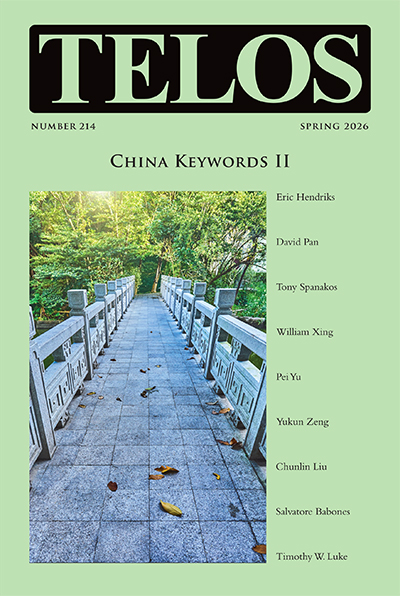
China Keywords / 中国关键词
A one-page version of this call for papers, in PDF form, is available here. We encourage you to print and post this page in your home institution.
About the Conference
The 2025 annual conference of the Telos-Paul Piccone Institute will culminate the first year of a five-year program—the Telos China Initiative—that has aimed to set Telos on a distinct intellectual course.
 The Telos circle falls outside many conventional intellectual categories. During the Cold War, this quality enabled us to form a bridge between Eastern Europe and the Anglosphere. We fostered work by Soviet-bloc intellectuals, helping Western readers understand the ideological dynamics at play behind the Iron Curtain; we supported a wide variety of dissidents in their opposition to bureaucratic centralization, as we have likewise for opponents of bureaucratic governance in the West; and we brokered an encounter between Marxism and phenomenology that was vital for critical thinkers in the Soviet and the liberal democratic world. The Telos circle falls outside many conventional intellectual categories. During the Cold War, this quality enabled us to form a bridge between Eastern Europe and the Anglosphere. We fostered work by Soviet-bloc intellectuals, helping Western readers understand the ideological dynamics at play behind the Iron Curtain; we supported a wide variety of dissidents in their opposition to bureaucratic centralization, as we have likewise for opponents of bureaucratic governance in the West; and we brokered an encounter between Marxism and phenomenology that was vital for critical thinkers in the Soviet and the liberal democratic world.
We believe that the future of the TPPI now lies in a parallel reciprocal engagement with China, to which we have given steadily increasing focus for the past ten years in our annual conferences. These meetings have laid the basis for seven special issues of the journal Telos, as well as numerous individual articles in the field. With the Telos China Initiative, we seek to become a key bridge for a mutually regarding, critical discussion of social and political theory between China and the West, well beyond the circles of East Asia specialists.
Continue reading →
The video of the third webinar in the Telos-Paul Piccone Institute’s “China Keywords” series is now available and can be viewed here. In this webinar, Eric Hendriks talks with Prof. Shadi Bartsch about the reception and use of ancient Greek philosophers in contemporary Chinese political thought.
Prof. Bartsch is the Helen A. Regenstein Distinguished Service Professor of Classics at the University of Chicago and the author and editor of a dozen books on Greek and Roman Antiquity. For her latest monograph on the reception of the ancient Greeks in China, she spent ten years studying Mandarin. The effort paid off: its fruit is Plato Goes to China: The Greek Classics and Chinese Nationalism (Princeton University Press, 2023).
Continue reading →
By Michael S. Kochin · Monday, May 13, 2024 The following essay is part of a special series of responses to recent events centered, for now, at Columbia University, and extending beyond its confines to include the wider array of societal problems that the disorder there symptomatizes. For details, see Gabriel Noah Brahm, “From Palestine Avenue to Morningside Heights.”—Gabriel Noah Brahm, Director of the Telos-Paul Piccone Institute’s Israel initiative How should American universities foster enlightening and challenging debates on matters of public, faculty, and student concern while maintaining a university community that is as politically, religiously, ethnically, and racially diverse as the country in which they sit? In the century or so that the leading American universities have wandered, unguided by their previous Christian mission, this problem—balancing academic freedom and diversity—has become the principal challenge for their administrators, from presidents and trustees down to dorm counselors.[1]
Columbia’s new president, Nemat “Minouche” Talaat Shafik, Baroness Shafik of Camden in the London Borough of Camden and of Alexandria in the Arab Republic of Egypt, was plucked from the London School of Economics by the Columbia trustees to address that challenge, and she has had to brave it amid harsher circumstances in her first year than those faced by her predecessors for decades.
The October 7, 2023, Hamas attack on Israel had as its objective the mass murder, rape, and kidnapping of as many Israeli men, women, and children as it could sadistically brutalize. The success of Hamas at achieving that objective has stimulated enthusiastic and even violent demonstrations of support—not only at Columbia but especially at Columbia, the academic home of some of the West’s most effective and most uncompromising Palestinian nationalists, such as the late Edward Said, as well as current professors in that same mold, Rashid Khalidi and Joseph Massad.
Continue reading →
The third webinar of the Telos-Paul Piccone Institute’s “China Keywords” series, entitled “The Greeks according to Chinese Nationalist Intellectuals,” will take place on Thursday, May 16, from 10:00 to 11:00 a.m. Eastern Time (16:00 to 17:00 Central European Time). Our guest will be Prof. Shadi Bartsch, who will discuss the reception and use of ancient Greek philosophers in contemporary Chinese political thought. Plato and Aristotle figure prominently in anti-Western polemics.
Click here to register for the webinar.
Continue reading →
By Corinne E. Blackmer · Friday, May 10, 2024 The following is an open letter to the American Association of University Professors, in response to the AAUP’s statement on the recent campus protests. Earlier this week the author also wrote about the anti-Zionism on display in the trans community.
My name is Corinne Blackmer, and I am professor of English and director of Judaic Studies at Southern Connecticut State University.
I am also the co-editor (with Andrew Pessin) and contributor to a volume titled Poisoning the Wells: Antisemitism in Contemporary America (Academic Press, 2023). This work, which appeared shortly before the events of October 7, seems prophetic in hindsight. Doing this volume helped me comprehend rather than merely react to the events that are befalling us that are discussed in the impassioned AAUP statement.
I do not by any means regard the AAUP’s statement as antisemitic, nor do I think it intended to traffic in antisemitic tropes. However, it accidentally both was and did. This occurred in small part because of culturally inculcated patterns but mainly because the statement was rhetorically divided against itself by attempting to meet the demands of its primary audience while doing a modicum of compromised justice to the myriad issues that contradicted its arguments. Please understand, I have no interest in overplaying—or underplaying—the role that antisemitism has played in these protests; nor do I have less than an excruciating sense of how both Democrats and Republicans have, in classic antisemitic fashion, positioned Jewish people as a political football to be tossed around like a bauble. As a result of this invidious sport, Jews, with a few exceptions in both camps, have no place to go that feels like home.
I wish to go over these matters in the hope that my comments might prove helpful in articulating more form-fitted responses to future crises as they unfold around us. We have not seen the last of these kinds of protests for various reasons, so it behooves us to see matters clearly in order to anticipate the future and stay resilient and savvy.
Continue reading →
|
|