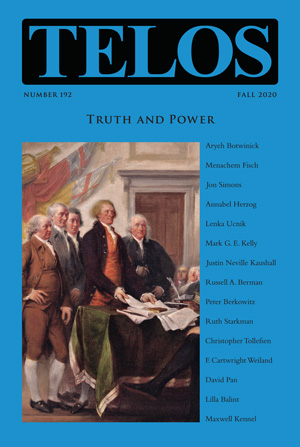
By Aryeh Botwinick · Friday, November 13, 2020 Aryeh Botwinick’s “Negative Theology, Power, and the Israeli–Palestinian Conflict” appears in Telos 192 (Fall 2020): Truth and Power. Read the full article at the Telos Online website, or purchase a print copy of the issue in our online store. Individual subscriptions to Telos are available in both print and online formats.
 From a Machiavellian perspective, peace is war by other means. You can have a much greater watchful vigilance of your former (or future) opponent in times of peace than in a time of war. Israel as a sponsor (or co-sponsor) of a kind of Middle East Marshall Plan: Rebuilding your enemy so that he becomes your ally and friend. Enemies must learn to use each other’s weapons. The weakness of the Palestinians has to be matched by the deliberate, self-consciously generated weakness of the Israelis in the form of benevolence and generosity in order for both sides to emerge as triumphant. If this approach is pursued, the Israeli–Palestinian conflict harbors the prospect of turning into a sum-sum conflict, where both sides stand equally to gain by pursuing peace. From a Machiavellian perspective, peace is war by other means. You can have a much greater watchful vigilance of your former (or future) opponent in times of peace than in a time of war. Israel as a sponsor (or co-sponsor) of a kind of Middle East Marshall Plan: Rebuilding your enemy so that he becomes your ally and friend. Enemies must learn to use each other’s weapons. The weakness of the Palestinians has to be matched by the deliberate, self-consciously generated weakness of the Israelis in the form of benevolence and generosity in order for both sides to emerge as triumphant. If this approach is pursued, the Israeli–Palestinian conflict harbors the prospect of turning into a sum-sum conflict, where both sides stand equally to gain by pursuing peace.
Continue reading →
By Ethan Putterman · Thursday, April 11, 2019 Ethan Putterman’s “Locke and ‘War by Design’” appears in Telos 186 (Spring 2019). Read the full article at the Telos Online website, or purchase a print copy of the issue in our online store. Individual subscriptions to Telos are available in both print and online formats.
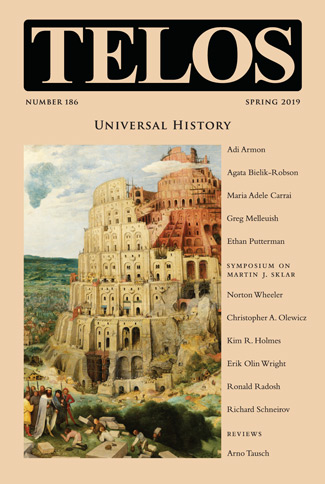 Few passages in John Locke’s writings are more controversial than the incongruous descriptions of the state of nature in chapters III and IX of the Second Treatise on Government. A hodgepodge of opposites where men live at once in a “State of Peace, Good Will, Mutual Assistance, and Preservation” yet remain “very unsafe, very unsecure,” Locke’s state of nature is, according to John Dunn, “probably the most misunderstood idea in the English radical’s political philosophy.” In this article, I explore Locke’s epistemology behind humankind’s comprehension of natural law to argue that his state of nature is more consistent than appears. I demonstrate that the symmetry of the philosopher’s state of nature is best understood by way of the theory of knowledge in his Essays on the Law of Nature and Essay Concerning Human Understanding. Few passages in John Locke’s writings are more controversial than the incongruous descriptions of the state of nature in chapters III and IX of the Second Treatise on Government. A hodgepodge of opposites where men live at once in a “State of Peace, Good Will, Mutual Assistance, and Preservation” yet remain “very unsafe, very unsecure,” Locke’s state of nature is, according to John Dunn, “probably the most misunderstood idea in the English radical’s political philosophy.” In this article, I explore Locke’s epistemology behind humankind’s comprehension of natural law to argue that his state of nature is more consistent than appears. I demonstrate that the symmetry of the philosopher’s state of nature is best understood by way of the theory of knowledge in his Essays on the Law of Nature and Essay Concerning Human Understanding.
Continue reading →
By Telos Press · Tuesday, May 1, 2018 New from Telos Press: Europe and the World: World War I as Crisis of Universalism, edited by Kai Evers and David Pan. Order your copy in our online store, and save 20% on the list price by using the coupon code BOOKS20 during the checkout process.
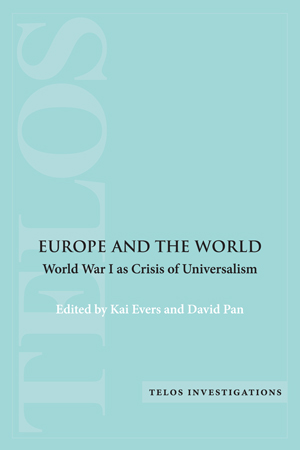 With contributions by Étienne Balibar, Annette Becker, Russell Berman, Jörn Leonhard, among many others, Europe and the World: World War I as Crisis of Universalism focuses within Europe on the conflicts between nationalism and cosmopolitanism as a universalist political project and globally on the conflicts between European imperial politics and universal ideals. This collection of essays probes how these conflicts defined the war as the transition point to a new structure of global relations and postcolonial understandings of cultural identity. The volume’s first part considers the history of European universalism and how it affected the lead-up to the war. The second part analyzes how universalist goals affected the conduct of the war itself. While August 1914 marked a simultaneous turning point in Europe, Africa, and Asia, the war ended without such global synchronicity. Instead, it gave way to a wide variety of new spaces and chronologies of violence on a global level. Part three offers case studies of how representations of the war affected its remembrance and the way such war stories subverted or fit into different national narratives. The contributions in part four investigate different ways in which the experience of war and mass violence affected national cultures and notions of universalism in the United States and within Europe. With contributions by Étienne Balibar, Annette Becker, Russell Berman, Jörn Leonhard, among many others, Europe and the World: World War I as Crisis of Universalism focuses within Europe on the conflicts between nationalism and cosmopolitanism as a universalist political project and globally on the conflicts between European imperial politics and universal ideals. This collection of essays probes how these conflicts defined the war as the transition point to a new structure of global relations and postcolonial understandings of cultural identity. The volume’s first part considers the history of European universalism and how it affected the lead-up to the war. The second part analyzes how universalist goals affected the conduct of the war itself. While August 1914 marked a simultaneous turning point in Europe, Africa, and Asia, the war ended without such global synchronicity. Instead, it gave way to a wide variety of new spaces and chronologies of violence on a global level. Part three offers case studies of how representations of the war affected its remembrance and the way such war stories subverted or fit into different national narratives. The contributions in part four investigate different ways in which the experience of war and mass violence affected national cultures and notions of universalism in the United States and within Europe.
Continue reading →
By Steven Torrente · Wednesday, January 31, 2018 Steven Torrente’s “Beyond Just War: Jan Patočka’s Solidarity of the Shaken” appears in Telos 181 (Winter 2017). Read the full article at the Telos Online website, or purchase a print copy of the issue in our online store. Individual subscriptions to Telos are now available in both print and online formats.
The just war tradition has for a long time provided the categories and logic used to debate the tensions inherent in armed conflict. If war and killing are seen as both inevitable and undesirable, some system of limitation must be developed. Just war concepts such as right authority, just cause, and others offer a framework of off-ramps on the road to nihilistic violence. However, critics contend that just war theory fails to negotiate a real compromise between naïve pacifism and unrestrained war. They argue that the just war tradition not only reduces to the unrestrained pole, but in fact it can legitimate and exacerbate war. If so, just war thinking suffers from a logical contradiction—it facilitates that which it seeks to limit.
Continue reading →
By Russell A. Berman · Wednesday, December 13, 2017 Telos 181 (Winter 2017): War and Civil War is now available for purchase in our store.
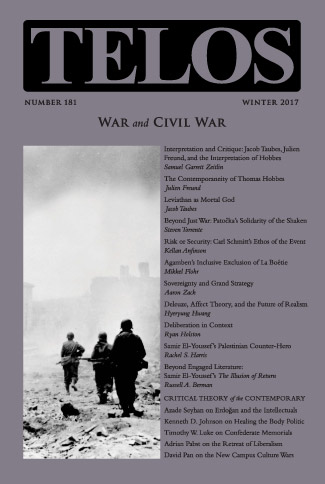 Consider the question: has American political life ever been as polarized as it is today? If the most appropriate answer is: yes, of course, in 1861, then the problem has been named and we are left with little comfort. The evaporation of anything like a bipartisan consensus in the political class leaves us staring at a battlefield, with few common bonds or shared attachments. Politics has become the internalization of war by other means. This is our version of the crisis of parliamentary democracy that Schmitt described in the Weimar years. Congressional Democrats are unwilling to cross the aisle to find room for compromise in the Trump era, but this only repeats the animosity among Republicans toward the Obama agenda eight years ago. Each party seeks its own advantage, which exclusively means the other party’s disadvantage, as the national good slips beneath the horizon. Each party focuses on mobilizing its base for votes and fund-raising, which means that each has an irresistible incentive to avoid solving those problems that are the most effective vehicles for rallying their supporters: when they held the majority, the Democrats preferred to keep the “dreamers” vulnerable, so as to be able to recycle them in future campaigns, just as the Republicans chose to punt on health care. Each issue is too successful in attracting voters, too valuable to give up. Consider the question: has American political life ever been as polarized as it is today? If the most appropriate answer is: yes, of course, in 1861, then the problem has been named and we are left with little comfort. The evaporation of anything like a bipartisan consensus in the political class leaves us staring at a battlefield, with few common bonds or shared attachments. Politics has become the internalization of war by other means. This is our version of the crisis of parliamentary democracy that Schmitt described in the Weimar years. Congressional Democrats are unwilling to cross the aisle to find room for compromise in the Trump era, but this only repeats the animosity among Republicans toward the Obama agenda eight years ago. Each party seeks its own advantage, which exclusively means the other party’s disadvantage, as the national good slips beneath the horizon. Each party focuses on mobilizing its base for votes and fund-raising, which means that each has an irresistible incentive to avoid solving those problems that are the most effective vehicles for rallying their supporters: when they held the majority, the Democrats preferred to keep the “dreamers” vulnerable, so as to be able to recycle them in future campaigns, just as the Republicans chose to punt on health care. Each issue is too successful in attracting voters, too valuable to give up.
Continue reading →
By Timothy W. Luke · Thursday, May 11, 2017 Assessing asymmetric wars in the abstract is a problematic task, even though most are “small wars” fought by “big nations.” Armed conflicts with these characteristics brim with persistent, undeclared, and low-intensity violence. It rarely is extinguished, and the lingering injuries sustain even more violence on the same scale. Many of these small wars began in Asia, Africa, Latin America, or the Middle East during, or not long after, World War II. Armed resistance there never completely ended; instead it intensified with decolonization and/or postcolonial state failure. Now virtually institutionalized in many violent wild zones around the world, low-intensity wars also flare up as asymmetric conflicts between rich countries and poor peoples, Westernized nations and anti-Western movements, liberal democratic states and illiberal theocratic insurgents after 1989.
Continue reading →
|
|