By Russell A. Berman · Monday, April 12, 2021 Wolfgang Reitzle is one of Germany’s premiere business executives, and Klaus Boldt, part of the editorial leadership of Die Welt, one of the foremost business journalists. The wide-ranging interview here points to the multiple dimensions of the problems facing Germany at the end of the Angela Merkel era. The general elections in late September are sure to lead to a new coalition government in Berlin—and a new chancellor—who will face all the problems that Reitzle diagnoses, with the possible exception of the pandemic, hopefully over by the fall, even in Europe. While the coronavirus’s economic, social, and political consequences are however sure to linger on, it figures here primarily as an example of massive government failure and the toxic mixture of bureaucracy, ideology, and incompetence that Reitzle denounces and that leads him to call Berlin “a failed state.”
Those are harsh words from a prominent leader of the German business community, especially when one recalls how in the U.S. political discussion in recent years Germany has been repeatedly held up as the better alternative to the Trump administration. Not long ago the myth of Angela Merkel as the new leader of the free world circulated through the press. That once-glowing imagery has now vanished in the face of the catastrophes of the German and the EU corona response, and the prospect of continued slow economic growth, fraying infrastructure, and insufficient support for technological innovation in the country where one would least expect it. Reitzle helps us understand why.
Continue reading →
By Telos Press · Thursday, April 8, 2021 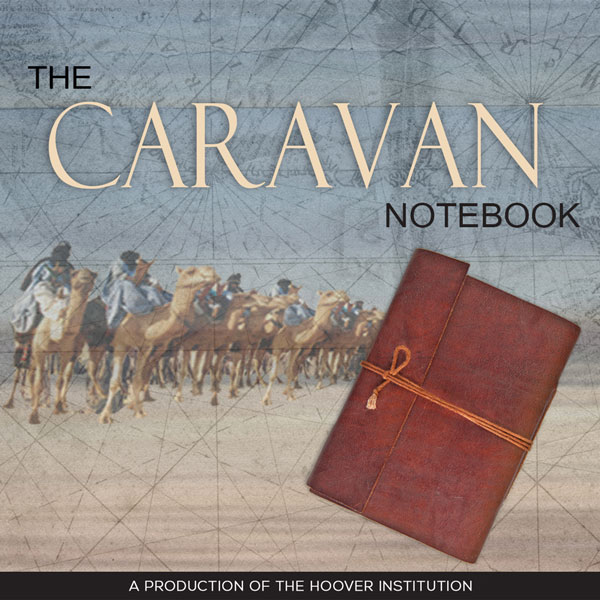 On The Caravan Podcast at the Hoover Institution, Russell Berman talks with political scientist Matthias Küntzel about the potential return of the United States to the Iran Deal, Germany’s long-standing special relationship with Iran, anti-Americanism in Europe, and the anti-Semitism of the Iranian regime. Listen to the podcast here. Küntzel is the author of Germany and Iran: From the Aryan Axis to the Nuclear Threshold (Telos Press, 2014), which examines why the history of the special relationship between Germany and Iran is critical to understanding the ongoing controversy over Iran’s nuclear program. Both Germany and Iran and Küntzel’s earlier book Jihad and Jew-Hatred: Islamism, Nazism, and the Roots of 9/11 are available in our online store for 25% off the list price. Küntzel’s articles for Telos are also available at our online archive. On The Caravan Podcast at the Hoover Institution, Russell Berman talks with political scientist Matthias Küntzel about the potential return of the United States to the Iran Deal, Germany’s long-standing special relationship with Iran, anti-Americanism in Europe, and the anti-Semitism of the Iranian regime. Listen to the podcast here. Küntzel is the author of Germany and Iran: From the Aryan Axis to the Nuclear Threshold (Telos Press, 2014), which examines why the history of the special relationship between Germany and Iran is critical to understanding the ongoing controversy over Iran’s nuclear program. Both Germany and Iran and Küntzel’s earlier book Jihad and Jew-Hatred: Islamism, Nazism, and the Roots of 9/11 are available in our online store for 25% off the list price. Küntzel’s articles for Telos are also available at our online archive.
Continue reading →
By Telos Press · Monday, March 22, 2021 To read more in depth from Telos, subscribe to the journal here.
On The Agenda with Steve Paikin, the discussion about governmental responses to the COVID-19 pandemic turned to Thomas Brussig’s recent editorial “Risk More Dictatorship,” originally published in the Süddeutsche Zeitung and translated into English in TelosScope. Listen to the discussion here, and read Brussig’s full essay here, along with Russell Berman’s commentary on it here.
Continue reading →
By David Pan · Friday, March 19, 2021 Telos 194 (Spring 2021): Political Theology Today is now available for purchase in our store. Individual subscriptions to Telos are also available in both print and online formats.
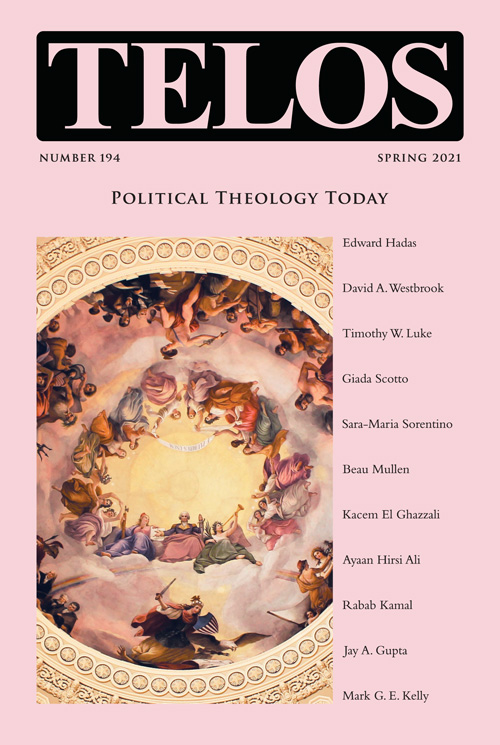 What does political theology mean today? At the Telos-Paul Piccone Institute conference from which many of the essays in this issue originated, a primary goal was to discuss the crisis of secular liberalism and “how faith is reshaping culture and politics today.” But even this project perhaps limits too much the scope of political theology, implying that we have a choice between reason and faith, or that political theology is a commitment to faith rather than an analysis of the element of faith that underlies all of our endeavors. The idea of political theology begins with the premise that every existing human order is built upon some understanding of ultimate meaning. The task would then be to analyze the kind of meaning that each existing order embodies and determine the kinds of decisions about meaning that are made and need to be made at various points in its history. Even secular liberalism, to the extent that it constitutes an existing order, presumes some answer to this question of meaning, and a closer look at the political theology of the United States reveals a mythic dimension that underlies its liberal democratic processes. The essays in this issue examine the political theological underpinnings of economy, politics, technology, and religion, laying out the ways in which these areas of human life develop not as autonomous spheres but as the result of struggles over a set of political theological choices. What does political theology mean today? At the Telos-Paul Piccone Institute conference from which many of the essays in this issue originated, a primary goal was to discuss the crisis of secular liberalism and “how faith is reshaping culture and politics today.” But even this project perhaps limits too much the scope of political theology, implying that we have a choice between reason and faith, or that political theology is a commitment to faith rather than an analysis of the element of faith that underlies all of our endeavors. The idea of political theology begins with the premise that every existing human order is built upon some understanding of ultimate meaning. The task would then be to analyze the kind of meaning that each existing order embodies and determine the kinds of decisions about meaning that are made and need to be made at various points in its history. Even secular liberalism, to the extent that it constitutes an existing order, presumes some answer to this question of meaning, and a closer look at the political theology of the United States reveals a mythic dimension that underlies its liberal democratic processes. The essays in this issue examine the political theological underpinnings of economy, politics, technology, and religion, laying out the ways in which these areas of human life develop not as autonomous spheres but as the result of struggles over a set of political theological choices.
Continue reading →
By Telos Press · Thursday, March 18, 2021 To read more in depth from Telos, subscribe to the journal here.
In today’s episode of the Telos Press Podcast, Camelia Raghinaru talks with F. Cartwright Weiland about his article “Reflections of a Rapporteur,” one of a group of essays from Telos 192 (Fall 2020) on the U.S. State Department’s Commission on Unalienable Rights. An excerpt of the article appears here. If your university has an online subscription to Telos, you can read the full article at the Telos Online website. For non-subscribers, learn how your university can begin a subscription to Telos at our library recommendation page. Purchase a print copy of Telos 192 in our online store.
Listen to the podcast here.
Continue reading →
By B. Venkat Mani · Monday, March 15, 2021 To read more in depth from Telos, subscribe to the journal here.
On January 31, 1920, Dr. Bhimrao “Babasaheb” Ambedkar—lawyer, thought leader, social thinker, and one of Columbia University’s most famous alumni, who later became the prime architect of the constitution of the postcolonial Republic of India—published the first issue of the Dalit newspaper Mooknayak (The Silent or Muted Hero). The aim was to create, in the Marathi language, an alternative narrative of self-representation of Dalits (then called “untouchables”) to counter the caste-biased local vernacular and colonial English-language newspapers in pre-independence India. Under Dr. Ambedkar’s leadership, and often led by his editorials, Mooknayak quickly turned into a megaphone for those who were consciously being silenced by those in power, a platform to champion the rights and dignity of the oppressed and impoverished lowest castes. The idea was effective: through Mooknayak, those who were marginalized and minoritized were able to leave a paper trail of their accounts, their struggles for dignity, hope, and rights for the next generations to come.
On December 18, 2020, at the end of a year marred by the global COVID-19 pandemic, during which a shadow pandemic exposed the socio-economic divisions and the differences between the mainstream and the marginalized across the world, the most befitting centennial tribute to the spirit of Babasaheb’s Mooknayak came through the publication of Trolley Times, a self-published newspaper of the Indian farmers’ movement. The paper drew its title from the trolleys (trailers) hitched to a tractor or a truck that have become the temporary abodes of thousands of farmers protesting at the borders of New Delhi since November 2020. The genesis of this newspaper is as extraordinary as its founding team, comprising a freelance journalist, a filmmaker, a documentary photo artist, and a physical therapist and farmer. Launched bilingually in Punjabi and Hindi with a first printing of 2,000 copies that quickly grew to 10,000 in the subsequent editions, Trolley Times established itself as a very important space for the narrative self-representation of the political and cultural spirit that is the driving force of the ongoing Indian farmers’ movement. With the digital presence of this newspaper on Facebook, Twitter, and Instagram, and more recently through online English translations of its issues, it is hardly surprising that Bloomberg called it the “fastest growing newspaper in India today.”
Continue reading →
|
|