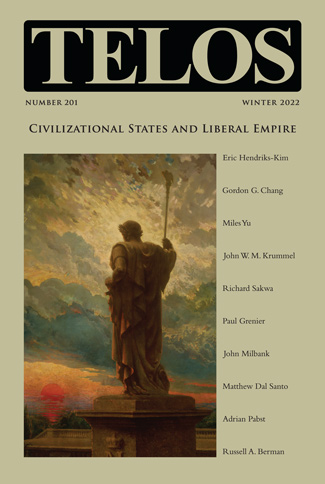
In today’s episode of the Telos Press Podcast, David Pan talks with Paul Grenier about his article “Konstantin Krylov’s Ethical Theory and What It Reveals about the Propensity for Conflict between Russia and the West,” from Telos 201 (Winter 2022). An excerpt of the article appears here. In their conversation they discuss Russian conservative thinkers, including Konstantin Krylov, Vadim Tsymburski, and Vladimir Solovyov, and their attitudes toward the West; how Krylov differentiates between different civilizational types as well as how he differentiates between liberalism and Russian civilization; how Krylov frames his critique of liberalism and of Russian civilization; how his view of liberalism compares with other definitions; how else we can interpret the weaknesses of liberalism, aside from Krylov’s view of a good and bad version; the relationship between liberalism and tradition; and what Krylov’s thought tells us about the development of Russian perspectives on its relationship to the West today. If your university has an online subscription to Telos, you can read the full article at the Telos Online website. For non-subscribers, learn how your university can begin a subscription to Telos at our library recommendation page. Print copies of Telos 201 are available for purchase in our online store.
|
Telos 201 (Winter 2022): Civilizational States and Liberal Empire is now available for purchase in our store. Individual subscriptions to Telos are also available in both print and online formats.
When we consider the way in which power functions on a global level, it will also be crucial to understand how a world order will reflect a particular way of structuring the relationship between values and power. Even the seemingly most egregious use of power can only take place within the framework of an attempt to realize values in the world, and realist accounts of global order must also recognize the importance of some ideology such as nationalism as a means of establishing political values. Accordingly, discussions of balance-of-power dynamics can only begin once great powers emerge as a consequence of the political will of certain peoples to understand themselves in a certain way. Based on such measures as GDP, population, and military spending, Russia does not rank particularly well in relation to countries such as Brazil and India, neither of which pretends to great power status. If Russia can be considered a great power today, it is primarily because of the goals and values that its government embodies. Values form the foundations of global order, and Russia only continues to project its power because it maintains a sense of the global reach of its values for determining order for others. Volodymyr Zelensky has virtually single-handedly demonstrated the world-historical importance of sovereignty and its mechanisms. Before his courageous insistence on Ukrainian sovereignty, the world—including the United States, with its offer of a helicopter ride for Zelensky out of Kyiv—was already treating the Russian subjugation of Ukraine as a fait accompli and the continuation of business as usual. Russia was using in Ukraine the methods that it had already successfully practiced in Chechnya, Syria, and Belarus while the rest of the world stood by to allow such methods to become normalized. By taking his stand in Kyiv, Zelensky was declaring to the Ukrainian people and the rest of the world that Russia’s invasion was in fact not a normal action that had to be accepted. Suddenly, Russia’s years-long undermining of the idea of popular sovereignty in different parts of the world had been called out as a transgression, leading to global insights about recent history and our role in its development. The nations of Europe above all, but also the United States, have had to face the extent to which their energy policies were contributing to Russia’s reshaping of global norms. Zelensky has forced us to take a stand one way or the other in deciding the political shape of the world for the foreseeable future.
In today’s episode of the Telos Press Podcast, David Pan talks with Mark G.E. Kelly and Timothy W. Luke about the Russian invasion of Ukraine and its consequences for world order. Our current issue, Telos 199 (Summer 2022), features essays by Luke, Kelly, and Pan on the war in Ukraine, excerpts of which appear here. Click through to read the full articles at the Telos Online website (subscription required). To learn how your university can subscribe to Telos, visit our library recommendation page. Print copies of Telos 199 are also available for purchase in our online store.
|
   |
|||
|
Privacy Policy · Data Protection Copyright © 2026 Telos Press Publishing · All Rights Reserved |
||||